
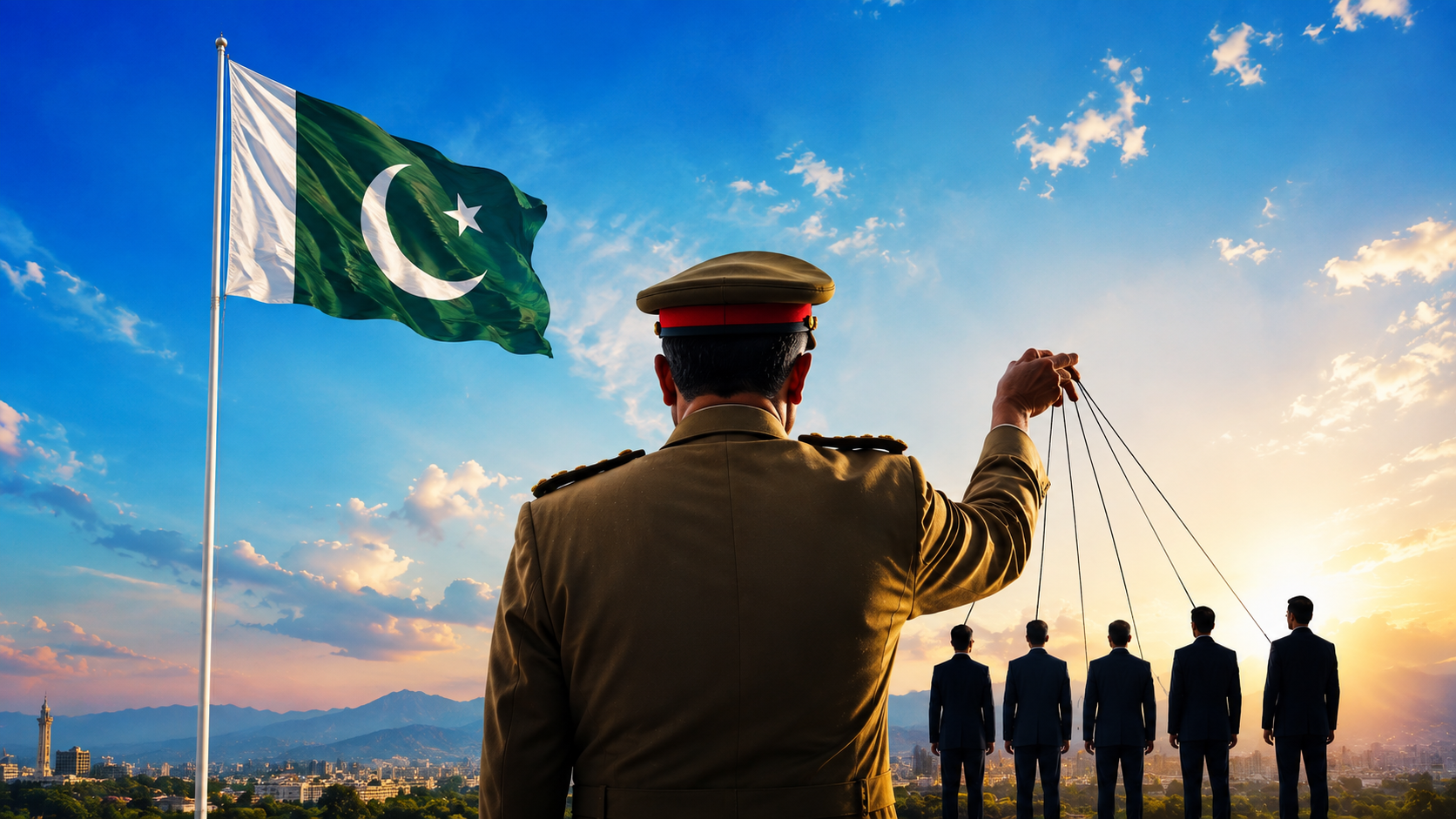
- It is vital to note that this rebirth was not spearheaded by the country’s democratic and civilian institutions. Rather, the Pakistani Army is driving this progress. The Pakistani Army, not Prime Minister Shahbaz Sharif or Deputy Prime Minister Ishaq Dar, is the true anchor.
- Pakistan lacked functioning political institutions for historical and political reasons, allowing the army to control both internal and external affairs.
- The Army’s persistent intervention was done for entrenched political and commercial objectives, as demonstrated by various academic publications.
- A country’s national interests are better served when it has robust democratic institutions and no single dominant institution or leader.
Pakistan and Kuwait have finalised a five-year defense cooperation agreement centred on military training and intelligence exchange. This might be viewed as yet another spectacular military and diplomatic achievement for Pakistan in West Asia. Pakistan is already Saudi Arabia’s NATO-style defense treaty partner, and it is actively involved in settling the current military tension between the United States and Iran. What we are witnessing is the resurgence of Islamabad’s crucial role in regional diplomacy, which had declined following the United States’ withdrawal from Afghanistan in 2021. Pakistan is a strategic partner of Beijing and is seeking a similar strategic alliance with Washington. Pakistan is a treaty ally of Saudi Arabia, but it is also inextricably linked to Tehran due to their geographical proximity. Currently, only a few countries are in such strategically advantageous positions.
It is vital to note that this rebirth was not spearheaded by the country’s democratic and civilian institutions. Rather, the Pakistani Army is driving this progress. The Pakistani Army, not Prime Minister Shahbaz Sharif or Deputy Prime Minister Ishaq Dar, is the true anchor. The goal here is not to explore the military’s current dominant role in the country’s international affairs, but rather to investigate the factors that led to the army becoming the country’s sole working organ. Pakistan lacked functioning political institutions for historical and political reasons, allowing the army to control both internal and external affairs.
Historical Reasons: Colonial Past
The British presented the Mountbatten Plan, often known as the 3rd June Plan, to split post – colonial India. This proposal divided the united India into two sovereign entities: India and Pakistan. India developed as a real successor to British India, inheriting the British political capital of New Delhi as well as the empire’s key economic bases in Bombay and Calcutta. On the other hand, Pakistan acquired a poor political and industrial base. According to Hussain Haqqani (2016), Pakistan received only 17% of British India’s revenue and had no substantial industrial capital, but it received 30% of the British India Army, 40% of its navy, and 20% of its air force. Pakistan inherited no well-established political capital from British India because the British Empire overlooked these regions (which later became parts of Pakistan). They were viewed as the empire’s periphery and required for security purposes. Due to these security concerns, the British Empire formed its Northern Command in Rawalpindi, which ultimately became the main headquarters of the Pakistani Army.
As a result, Pakistan inherited the poor political and industrial base from the British Empire while gaining a strong military institution. This bad colonial inheritance resulted in a domestic institutional mismatch between weak civilians and robust military organisations.
Political Factors: Weak Party System, Messianic Politics
The internal institutional imbalance was exacerbated by the weak political basis of the All-India Muslim League (which demanded and founded Pakistan) in the British Indian territory that became Pakistan. The significant political base of AIML remained in British India’s provinces of Bihar, United Province, and Bombay, all of which became part of India rather than Pakistan. Unlike the Indian National Congress, the League lacked a solid institutional structure based in provinces. Its strength stemmed from Jinnah’s charismatic leadership and communal mobilisation. Pakistan still lacks a major political party with well-established institutional structures in its provinces. This further creates a vacuum in which the Pakistani army can control politics.
Pakistan’s leadership (both civilian and political) has made decisions that are detrimental to the operation of democracy since its inception. The country’s leadership has traditionally represented messianic politics, which holds that only one individual can save Pakistan and overcome its significant crisis. It demonstrated a lack of trust in the country’s civilian institutions. This trend began with the country’s founder, Muhammad Ali Jinnah, who established a vicegeral government in the country by appointing himself governor-general and concentrating all authority in his hands. He made all significant decisions without consulting the Prime Minister’s office. For example, he made the decision to coercively annex the princely state of Kalat, which resulted in political and militant troubles in Baluchistan.
The problem of messianic politics persists in Pakistani politics, as evidenced by the political movement led by Pakistan’s most popular political party, the Pakistan Tehreek-e-Insaf, which is centred on Imran Khan. The party thinks that releasing and restoring Imran Khan as prime minister of the country will only solve the country’s main democratic and economic issues. As with other political parties such as the PML-N and the PPP, no one has a clear roadmap for improving the functioning of democracy in the country. There is no mainstream movement in the country that emphasises the importance of strong institutional structures.
Conclusion: Is the Pakistani Army innocent?
The Pakistani Army has widely propagated the view that the army’s engagement in the country is the result of a political crisis caused by the country’s civilian leaders. However, this is a completely wrong perspective. It is true that Pakistan lacks well-functioning democratic institutions, but the army’s continual engagement in politics has weakened democracy. Democracy is a self-correcting system because its internal crises necessitate internal solutions. The Army’s persistent
intervention was done for entrenched political and commercial objectives, as demonstrated by various academic publications.
The Pakistani army is concerned about its image at home and internationally as the country’s only operating institution. It is in the interest of the Pakistani Army not to launch a direct military coup in the country. The country’s economy is already weak, and there is growing scepticism of the military forces following the PTI protests in the country. Similarly, the international situation is not conducive to direct army intervention. The Pakistani army uses a hybrid structure to regulate both internal and external affairs. Where democracy is only a showcase and the army genuinely governs the country.
Whether the army rules directly or indirectly, the country’s civilian and democratic institutions would remain vulnerable. Even if democracy is seen as insignificant, its ineffective functioning has a detrimental impact on the nation. It did not allow the country to address its political concerns peacefully, as force is viewed as the only effective means of dealing with the crisis. There is also a lack of transparency in foreign relations, which could jeopardise Pakistan’s national interests. A country’s national interests are better served when it has robust democratic institutions and no single dominant institution or leader.

Dr Mohammad Rizwan holds a PhD in political science from Jamia Millia Islamia. His doctoral research focuses on Pakistan’s relations with major global powers. Views expressed are the author’s own.
 Archita Gaur
  Hridbina Chatterjee
  Divyanka Tandon