
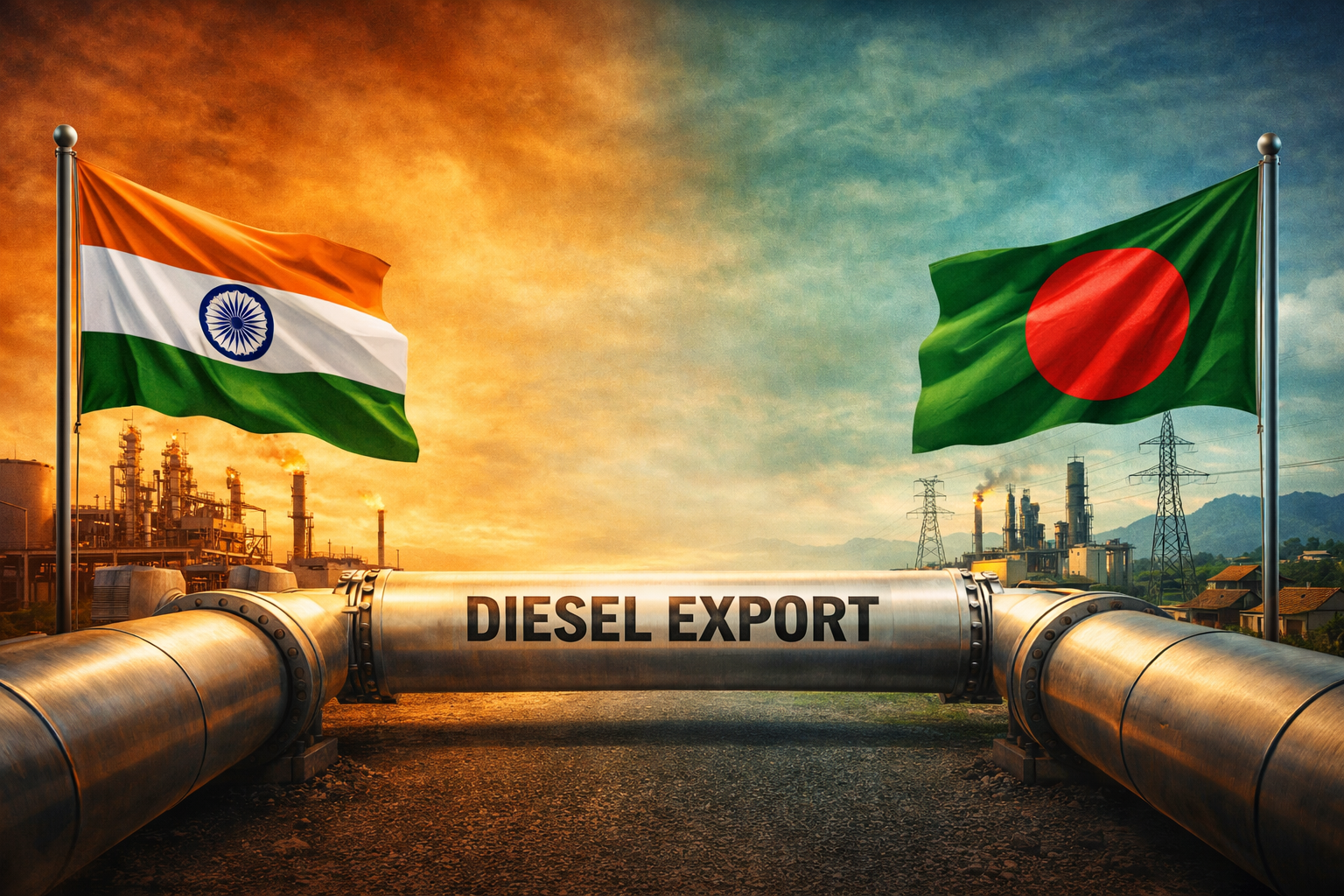
- India’s diesel exports are a transition toward infrastructure-led regional influence, where pipelines, grids, and supply chains are leveraged to enhance geopolitical leverage.
- From an analytical perspective, this represents a shift from purely transactional trade to structured interdependence.
- India is strategically utilising its spatial advantage to position itself as a reliable and preferred energy partner for neighbouring countries.
- India’s diesel diplomacy, therefore, is not solely about meeting immediate energy demand; it is indicative of a deeper transformation in the structure of regional order and power projection.
India’s ongoing diesel exports to Bangladesh have attracted significant attention in recent years, not because they are unusual, but because of what they signify. This development is unfolding at a time when global energy markets are experiencing heightened volatility. While some analysts interpret these exports as a response to Bangladesh’s immediate fuel constraints, they are, in fact, part of a broader structural shift in South Asia: the emergence of India-led energy regionalism.
India’s diesel exports are not merely a temporary or reactive measure; rather, they reflect a calibrated strategy aimed at integrating the economies of its neighbours into its energy network. As this article argues, India’s diesel exports to Bangladesh are more than just an instrument of trade or conventional diplomacy. They represent a transition toward infrastructure-led regional influence, where pipelines, grids, and supply chains are leveraged to enhance geopolitical leverage.
From trade based on transactions to structured interdependence
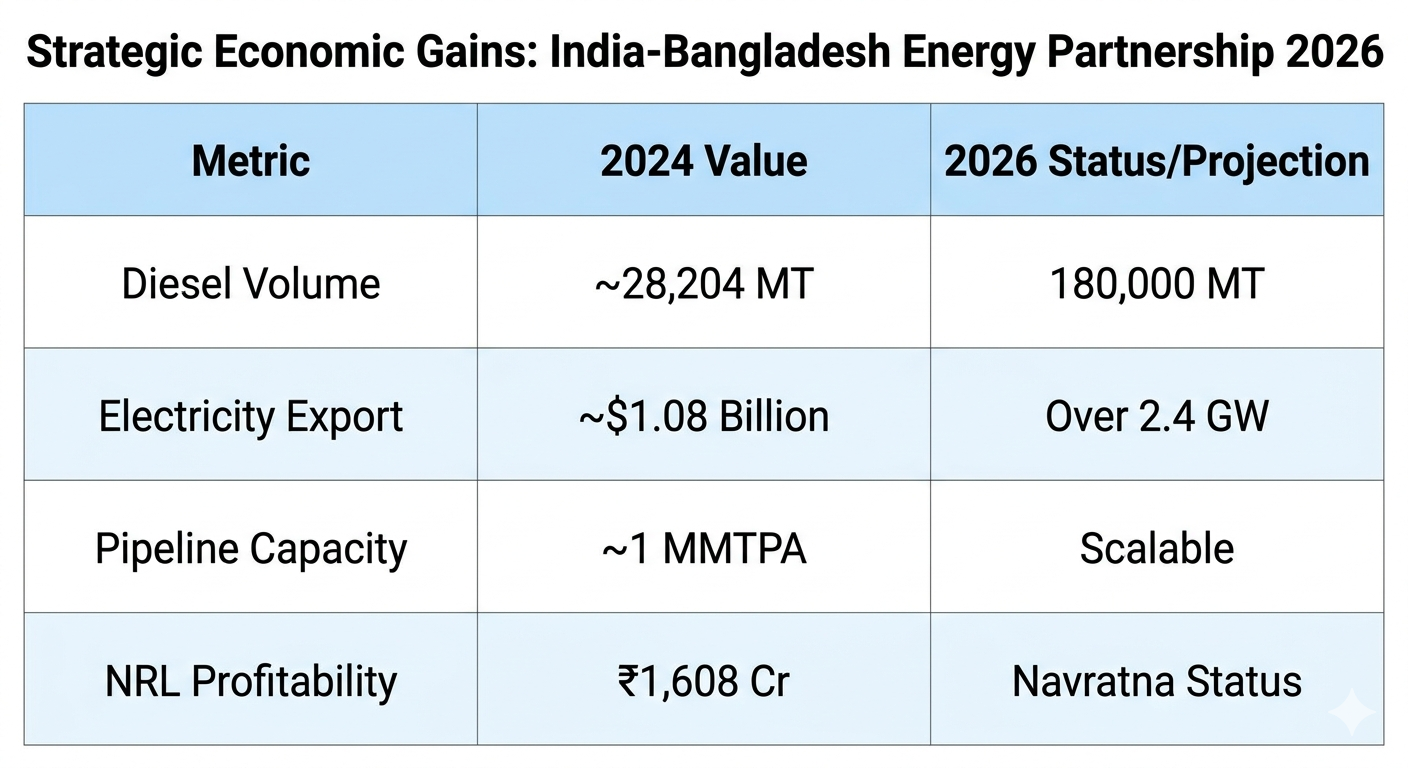
The India–Bangladesh Friendship Pipeline connects the Numaligarh Refinery in Assam to Parbatipur in northern Bangladesh. Through this pipeline, India exports diesel directly to Bangladesh, and since its commissioning in 2023, it has fundamentally transformed the modality of bilateral energy trade.
Prior to the pipeline’s operationalisation, diesel exports were transported primarily via rail, which was slower, costlier, and operationally less reliable. In contrast, the pipeline ensures a continuous, high-volume supply at significantly lower transportation costs. More importantly, it institutionalises the energy relationship between the two countries.
From an analytical perspective, this represents a shift from purely transactional trade to structured interdependence. Bangladesh is no longer merely a buyer in the global market; it is now integrated into a dedicated supply corridor linked to Indian energy infrastructure. This reduces supply uncertainty for Bangladesh, but simultaneously limits its strategic flexibility, thereby increasing its structural dependence on India for energy security.
These setups are not often neutral. They change the balance of power by creating unequal dependencies where the supplier has a long-term advantage over the customer.
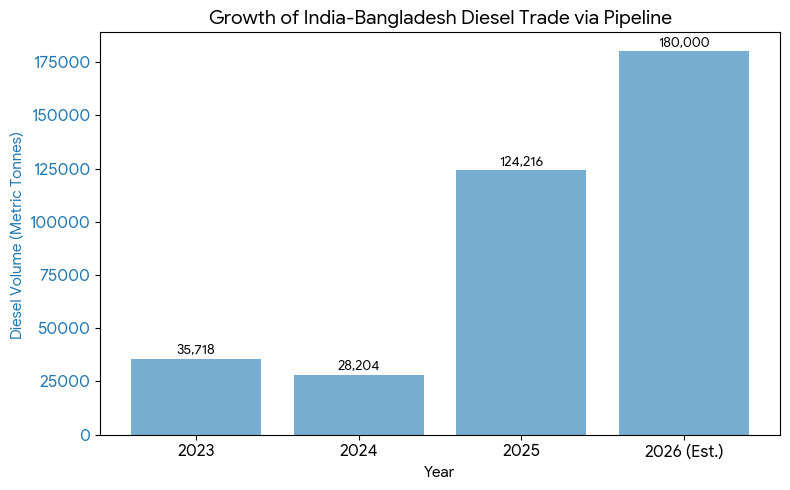
Image 1, Diesel transported via the India-Bangladesh Friendship Pipeline (IBFP)
The logic of closeness: using geography as a strategy
India’s geographic location constitutes a significant strategic advantage in supplying diesel to Bangladesh. India is geographically closer than alternative suppliers in West Asia or Southeast Asia, resulting in lower transportation costs, faster delivery timelines, and reduced exposure to logistical disruptions.
In today’s world, with persistent supply chain disruptions, volatile freight costs, and heightened geopolitical tensions, proximity has emerged as a critical strategic asset. India’s ability to transport diesel via overland pipeline infrastructure significantly mitigates the risks associated with maritime trade, including port congestion, shipping delays, and external chokepoints.
This brings up an important point of analysis: geography is being deliberately leveraged as a form of geopolitical capital. India is strategically utilising its spatial advantage to position itself as a reliable and preferred energy partner for neighbouring countries.
Energy Surplus and Strategic Deployment
India’s status as a diesel exporter is supported by its refining capability. With some of the world’s largest refineries and access to low-cost crude imports, India has emerged as a major supplier of refined petroleum products. The surplus is crucial. Without it, energy diplomacy would not be possible. India’s ability to meet domestic demand while sustaining exports enables it to serve as a regional energy hub.
However, the essential insight is in how this surplus is utilised. Rather than viewing exports solely as an economic activity, India is strategically directing energy flows to adjacent countries. This reflects a broader shift in policy thinking, in which economic resources are used to achieve geopolitical goals.
Bangladesh’s energy problems: what can be done and what can’t be done
Bangladesh’s current energy problems are directly linked to India’s diesel exports. The country is more vulnerable because it relies heavily on imported oil, and sometimes the supplies are cut off around the world.
But this flaw isn’t new. It is a part of Bangladesh’s energy system due to limited local supplies and rising demand. The current crisis only shows how bad these problems really are.
India sees this as both a chance and a duty. Bangladesh’s reliance on India bolsters India’s standing. India is worried about Bangladesh’s instability because the two countries share a border and have economic ties. So, India’s diesel exports can be seen as a response to two needs: to make the most of strategic chances and stop instability in the region.
The Pipeline Model: Infrastructure as Influence
The Friendship Pipeline is part of India’s broader regional policy, which seeks to leverage infrastructure to create durable economic and strategic linkages. This approach is not limited to Bangladesh; India is also advancing cross-border electricity trade initiatives with Nepal and Bhutan, alongside broader efforts aimed at enhancing regional energy connectivity across South Asia.
This model is particularly significant because of its subtle yet enduring nature. Infrastructure-based linkages operate through functional dependency rather than formal military alliances or treaty-based commitments. In this framework, countries are connected through shared systems, integrated networks, and continuous resource flows, rather than ideological alignment or explicit security guarantees.
This kind of integration is harder to undo. It’s hard and expensive to switch suppliers when a country joins a pipeline network. Infrastructure helps long-term strategic stickiness, then.
Domestic Balancing: The Limits of Energy Diplomacy
India’s diesel diplomacy offers clear strategic advantages, but it is constrained by domestic political and economic considerations. Fuel prices remain a politically sensitive issue, and any perception that energy resources are being diverted for export at the expense of domestic consumption can trigger public and political criticism.
The government has managed these pressures through a combination of policy interventions, including closely monitoring domestic fuel availability, periodically adjusting export policies in response to market conditions, and ensuring that domestic supply remains stable and insulated from external commitments.
This shows a major problem with India’s strategy: it needs to find a way to balance its goals outside of India with its need for stability within India. Energy diplomacy can’t hurt the legitimacy of politics at home.
Changing the way we think about “help”: from aid to strategy
People often say that India’s diesel exports are “helping” Bangladesh during a crisis. This framing isn’t completely wrong, but it hides the more complicated forces at work.
India does not extend unconditional aid in this context; rather, it engages in a mutually beneficial exchange that aligns with its broader strategic interests. Bangladesh secures a reliable and consistent fuel supply, while India derives economic returns alongside enhanced regional influence.
Reframing the connection in this way gives a more accurate picture of how international relations work today, where people often work together because they have similar goals instead of out of kindness.
Conclusion: Power via pipelines
India’s diesel exports to Bangladesh are not merely a one-time transaction; rather, they reflect a broader transformation in the exercise of power within South Asia. India is transitioning from a passive participant to an active shaper of regional dynamics by using its refining capacity, geographic advantages, and sustained investments in infrastructure.
The importance of this move is not in the amount of diesel that is exported, but in the model it represents. Energy flows are becoming ways to control people, and infrastructure is becoming the way to keep that control.
In this changing world, pipelines may become as strategically consequential as territorial boundaries, and fuel supply arrangements may carry comparable weight to formal diplomatic agreements. India’s diesel diplomacy, therefore, is not solely about meeting immediate energy demand; it is indicative of a deeper transformation in the structure of regional order and power projection.

Anusreeta Dutta is a columnist and climate researcher with experience in political analysis, ESG research, and energy policy. Views expressed are the author’s own.
 Dr Mohmmad Rizwan
  Parag Gilada
  Archita Gaur