
- The European project of strategic independence is real — more real today than at any point since the Cold War.
- The Re-Arm Europe plan, which started in 2025, is the most ambitious attempt by Europe to work together on defence.
- The European Union and India will work together on security, cybersecurity, counterterrorism, and new technologies such as artificial intelligence.
- The question is whether it can build enough credible capacity, in enough domains, to shape outcomes rather than merely react to them.
The idea that Europe could rely on the US for protection forever without paying a price has not held up well. In February 2022, Russia invaded Ukraine. In January 2025, Donald Trump won the presidency again. This can be considered the two major events that caused a shift in how cities throughout Europe thought about one question — how can recently established European cities, who’ve had to depend on the United States and other countries for decades, defend themselves, impact the world, and defend their economic interest?
The answer now, in mid-2026, is a cautious yes. This is because things are moving at a speed that would have been thought impossible in 2019. However, decades of underinvestment, buying defence stuff in bits and pieces and countries having priorities do not change overnight. To see where Europe is, we need to look at both the progress and the problems.
The structural deficit that history built
The Cold War ended with a deal for European members of NATO: the United States would provide protection and European countries would handle the politics. This led to a period of peace, and as a result, budgets for defence went down below the target of 2% of the country’s income, and the industries that made weapons got smaller. When Russia went into Ukraine, European countries did not have weapons production was slow, and people were still very careful about spending money on the military.
The facts are clear. European countries have not spent enough on defence. This has added up to a huge amount. Around €1.8 trillion. Since the Cold War ended. This is not about buying more weapons; it is also about the money that was not spent on research, buildings and industries that could make weapons. To fix this problem, European countries need to change the way their defence industries work, make their buying systems more efficient and convince people that spending money on defence is necessary.

ReArm Europe and the industrial pivot
The response from politicians has been really strong. The Re-Arm Europe plan that started in 2025 is the plan to work together on defence that Europe has ever tried. It is a plan to make a big difference by buying a lot more weapons, buying things together, and creating a real European Defence Technological and Industrial Base. The idea is that buying weapons made in Europe does not just fill the gaps we have. It also helps us become more independent in the long run.
“Europe cannot keep itself safe if it has to rely on countries for the important parts of its military. The change that is happening now is not about how things look. It is about how things really are”.
Germany has made a change. For twenty years, Germany was not allowed to borrow a lot of money. In February 2025, it made a new plan that says it can spend more than 1% of its money on defence without worrying about debt. It also made a fund of €500 billion to spend on schools, roads, making the air cleaner and helping the economy. We can already see how this is affecting countries in Europe: Spain, Poland and the countries in the north are all saying they will meet their NATO targets sooner.
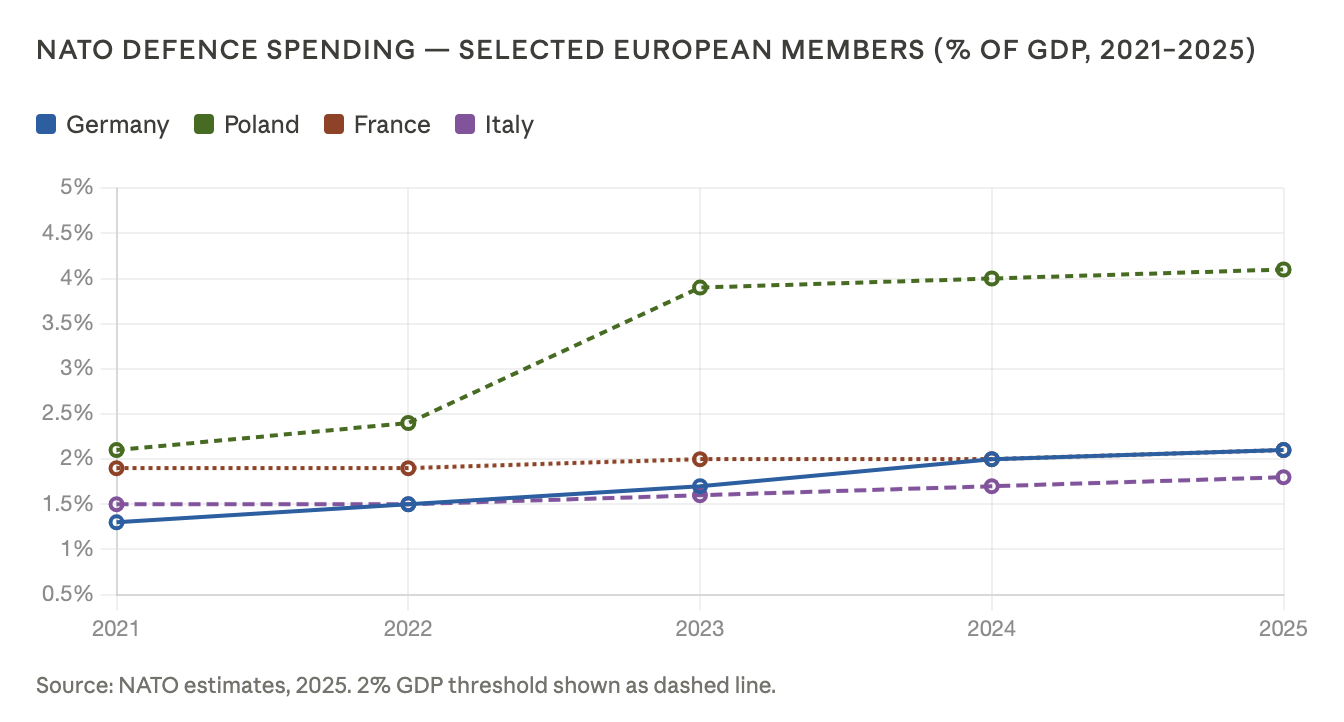
However, in addition to mere expenditure, the EU has strengthened its institutional structure. Through PESCO, more than 40 joint capability projects are underway. The EDF provides support for cross-border research and development. Finally, the adoption of the first-ever EDIS in March 2024 marks an important milestone for establishing a vision of a fully autonomous defence industry by 2030.
Foreign policy: the machinery and its limits
On the diplomatic front, the EU’s capacity has grown — but ambition has often run ahead of delivery. The Common Foreign and Security Policy (CFSP) framework remains hamstrung by the unanimity requirement: a single dissenting member can block collective action, and in an expanded union of 27 states, dissent is rarely absent. Hungary’s consistent use of this veto has been the most visible manifestation of a structural flaw that reformers have long identified but never managed to fix.
The Strategic Compass, adopted in 2022, was the EU’s attempt to articulate a coherent security vision — including the creation of a 5,000-strong Rapid Deployment Capacity for crisis intervention. Progress on this capability has been genuine, though implementation timelines have slipped and questions about political will remain.
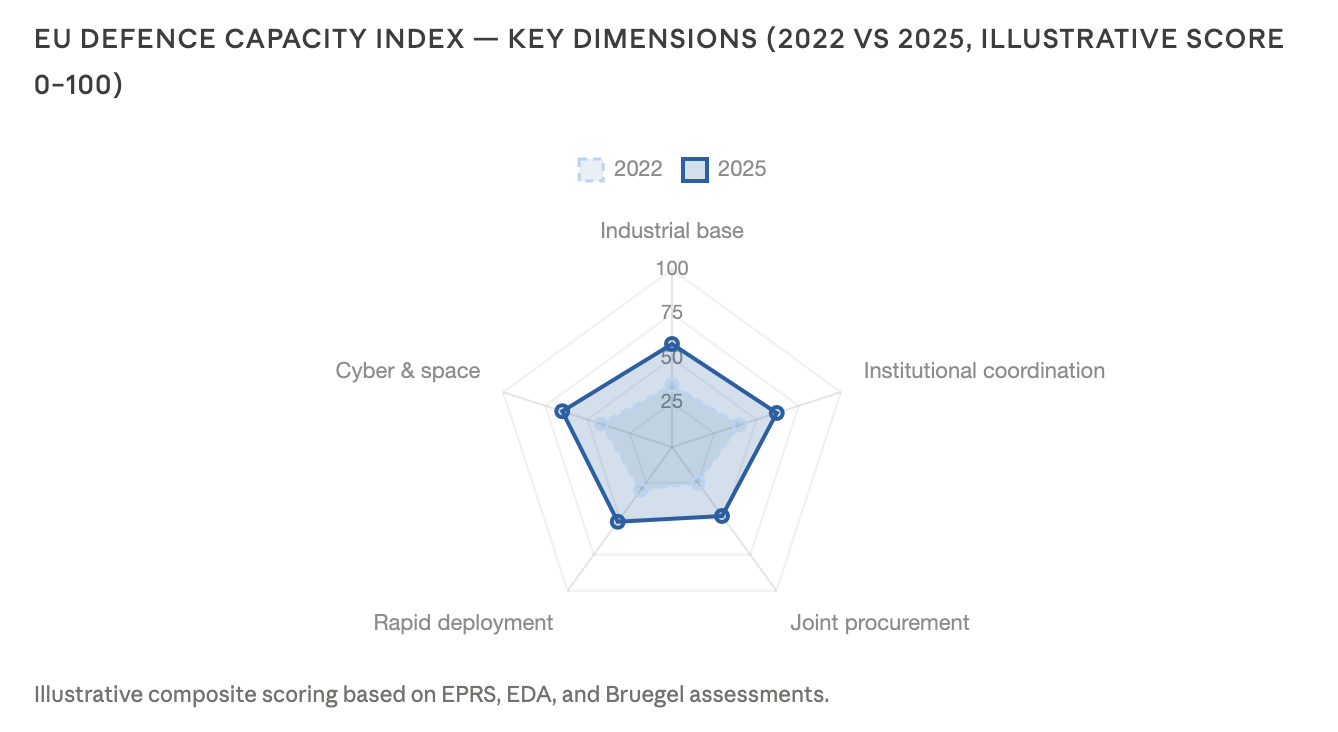
What has genuinely shifted is the political psychology. Europe’s leaders, for the first time since the Cold War, are speaking openly about military contingencies — including the possibility of Russian aggression against NATO territory within the decade. That shift in discourse, from managing crises at the periphery to deterring threats at home, marks a qualitative change in how the bloc understands its own security environment.
India and the emerging axis of strategic convergence
The EU–India Security & Defence Partnership
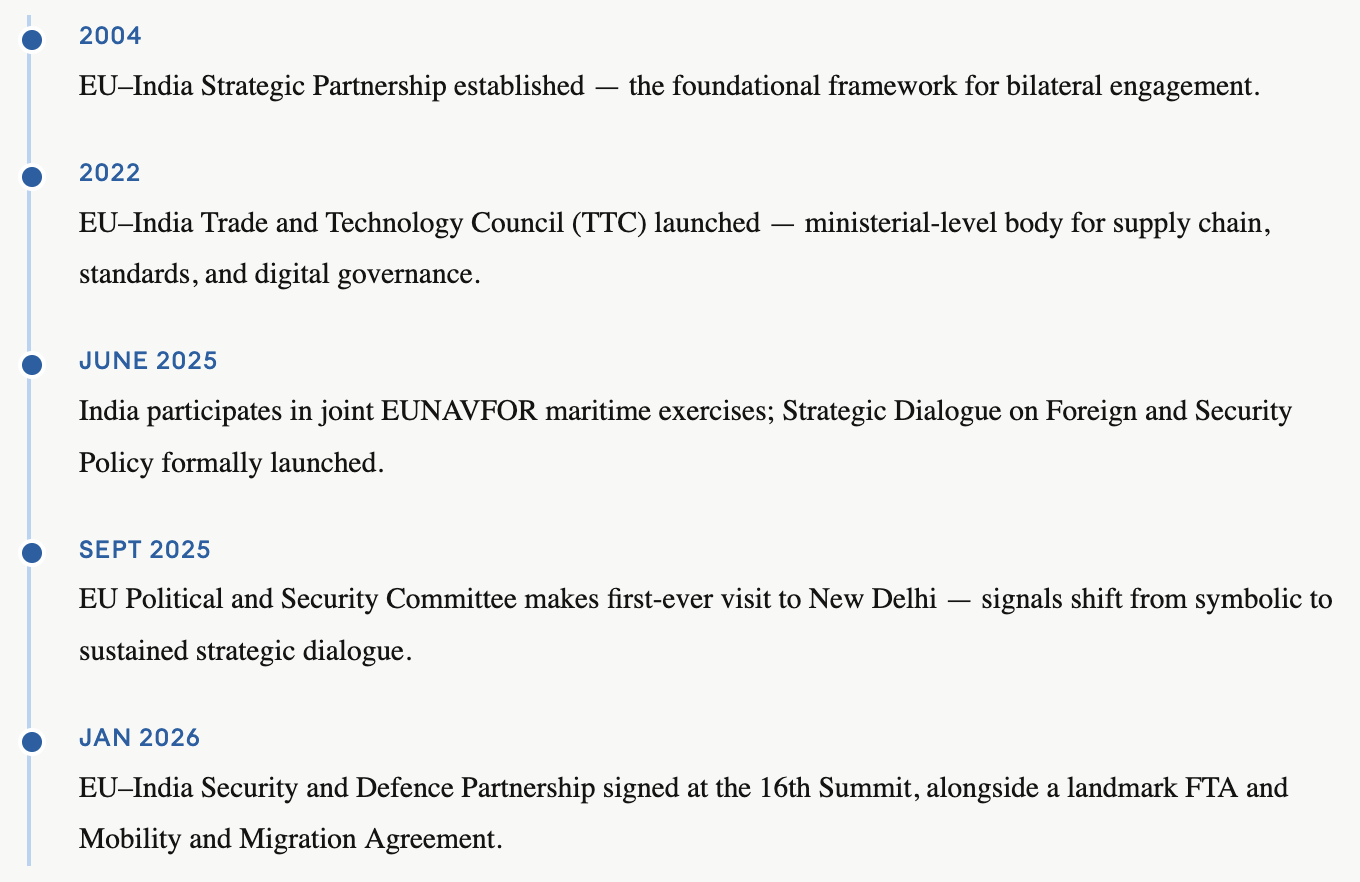
On 27 January 2026, the European Union and India signed an important Security and Defence Partnership on the side of the EU-India Summit. This is the first time the two have had a special framework for talking about defence. High Representative Kaja Kallas and External Affairs Minister S. Jaishankar signed the agreement. This means the European Union and India will work together on security, cybersecurity, counterterrorism, and new technologies such as artificial intelligence.
The European Union and India started working more closely before signing this agreement. In June 2025, Indian ships and European Union naval forces did exercises together. The European Union and India also started talking about security policy in the same month. Then, in September 202,5 the European Union Political and Security Committee visited New Delhi for the first time. All these things show that the European Union and India think their interests are becoming more similar. They also think it is worth putting in the effort to make their relationship more formal.
The way the European Union thinks about India has changed a lot over the years. The relationship used to be about trade. The European Union is still India’s trading partner for goods. In 2024, they traded about €120 billion worth of goods. Now the European Union and India are also working together on security. The European Union buys a lot of goods from India, about €71.4 billion worth. This shows how much the two economies depend on each other. It also shows why their political relationship is important.
France has always been a player in the European Union’s relationship, with India. The big deal to buy Rafale planes from Dassault Aviation is an example. France and India are also working together on submarines and other military projects. But the Security and Defence Partnership signed in January 2026 shows that the whole European Union wants to work with India, not France. The European Union wants to engage with India as a group, not one country at a time.
The plan is simple. India has a lot of power in the Indian Ocean. It is making its own military equipment under the “Make in India” initiative. India also does not take sides with countries, which is good for Europe. This is because India can help Europe deal with China’s influence in Asia. India and Europe can work together on things, such as keeping the Red Sea safe, stopping cyber threats and watching what happens in space.
For India, getting technology from Europe and money to invest is a thing. Working with Europe also gives India options so it does not have to rely only on the United States or Russia.
This partnership is not easy, though. India still has ties with Russia, which can be a problem. India buys oil from Russia at a price and has always relied on Russia for weapons. This does not fit well with Europe’s efforts to pressure Russia. India also likes to make its decisions and does not want to be tied down to any particular group. These issues can be managed, and both India and Europe seem to understand this.
The road ahead: promise and friction
The European project of strategic independence is real — more real today than at any point since the Cold War. The institutional machinery is in place, the spending commitments are materialising, and the political will exists in a way it simply did not five years ago. The EU’s space assets — Galileo, Copernicus, and the forthcoming IRIS2 sovereign satellite communications system — are reducing external dependencies in critical domains. The InvestAI plan’s €20 billion earmarked for AI Gigafactories is a bet on technological sovereignty in a sector currently dominated by Washington and Beijing.
But friction remains. The European defence market is still fragmented. National procurement preferences persist. Eastern members prioritise the transatlantic relationship over European-led initiatives, while Western members push for European-first solutions. The unanimity trap in foreign policy has not been resolved. And the gap between declared ambition and delivered capability remains uncomfortably wide in several domains, from ammunition production to military mobility infrastructure.
None of this makes the project futile. It makes it hard — which is what the project always was. The question for the coming decade is not whether Europe will achieve full strategic independence; it almost certainly will not, in any absolute sense. The question is whether it can build enough credible capacity, in enough domains, to shape outcomes rather than merely react to them. On current trajectory, the answer appears to be a cautious, contingent yes.
References
- Crédit Agricole / CPRAM — “European strategic autonomy also encompasses defense” (2025). cpram.com
- Bruegel Policy Brief — “A European defence industrial strategy in a hostile world”, Mejino-Lopez & Wolff (2024). bruegel.org
- European Parliament Think Tank — “The future European security architecture: Dilemmas for EU strategic autonomy” (March 2025). epthinktank.eu
- EEAS Joint Communication — EU–India Strategic Partnership Framework, JOIN(2025) 50 final (September 2025). eeas.europa.eu
- EEAS — “Security and Defence: EU and India sign Security & Defence Partnership” (January 2026). eeas.europa.eu
- ORF Online — “The Strategic Logic of the India–EU Security and Defence Partnership” (March 2026). orfonline.org
- Cambridge Core / European Journal of International Security — “Strategic autonomy: A ‘quantum leap forward on’ European total defence?” (2026). cambridge.org
- CELIS Institute — “The EU’s Evolving Approach to Open Strategic Autonomy” (February 2025). celis.institute
- SAGE Journals — “Restructuring the EU’s Defence Industrial Base Amid Geopolitical Shifts”, Genini (2025). journals.sagepub.com
- European Commission / DG DEFIS — “EU Space and Defence Industry for an Autonomous Europe”. defence-industry-space.ec.europa.eu

Raghvendra Tripathi is an independent researcher with a background in computer applications and a keen interest in technology and geopolitics. His articles focus on how emerging technologies influence international strategy, policy, and global power dynamics. Views expressed are the author’s own.
 Rajeev KS
  Hridbina Chatterjee
  Diksha Bharti