
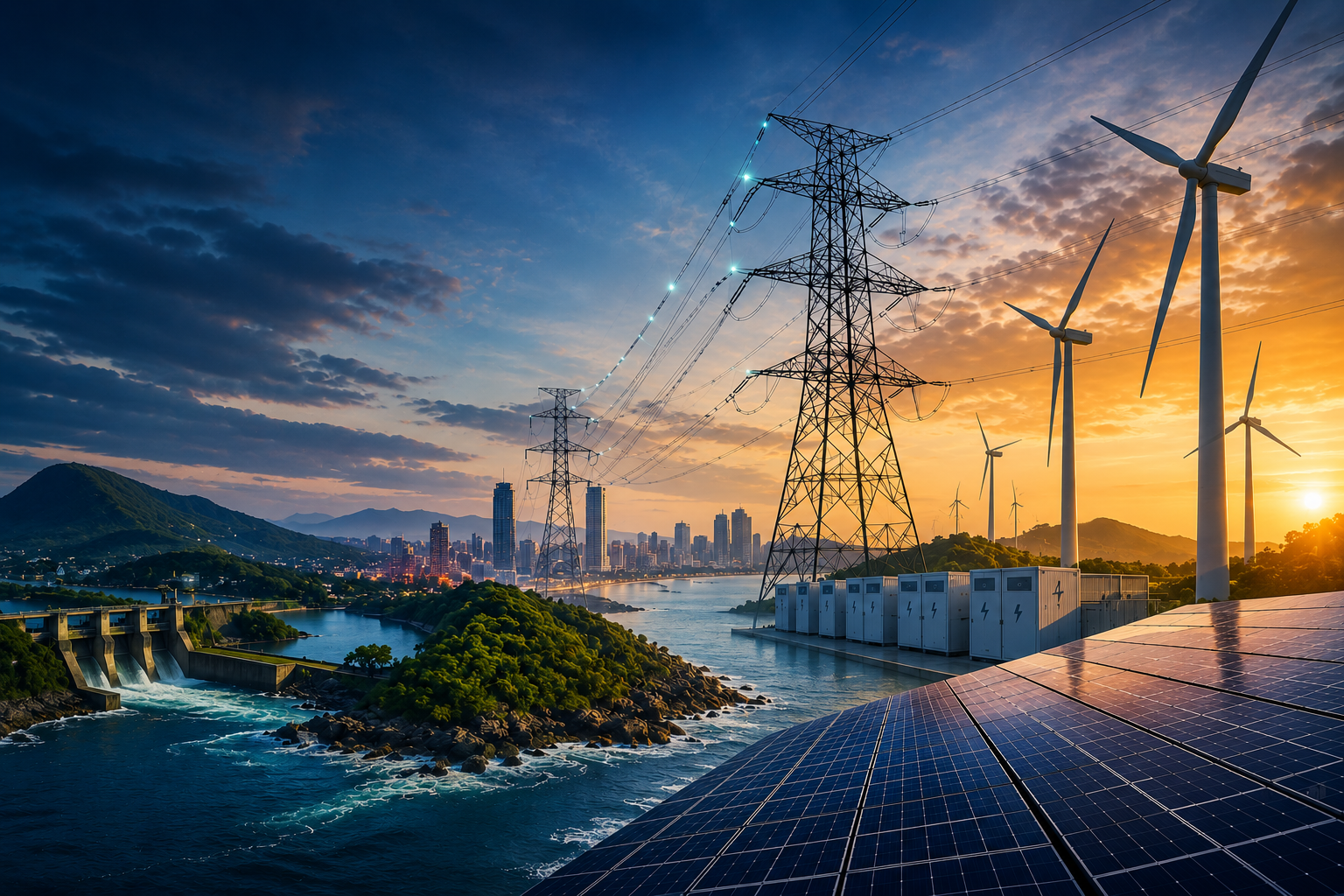
- The state is executing a vital transition toward deep private sector energy grid integration, a strategy built to replace unsustainable public debt with private capital, slash the country’s prohibitive industrial electricity tariffs, and secure long-term macroeconomic resilience.
- This transformative change in Ceylon’s energy system from a model of environmental sustainability to one in which private sector investment in the energy grid is now considered an absolute necessity for the continued existence of the country’s industrial base.
- According to Sri Lanka’s plan for the future, it is expected that 70% of its power will be produced from renewable sources by the year 2030.
- The transition from emergency economic stabilisation to structural private energy grid integration represents Sri Lanka’s most definitive step toward genuine financial self-reliance.
The macro-fiscal landscape of Sri Lanka has undergone an aggressive pivot from short-term economic survival to structural permanence. Following the devastating macroeconomic collapse of 2022, Colombo’s immediate focus was strictly anchored in emergency financial assistance, defined by rigid International Monetary Fund structural benchmarks, multilateral bridge financing, and bilateral fuel credits. While these emergency interventions successfully stabilised the rupee and curbed hyperinflation, they were inherently defensive measures designed to manage insolvency rather than generate sustainable growth. Now, the state is executing a vital transition toward deep private sector energy grid integration, a strategy built to replace unsustainable public debt with private capital, slash the country’s prohibitive industrial electricity tariffs, and secure long-term macroeconomic resilience (World Bank, 2026).
The Expiry of Sovereign Buffers and the Cost of Inaction
The reliance on foreign aid in times of emergency is essentially a gamble with the clock running out. For many years, Ceylon’s electricity system was based on a state-owned (CEB) business model that was neither feasible nor sustainable—this single-buyer model depended heavily on imported fossil fuels that Ceylon could not produce or extract on its own. When Ceylon lost its foreign exchange reserves, it was no longer able to import diesel or coal and experienced long rolling blackouts, which essentially crippled Ceylon’s domestic economy.
Emergency loans and technical help provided a minimal buffer, but did nothing to address the core vulnerability—Ceylon’s unhedged exposure to global price fluctuations (i.e. highly volatile commodity markets) and a huge domestic budget deficit (Huang et al., 2025). The implementation of high tariffs by the government to achieve “cost-reflective” pricing required by multilateral lenders has resulted in some of the least competitive electricity prices on the planet for the domestic manufacturing sector in Ceylon (World Bank, 2026). This transformative change in Ceylon’s energy system from a model of environmental sustainability to one in which private sector investment in the energy grid is now considered an absolute necessity for the continued existence of the country’s industrial base.
Institutional Unbundling and Democratising the Grid
The legislative basis for this modern-era shift is a full unbundling of the state-controlled power industry, which now separates and actively breaks up the state monopoly, allowing independent power producers to compete on equal terms. The unbundling of the CEB (Ceebasi Encai Bakshan) suggests that, at the same time, an open-access transmission regime will be established by separating the generation, transmission and distribution of CEB operations legally.
The establishment of a separate corporate entity will allow for private developers of green energy projects to enter into corporate power-purchasing agreements (PPAs) with major industrial users directly and without reference to government balance sheet limitations.
This structural democratisation is likely to remove the barrier of requiring sovereign guaranties (which are prohibited under Sri Lanka’s strict debt framework) to attract large private direct investments. By allowing private sector entities to develop, operate and monetise the generation assets (i.e. large-scale solar photovoltaic projects on commercial rooftops and large onshore wind farms), the government will effectively pass the cost of all capital expenditures and the risks associated with technological failures from the constrained public treasury onto private sector investments.
Capital Mobilisation and the 70% Renewable Target
According to Sri Lanka’s plan for the future, it is expected that 70% of its power will be produced from renewable sources by the year 2030. The only way to accomplish this is if they develop an enormous amount of new capacity in the next 2-3 years (CEB, 2025; World Bank, 2026). Because the government does not have the ability to finance these expansions, the responsibility of providing this capacity will fall on the private sector (World Bank, 2026). International institutions are currently not providing funding in the form of traditional budgetary support; instead, they are providing financing through specialised blended finance instruments such as green bonds and partial risk guarantees to make local energy projects viable to international Independent Power Producers (IPP’s). International and domestic companies are focusing on harnessing the wind corridors of Mannar and Pooneryn, as well as solar hybrid mini-grids in the northern and eastern provinces. These decentralised networks greatly reduce transmission losses, improve the resilience of rural electric grids, and provide a reliable source of low-cost electricity to the national grid, thereby reducing overall production costs.
Technical Modernisation and Smart Infrastructure
The integration of variable renewable energy (VRE) at scale deep into the system presents many challenges that cannot be managed by traditional centralised grid infrastructure. Due to the intermittent nature of solar and wind energy, there is a need for rapid deployment of modern ancillary grid systems. Thus, private sector integration extends well beyond just owning the asset itself; it also includes actively deploying private sector technology, utilising smart grid technologies for monitoring, making use of AI for predicting weather patterns, and developing localised battery energy storage systems (BESS).
The utility network can leverage partnerships with private digital infrastructure and technology companies to seamlessly move the utility network toward automated demand response capabilities. This change in technology enables the grid to dynamically balance industrial load in real time to avoid localised voltage collapse, as well as provide protection against unanticipated declines in natural generation to ensure that peak demand periods do not experience any interruptions.
Geopolitical Integration and Regional Grid Connectivity
Sri Lanka’s private sector energy policy is closely connected to a larger, sub-regional master plan focused on cross-border electricity trade (CBET) in South Asia (Hazra, 2026). Significant technical and commercial development work is currently being conducted to develop a High Voltage Direct Current (HVDC) maritime transmission grid that will interconnect the electricity grid in Sri Lanka with the large Indian power market via the Palk Strait (Hazra, 2026).
This strategic cross-border electricity integration will have a profound impact on the financial picture for private developers considering investing in Sri Lankan energy resources. Private energy developers that previously had limited options for monetising their investments through domestic sales will now have a direct access route into the Indian power exchange for monetising the abundant, underutilised wind and solar energy resources available to Sri Lanka (Hazra, 2026). In addition, during periods when local weather conditions produce limited hydropower generation capacity in Sri Lanka, the country can now import energy from mainland India, thus allowing Sri Lanka to eliminate the need for having costly, oil-fired thermal generation capacity available as backup energy sources for domestic use.
Achieving Sustained Macro-Fiscal Autonomy
The transition from emergency economic stabilisation to structural private energy grid integration represents Sri Lanka’s most definitive step toward genuine financial self-reliance. By substituting expensive, imported fossil fuels with domestic, privately funded green infrastructure, Colombo is directly insulating its balance of payments from unpredictable external energy shocks. The resulting reductions in baseline wholesale energy costs will systematically lower the cost of doing business, restoring the regional competitiveness of Colombo’s manufacturing, textiles, and maritime logistics sectors (World Bank, 2026). Ultimately, utilising private capital to modernise and green the national grid is transforming Sri Lanka’s legacy economic vulnerabilities into a highly competitive, self-sustaining model for emerging market growth.
References:
- BOARD, C. E. (2025). Long-term generation expansion plan 2025-2044. Ceylon Electricity Board Transmission & Generation Planning Branch.
- Hazra, M. Z. (2026). South Asia’s integrated grid and clean energy transition. Observer Research Foundation.
- Huang, G., Crooke, M., Essl, S., Le Manchec, M.-H., & Sharan, R. (2025). Sri Lanka: Technical assistance report-preparing a fiscal risk statement. International Monetary Fund Technical Assistance Reports.
- World Bank. (2026). Country partnership framework for the Democratic Socialist Republic of Sri Lanka (FY2026-30).

Hridbina Chatterjee is a final-year postgraduate student in International Relations at Jadavpur University, Kolkata. She has written for newspapers and think tanks, with interests in South Asian politics, India’s foreign policy, and the Indo-Pacific. Views expressed are the author’s own.
 Aayush Pal