
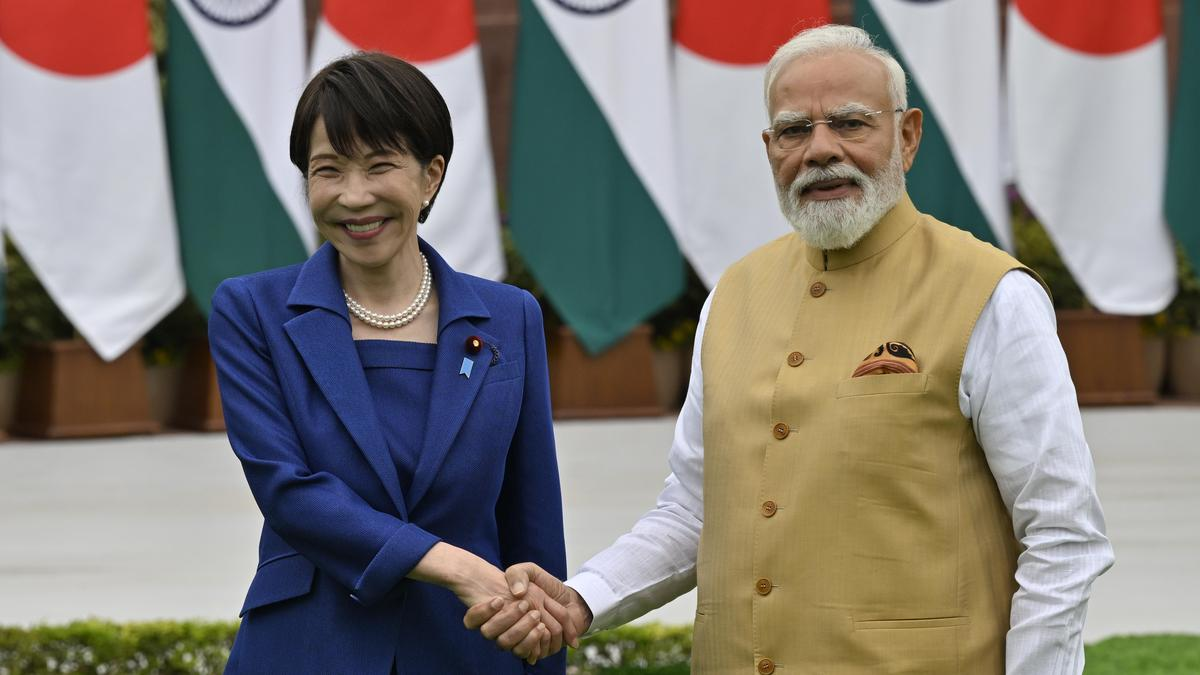
- Both Prime Minister Narendra Modi and Prime Minister Sanae Takaichi described the visit as the beginning of a new chapter in India-Japan relations.
- Both countries signed agreements and cooperation frameworks in artificial intelligence, energy security, critical minerals, semiconductor supply chains, and defence technology.
- India and Japan have also adopted a roadmap to upgrade the India-Japan Comprehensive Economic Partnership Agreement (CEPA).
- The strengthening of India-Japan relations is also important for maintaining balance in the Indo-Pacific. India, however, has consistently sought a more independent relationship with Japan.
In an important geopolitical development, Japanese Prime Minister Sanae Takaichi visited India. This visit is historic in many ways, as it is not only the first visit by the Japanese Prime Minister after being elected, but more importantly, it is coming at a crucial time when contemporary geopolitics has been witnessing greater instability and the Asia-Pacific has become the new theatre of global politics.
Both Prime Minister Narendra Modi and Prime Minister Sanae Takaichi described the visit as the beginning of a new chapter in India-Japan relations. Both countries signed agreements and cooperation frameworks in artificial intelligence, energy security, critical minerals, semiconductor supply chains, and defence technology. India and Japan have also adopted a very important roadmap for economic security, which mainly focuses on strengthening supply chains in strategic sectors such as critical minerals and semiconductors.
Strengthening Economic and Strategic Cooperation
There was a great sense of camaraderie visible between the two Prime Ministers, as Prime Minister Narendra Modi referred to his Japanese counterpart as his younger sister. The relationship between India and Japan has always been very warm. Japan has been a strategic partner for India, and Japanese investments have been deeply involved in India’s critical infrastructure and national security sectors. Both countries have enjoyed a historic relationship and continue to strengthen it.
India and Japan have also adopted a roadmap to upgrade the India-Japan Comprehensive Economic Partnership Agreement (CEPA). In a first-of-its-kind move, both countries announced the first India-Japan defence co-development project, called UNICORN, which will further boost defence ties between the two nations. Both countries have also agreed to jointly develop critical defence technologies and innovations, while expanding maritime exercises and defence cooperation. The Japanese Prime Minister has also agreed to further increase investments in India.
China Factor and the Indo-Pacific Equation
This visit comes at a very important time, particularly because both India and Japan are situated at a critical junction in the Asia-Pacific. Both countries have also been witnessing a common challenge in the form of China. The rise of China in the Asia-Pacific and its continuous violations of the rule of law have become a concern for like-minded countries such as India and Japan. For India, its relationship with Japan matters not only economically but also in terms of geopolitics.
India and Japan are also important members of the Quadrilateral Security Dialogue (QUAD). However, in recent times, criticism has emerged that the relationship between the two countries has stagnated. Much of this has been linked to Japanese domestic politics. The Liberal Democratic Party of Japan has continued to struggle, witnessing almost four Prime Ministers within a span of six years. Now, with Sanae Takaichi, the Liberal Democratic Party appears to have found new hope. It is now up to India and Japan to further diversify their relationship and seek greater mutual benefits.
Beyond Alliances: Towards a Pragmatic Partnership
The strengthening of India-Japan relations is also important for maintaining balance in the Indo-Pacific. However, another criticism often raised is that much of the India-Japan relationship is influenced by the United States. This argument exists because many Japanese leaders have often aligned themselves with American strategic priorities. India, however, has consistently sought a more independent relationship with Japan. The more independent the India-Japan partnership becomes, the more both countries are likely to benefit. More importantly, it would also contribute to the broader security and stability of the Asia-Pacific.
The interesting paradox in India-Japan relations is that while both countries are trying to increase deterrence in the Asia-Pacific, they should also avoid forming rigid blocs. The United States, in recent years, has attempted to polarise the region and create alliances primarily aimed at countering China. It is therefore important for India and Japan to remain pragmatic, stay united in addressing common challenges, and work together where interests converge. At the same time, they should avoid becoming trapped in the politics of polarisation and bloc consolidation.

Aayush Pal is a freelance writer on contemporary geopolitical developments. The views expressed in his work are entirely his own.
 Kumar Satish
  Anjali Singh