

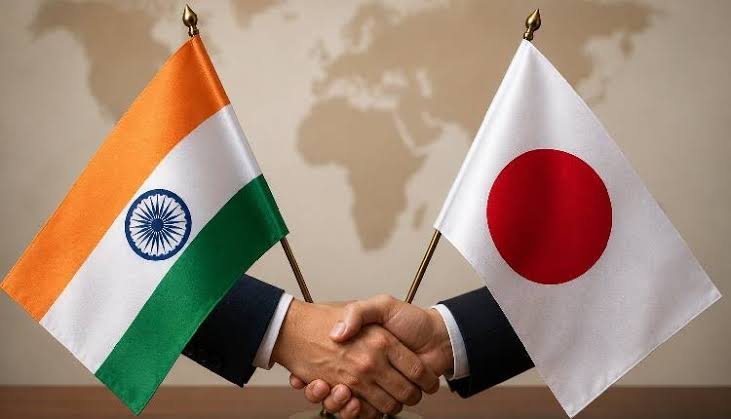
- The India-Japan relationship is becoming more symbolic of a larger shift in New Delhi’s foreign policy calculus, one where economic resilience, technological competitiveness and secure access to critical materials are becoming integral to National Security.
- Economic security has emerged as a strategic priority, encompassing secure supply chains, access to critical minerals, technological innovation, energy resilience, and trusted digital infrastructure.
- The India–Japan partnership today is not just about convergences in regional security concerns. Rather, it is a model of geo-economic statecraft where diplomacy is increasingly directed towards securing technologies, resources, and production networks that will shape future economic competitiveness and strategic autonomy.
- While India has yet to formally articulate an economic security doctrine, its growing collaboration with Japan suggests that many of its defining features are already taking shape in practice.
The recent India–Japan summit marked yet another milestone in bilateral relations. Agreements on artificial intelligence, critical minerals, semiconductor cooperation, supply-chain resilience, and defence technology signalled an emerging shift in how both countries view economic security in an increasingly uncertain global order. While these developments are widely interpreted through the prism of strategic convergence in the Indo-Pacific or as a reaction to an increasingly assertive China, such interpretations capture only part of the story. The India-Japan relationship, in particular, is becoming more symbolic of a larger shift in New Delhi’s foreign policy calculus, one where economic resilience, technological competitiveness and secure access to critical materials are becoming integral to National Security.
The Rise of Economic Security
Foreign policy has historically been focused on safeguarding territorial integrity, preserving strategic autonomy, and expanding diplomatic influence. Today, however, economic resilience has become an equally important element of national security. The disruptions caused by the COVID-19 pandemic, rising geopolitical tensions, and the weaponisation of trade and technology have exposed the risks of dependence on external suppliers for critical goods and technologies. As a result, economic security has emerged as a strategic priority, encompassing secure supply chains, access to critical minerals, technological innovation, energy resilience, and trusted digital infrastructure.
This broader evolution is particularly significant for India. As it tries to carve out a place as a global manufacturing hub and a nascent tech power, its foreign policy is no longer just about managing geopolitical relations. It is now increasingly being deployed to secure the economic prerequisites for sustained growth and economic resilience. The developing Japan relationship is a good example of this, where cooperation is not just about diplomatic platitudes but building resilience in industries that will determine economic competitiveness decades from now.
India and Japan: Building Economic Resilience Together
None of India’s bilateral relationships better exemplify its changing conception of economic security than its partnership with Japan. The two countries have long shared converging strategic interests in the Indo-Pacific, but their cooperation now extends well beyond traditional defence and maritime security. They are increasingly focusing on creating resilient economic systems that can handle geopolitical volatility and supply chain disruption.
A cornerstone of that partnership is collaborative technology development. As competition for advanced technologies intensifies, semiconductors, artificial intelligence, and digital infrastructure have become strategic rather than merely commercial sectors. India’s burgeoning digital ecosystem and Japan’s technological prowess offer scope for cooperation which can reduce dependence on concentrated global supply chains and at the same time enhance domestic industrial capabilities.
Japan holds a special place in the foreign policy of India. Unlike many great powers that are either technologically advanced and capital scarce, or capital abundant and technologically unadvanced, Japan is both technologically advanced and capital abundant and enjoys a high level of political trust with India. This allows collaboration in sensitive areas such as chips, digital infrastructure and high-tech manufacturing without the geopolitical hang-ups typically associated with great-power competition.
Likewise, the critical minerals cooperation has also taken on strategic importance. The world’s shift to clean energy technology and electric vehicles has sent demand for minerals like lithium, cobalt and rare earth elements soaring. Through cooperation to ensure stable supply chains and diversification of sources for these critical materials, India and Japan are aiming to mitigate vulnerabilities that come with over-reliance on a small number of providers. Control of critical minerals has become a geopolitical lever, and diversification is not just an economic goal but a strategic imperative.
The cooperation between them is also a sign of commitment to resilient and trusted supply chains. The COVID-19 pandemic and related geopolitical disruptions have shown that economic interconnectedness without resilience can make nations vulnerable to substantial strategic risk. Efforts to enhance manufacturing networks, deepen industrial collaboration, and facilitate investment are, thus, not simply measures of economic management, but of long-term national security.
In all, these measures reflect that the India–Japan partnership today is not just about convergences in regional security concerns. Rather, it is a model of geo-economic statecraft where diplomacy is increasingly directed towards securing technologies, resources, and production networks that will shape future economic competitiveness and strategic autonomy.
Implications for India’s Foreign Policy
The India–Japan partnership is not an isolated case but rather reflective of wider changes in India’s external engagement. With geopolitical competition intersecting more closely with technological rivalry, supply chain disruptions, and economic coercion, India’s foreign policy is broadening beyond traditional concerns with territorial security and strategic balancing. Economic resilience is becoming a strategic objective in itself.
This realignment will likely define how India engages with its partners in the future. Collaboration will increasingly be assessed not only through the lens of geopolitical alignment, but also by its ability to enhance India’s technological capabilities, secure access to critical materials, supply chain diversification and domestic industrial growth. In this context, diplomacy is not just about managing interstate relations but about leveraging those relations to advance long-term economic competitiveness and national resilience.
The India–Japan relationship offers a window into this emerging dynamic. Although India has yet to formally articulate an economic security doctrine, its growing cooperation with Japan indicates that economic security is already emerging as a key pillar of its foreign policy. As access to technology, critical minerals, and resilient supply chains becomes increasingly synchronous with strategic power in the modern era, India’s diplomatic triumphs will hinge not just on the relationships it builds, but also on the economic security they bolster.
Conclusion
The India–Japan relationship is more than a successful bilateral relationship; it also reflects the way in which Indian foreign policy is moving. With geopolitical competition now intertwining with technology rivalry, supply chain vulnerabilities and economic coercion, economic security is becoming a key strategic goal, rather than a peripheral economic issue. While India has yet to formally articulate an economic security doctrine, its growing collaboration with Japan suggests that many of its defining features are already taking shape in practice. In an era where access to critical technologies, resilient supply chains, and trusted partners increasingly determines strategic influence, the India–Japan relationship may well represent the future of Indian foreign policy.
References:
- Ministry of External Affairs, Government of India. India–Japan Joint Statement following the 16th India–Japan Annual Summit. (2026).
- Observer Research Foundation. The Policy Edge of Japan and South Korea in Securing Critical Minerals.
- Carnegie Endowment for International Peace. Economic Security and the Future of the Indo-Pacific.
- Reuters. India, Japan sign pacts on AI, metals and energy after summit. (July 2026).

System Administrator
 Hridbina Chatterjee
  Diksha Bharti
  Kumar Satish