- External Affairs Minister S. Jaishankar recently stated that India has gone “beyond advocacy” and is now in talks with both sides on matters such as Black Sea shipping, grain and energy flows, and even potential non-attack agreements.
- India’s current role is therefore better described as that of a facilitator or interlocutor rather than a formal mediator.
- New Delhi could focus on practical concerns—such as protecting shipping, maintaining grain exports and keeping energy supplies moving—where progress may be possible even without a broader political agreement.
- If New Delhi can turn its access into concrete agreements on issues such as maritime security, food and energy flows, it could establish a meaningful role in the search for a broader settlement.
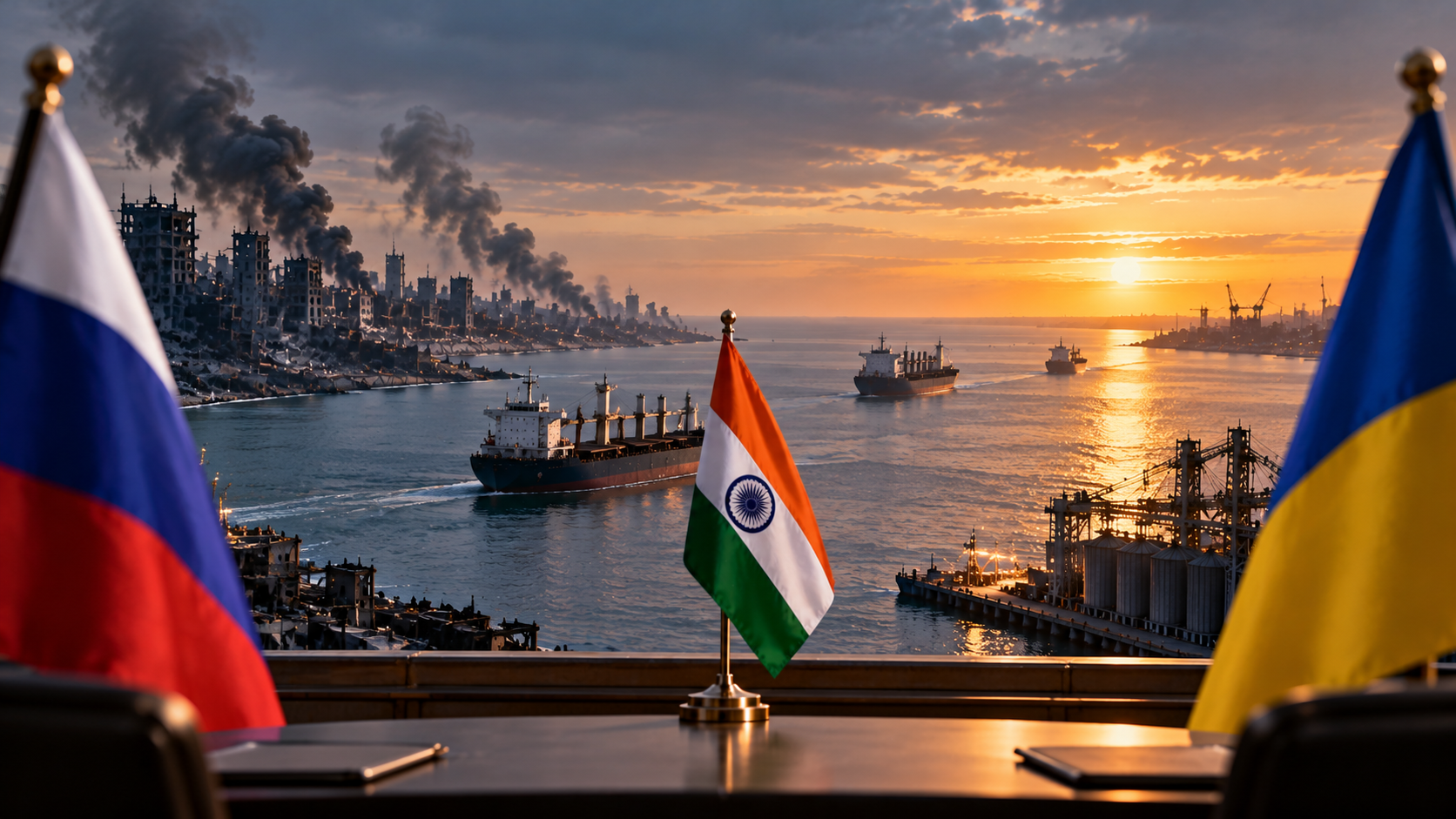
For much of the Russia-Ukraine war, India has advocated for dialogue, diplomacy, and a negotiated settlement. New Delhi has consistently called for an end to hostilities while maintaining working relations with both Moscow and Kyiv. However, India may now be entering a new stage. External Affairs Minister S. Jaishankar recently stated that India has gone “beyond advocacy” and is now in talks with both sides on matters such as Black Sea shipping, grain and energy flows, and even potential non-attack agreements.
This change is significant. It is one thing to call for peace; it is another to help create the conditions for peace. As the war continues to reshape European security, global energy markets, and the broader balance of power, India is increasingly finding itself in a diplomatic position that few other major powers can claim. Its relationship with Russia has endured throughout the war, while its strategic partnership with the United States and growing engagement with Europe have strengthened its ability to engage across competing geopolitical blocs. Meanwhile, New Delhi has kept channels of communication open with Ukraine.
This prompts a larger question: Is India transitioning from being a voice for peace to an active facilitator of peace? And if so, what would such a role mean for India’s long-standing commitment to strategic autonomy?
From Advocacy to Engagement
The country’s changing stance has become evident only recently. “We have moved from the stage of advocacy, and we are now talking to Russia and Ukraine,” Jaishankar said on October 4, a day after the first round of fighting in Ukraine ended with tentative agreements. He said that the talks initially focused on the security of commercial shipping in the Black Sea but have since widened to include issues such as grain exports, energy supplies, and possible non-attack arrangements.
The timing is significant. India’s renewed diplomatic effort was launched in July, after commercial vessels came under attack in the Black Sea. What began as an attempt to address maritime security has now expanded into questions that go to the heart of how the war is conducted and its broader economic consequences. The Black Sea is strategically important not only to Russia and Ukraine but also to global food and energy trade. Ensuring the security of shipping in the region therefore has implications that extend far beyond the battlefield.
India’s efforts also appear to be gaining traction on both sides. Ukrainian Foreign Minister Andrii Sybiha said that Kyiv had received proposals from four countries, including India, but described the Indian proposal as the “most comprehensive.” Russian President Vladimir Putin has separately referred to Prime Minister Narendra Modi’s proposals for finding a mutually acceptable solution to the conflict.
Why India Can Talk to Both Sides
India’s room to manoeuvre between Russia and Ukraine stems from a foreign policy that has long resisted aligning itself completely with either side of the war. Unlike many Western countries, New Delhi has maintained close ties with Russia even as its strategic partnership with the United States has deepened and its engagement with Europe has expanded. This has allowed India to retain diplomatic space at a time when the conflict has increasingly polarised the international community.
India’s relationship with Russia is of particular significance. Moscow remains a major defence partner and a substantial energy supplier, while decades of political and diplomatic engagement have established communication channels that have remained open throughout the war. At the same time, India has strengthened its ties with Ukraine. President Volodymyr Zelenskyy’s visit to India in 2026, along with subsequent diplomatic engagements, has provided New Delhi with an avenue for direct communication with Kyiv.
This positioning also gives India a degree of leverage that could prove useful in a conflict where direct communication between the two sides remains difficult. New Delhi does not need to agree with either Moscow or Kyiv on every issue to maintain dialogue with both. Instead, its approach to strategic autonomy has centred on maintaining relationships across geopolitical divides.
However, access alone does not make a country a mediator. A successful mediator must also be viewed as sufficiently credible by the parties involved and capable of translating diplomatic engagement into tangible outcomes. India’s current role is therefore better described as that of a facilitator or interlocutor rather than a formal mediator.
That distinction matters. India may have the relationships necessary to bring ideas to the table, but whether it can help move Russia and Ukraine closer to a sustainable settlement will depend on how far both sides are willing to engage with New Delhi’s proposals.
What India Brings to the Table
India’s role in the Russia-Ukraine conflict could extend beyond keeping lines of communication open with both countries. Its economic weight and diplomatic reach may also allow it to contribute to efforts aimed at reducing tensions.
One opportunity lies in the Black Sea, where attacks on ships and port facilities have put commercial traffic at risk. Disruptions could hinder the movement of fuel, food and other essential goods, while also driving up global prices and affecting countries such as India that remain exposed to international energy and food markets. New Delhi could therefore focus on practical concerns—such as protecting shipping, maintaining grain exports and keeping energy supplies moving—where progress may be possible even without a broader political agreement.
India’s ties with both sides offer another avenue for engagement. Its energy trade has maintained an important economic link with Russia, while growing trade and strategic cooperation with Europe and the United States have strengthened India’s position in the global economy. As a result, New Delhi is connected to several economic networks that have been shaped by the conflict.
There is also a broader diplomatic dimension. India has repeatedly argued that conflicts cannot be resolved through military means alone and that dialogue must ultimately remain part of the process. Its position at the intersection of the developed and developing world, alongside its growing role in the Global South, allows it to frame the conflict not only as a European security crisis but also as an issue affecting food security, energy security, trade and the wider global economy.
This may be where India’s role becomes most consequential. Rather than attempting to impose a settlement, New Delhi could focus on creating smaller areas of agreement that reduce the economic and humanitarian costs of the conflict. The question is whether these limited areas of cooperation can eventually create enough diplomatic space for the larger political questions to be addressed.
Conclusion
India’s evolving role in the Russia-Ukraine conflict reflects a broader transformation in the way New Delhi approaches a fragmented global order. For much of the war, India’s emphasis was on dialogue and diplomacy while maintaining its relationships with both sides. Its recent efforts suggest that New Delhi may now be seeking to translate that diplomatic space into more active engagement.
Yet the distinction between advocating for peace and facilitating it remains important. India’s relationships with Moscow and Kyiv, its economic weight and its standing in the Global South give it the ability to keep channels of communication open. But diplomacy ultimately depends on the willingness of the parties to engage, and no outside power can manufacture a settlement that Russia and Ukraine are unwilling to pursue.
For India, therefore, the objective may not be to become a conventional mediator. It may instead be to demonstrate what strategic autonomy can look like in practice: maintaining relationships across geopolitical divides while using those relationships to address specific areas of conflict. If New Delhi can turn its access into concrete agreements on issues such as maritime security, food and energy flows, it could establish a meaningful role in the search for a broader settlement.
The Russia-Ukraine war has tested India’s ability to balance competing interests. Its next test may be whether that balance can be converted into diplomatic influence. Whether India ultimately emerges as a mediator or remains a facilitator, its growing engagement suggests that New Delhi is increasingly seeking not merely to navigate the changing international order, but to shape it.

Archita Gaur is a postgraduate student at the School of International Studies, JNU. She specialises in the World Economy and has a strong interest in public policy, economic research, and governance. The views expressed are the author’s own.
 Anjali Singh
  Aayush Pal