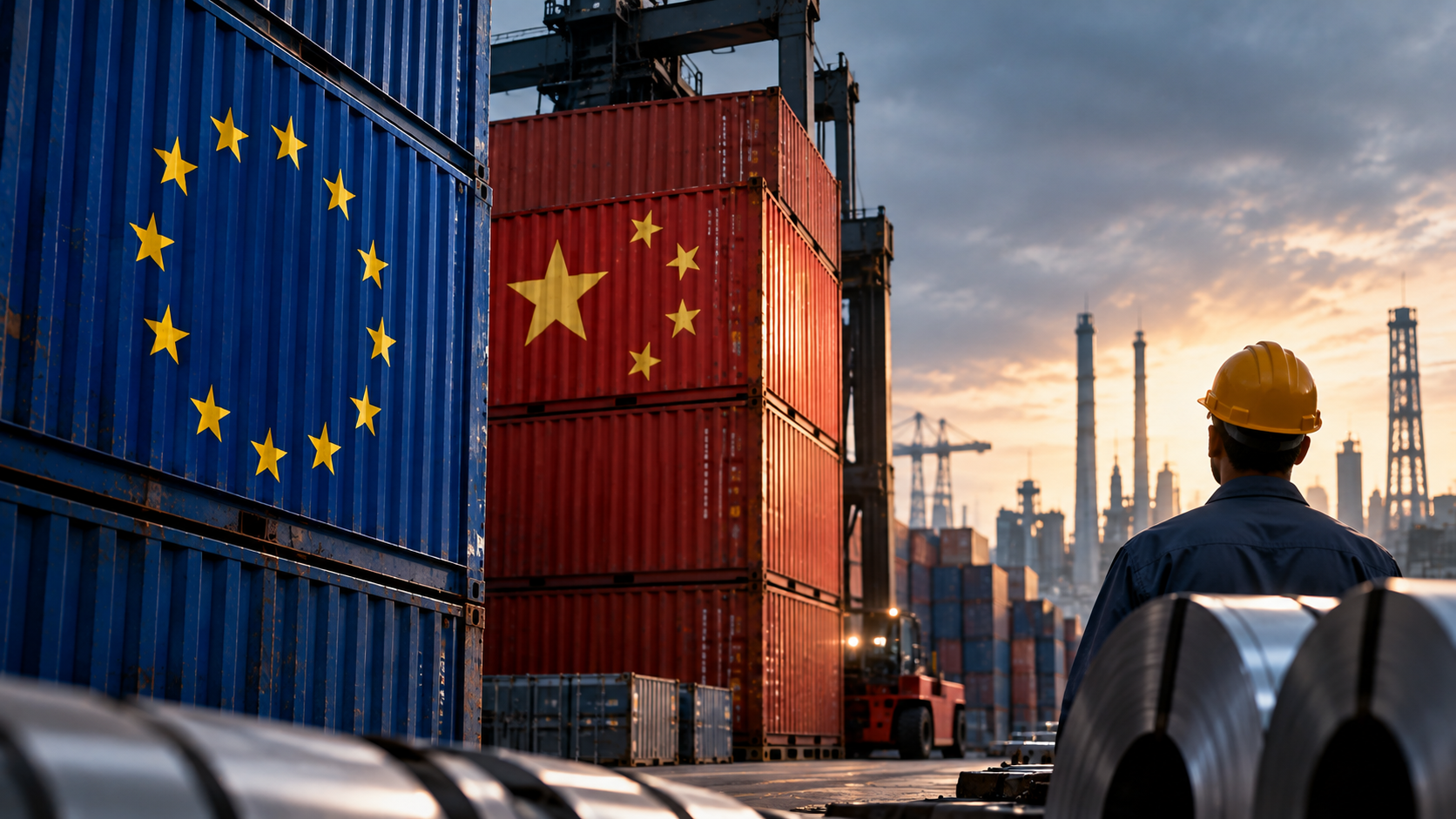
- The European Union arrives in the Chinese capital with a mission to compel Beijing to take concrete measures to mend a $360B annual deficit (roughly $1B a day); otherwise, the EU will take defensive measures.
- Over the previous five years, Chinese exports to the EU have grown by 50% while EU exports to China have fallen by 30%.
- This poses a direct threat to make India’s Make in India initiatives meaningless, as its manufacturing and new EV startups can be undercut by a sudden influx of artificially low-priced Chinese electronics, automotive parts, and machinery.
- Navigating the new paradigm requires extreme agility, where New Delhi must quickly insulate its domestic markets from the collateral damage of diverted Chinese exports, and simultaneously roll out the red carpet to the fleeing European capital.
As Europe’s Trade Commissioner Maroš Šefčovič and Chinese Commerce Minister Wang Wentao meet in Beijing for two days of high-level negotiations on October 8th and 9th, 2026, the global macroeconomic order finds itself at a crossroads. The European Union arrives in the Chinese capital with a mission to compel Beijing to take concrete measures to mend a $360B annual deficit (roughly $1B a day); otherwise, the EU will take defensive measures. This signals the end of the free-trade orthodoxy of Europe and the beginning of the “economic security” era. However, the repercussions of this high-stakes negotiation stretch far beyond the Eurasian landmass. As Europe seeks to de-risk its supply chains and impose higher trade barriers against state-subsidised Chinese manufacturing, the inevitable reshuffling of global trade will entail both challenges and once-in-a-generation opportunities for emerging economic powerhouses such as India.
For years, the European approach to China has oscillated between viewing it as an essential strategic partner and a system rival. However, the reality of the math has forced Brussels into a combative position where it must force Beijing to mend an increasingly untenable trade account. Over the previous five years, Chinese exports to the EU have grown by 50% while EU exports to China have fallen by 30%. The EU buys $1B more a day from China than it sells it. Chinese domestic consumption only comprises 13% of global consumption, but China holds 45% of the world’s industrial output. With the U.S. systematically sealing its doors to receiving Chinese overcapacity, Europe becomes the last viable open market that can absorb massive amounts of industrial overstock. Šefčovič’s talks with Wang Wentao attempt to address this imbalance with “structural engagement” to avoid an outright trade war, but patience in Brussels has worn thin. The European Parliament overwhelmingly voted in a resolution on October 7th, 2026, in a 454 to 86 vote expressing the will of the EU to seek economic reciprocal measures if Beijing does not loosen its belt.
The current $1B daily deficit is primarily driven by massive influxes of heavily competitive Chinese goods in crucial sectors. The venerable auto industry, Europe’s old crown jewel, is finding itself in an existential crisis as Chinese plug-in hybrids enjoy an 86% increase in imports through September 2026 and battery electric cars see a massive 40% increase in imports despite tariffs. Crucially, Chinese plug-in hybrid prices enjoy a 20% decrease on average, enabling them to undercut the European legacy automakers and cause massive job losses at firms such as Volkswagen. At the same time, while flooding the European single market with finished goods such as electric cars, solar panels, and vital machinery, Beijing has simultaneously cracked down on the exports of rare earths and critical minerals. These materials are the lifeblood of the European clean-energy revolution, semiconductor manufacturing, and the digital economy. Šefčovič has specifically warned that the resource “chokehold” would be a central grievance during the Beijing talks.
Faced with what politicians across the 27-nation bloc see as an existential threat to their core industries, the European Commission is preparing for unprecedented counter-measures. Recently, France and Germany sent a joint letter calling for a comprehensive rethink of the EU’s China policy, including deploying the EU’s newly minted, never-before-used legal instrument known as the Anti-Coercion Law, or the “trade bazooka”, which would enable the EU to block or restrict trade or investments from countries that are unduly forcing economic pressure upon member states or corporations. In addition, there is growing momentum in Brussels think tanks, such as the European Policy Centre, to set up a robust trade investigation body modelled off of the U.S.’s Section 301 of the Trade Act, which would enable broad-based retaliatory levies. Understanding the threat, China has promised countervailing measures, recently launching an anti-dumping inquiry on EU chemical imports and warning that any ‘Made in Europe’ legislative plans will meet swift retaliation.
The growing economic friction between the EU (India’s largest trading partner) and China (India’s geopolitical rival) is having profound implications on the global industrial order. For Indian policymakers and corporates, this presents both risks and opportunities across three major vectors:
The immediate threat of trade diversion and “Dumping”
“If the EU successfully constructs substantial tariff walls to Chinese green-tech, basic metals, and chemicals, China’s massive over-capacity will not simply disappear, but instead be redirected. Just as China aggressively redirected exports to Europe after U.S. tariffs arose, it is expected that Beijing will seek to target vast consumer markets such as India to divert its massive over-capacity.” This poses a direct threat to make India’s Make in India initiatives meaningless, as its manufacturing and new EV startups can be undercut by a sudden influx of artificially low-priced Chinese electronics, automotive parts, and machinery. New Delhi must be prepared to quickly put in place anti-dumping duties and measures to protect its domestic ecosystem from artificial price suppression.
Accelerating the “China Plus One” and Friend-Shoring Opportunities
Conversely, Europe’s urgent mandate to diversify its supply chains away from a Beijing-centric approach presents a generational opportunity for Indian manufacturing. As Šefčovič noted, Europe cannot simply construct an autarchy, but must secure new markets. The pressure on Europe to re-shore or “friend-shore” presents an opportunity for India to absorb significant supply chain migration. India appears to have the demographic scale, emerging infrastructure, and regulatory frameworks such as the Production Linked Incentive scheme that would absorb massive supply chain migrations. We have seen the EU actively prioritise alternate markets, with Šefčovič already secretly securing significant trade deals with nations such as India, Indonesia, and Thailand to offset its over-reliance on Beijing. Sectors such as pharmaceuticals, electronics, and speciality chemicals in India are poised to receive a surge of European Foreign Direct Investment (FDI).
Collaborative Resilience in Critical Minerals
The EU’s alarm over China’s monopoly on rare-earth exports is a strategic vulnerability that India shares. India’s own aspirations to cultivate a sovereign semiconductor industry and transition to renewable energy is reliant on the very same constrained supply chains. The friction between Brussels and Beijing would most likely act as a catalyst for a stronger EU-India strategic partnership in securing, extracting, and processing critical minerals. By pooling capital and coordinating through alliances such as the Quad and bilateral agreements with the EU, India and the EU could jointly underwrite the massive capital expenditure required to set up alternative mineral supply chains that are independent of Chinese influence.
The summit between Maroš Šefčovič and Wang Wentao is not only a crucial diplomatic exercise, but also a stress-test of the global economic order. The era of unmitigated European market openness has ended and has been replaced by a defensive posture that prioritises industrial survival. Navigating the new paradigm requires extreme agility, where New Delhi must quickly insulate its domestic markets from the collateral damage of diverted Chinese exports, and simultaneously roll out the red carpet to the fleeing European capital.
References:
- Japan Times. (2026, Oct 08). EU takes firmer stance on China’s trade practices as Beijing talks begin.- https://www.japantimes.co.jp/business/2026/10/08/economy/eu-china-trade-gap-talks/#:~:text=The%20European%20Union%20is%20striking%20a%20more,deficit%20that%20exceeds%20%241%20billion%20a%20day.
- The Hindu. (2026, Oct 08). EU sends envoy to Beijing as rising exports from China raise economic anxiety. https://www.thehindu.com/news/international/eu-sends-envoy-to-beijing-as-rising-exports-from-china-raise-economic-anxiety/article71558543.ece#:~:text=China%20diverted%20many%20of%20its%20exports%20to,if%20China%20does%20not%20open%20its%20markets.%E2%80%9D
- BigGo Finance. (2026, May 17). EU Trade Chief Sefcovic: China Deficit Hits €1 Billion a Day. https://www.kucoin.com/news/flash/eu-seeks-to-cut-1-billion-daily-trade-deficit-with-china-in-beijing-talks
- KuCoin. (2026, Oct 08). EU Seeks to Cut €1 Billion Daily Trade Deficit with China in Beijing Talks. https://www.kucoin.com/news/flash/eu-seeks-to-cut-1-billion-daily-trade-deficit-with-china-in-beijing-talks
- The Annapurna Express. (2026, Oct 08). EU-China trade talks begin in Beijing amid escalating pressure. https://theannapurnaexpress.com/story/67748/

Parag Gilada is a Master’s student at IISM Mumbai in Sports Management, with a bachelor’s from OP Jindal Global University in Global Affairs, with an interest in Sports Diplomacy and Governance. Views expressed are the author’s own.
 Aayush Pal
  Archita Gaur
  Hridbina Chatterjee