
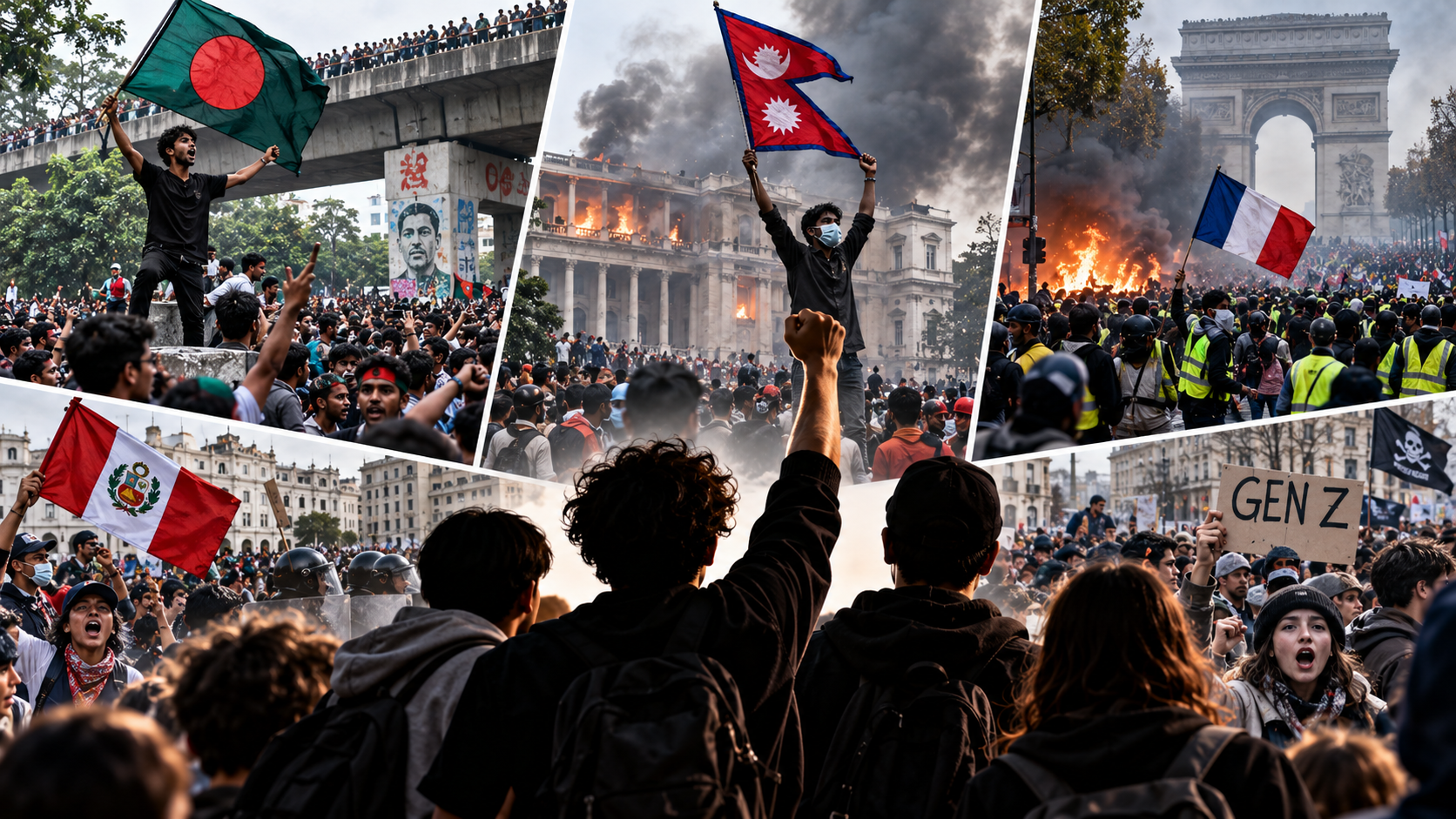
- The simultaneous emergence of these movements raises a fundamental question: have protests become a pretext for political actors to advance their interests across countries, and who ultimately benefits from the so-called Gen Z protest wave?
- The involvement of established political actors raises questions about whether genuine public concerns are being used by individuals and groups already belonging to the political class.
- The possibility that genuine grievances are being exploited cannot be dismissed, but neither can it be treated as established fact without concrete evidence.
- The challenge is to distinguish legitimate dissent from attempts to exploit it, ensuring that the right to protest is protected without allowing violence or manipulation to go unexamined.
The global Gen Z movement has gained momentum, with young people taking to the streets and questioning their respective governments. Protests have always been an important feature of democracy, but the emergence of a new wave of youth-led demonstrations across different countries has raised questions about their causes, political direction and wider consequences. The phenomenon gained particular attention in 2025, when protests in Bangladesh and Nepal brought significant political developments, including the removal of established political leadership. However, it is important to note that the violence witnessed during these demonstrations was not necessarily representative of every participant or the original grievances that brought people onto the streets.
The simultaneous emergence of these movements raises a fundamental question: have protests become a pretext for political actors to advance their interests across countries, and who ultimately benefits from the so-called Gen Z protest wave?
India: Genuine Grievances and the Question of Political Capture
One of the major talking points in the current wave of protests has been India, where the newly formed, youth-led Cockroach Janta Party has taken to the streets to challenge the government. The movement had previously organised demonstrations over educational grievances, questioning the state of educational infrastructure and the lack of accountability in the examination system. Concerns over repeated paper leaks in competitive examinations, including NEET, have raised serious questions about the integrity of examinations across India.
These grievances deserve attention. However, the question is whether a movement that presents itself as an independent voice of the youth can remain independent of the political establishment. The involvement of established political actors raises questions about whether genuine public concerns are being used by individuals and groups already belonging to the political class. In such circumstances, a legitimate movement can become a Trojan horse for those seeking to advance their own political interests.
The latest demonstrations have further intensified this debate, with the Cockroach Janta Party demanding the resignation of Chief Election Commissioner Gyanesh Kumar over alleged irregularities and a lack of transparency in the electoral process, particularly the Special Intensive Revision (SIR) of electoral rolls. A report by The Indian Express concerning disagreements among election commissioners over aspects of the process has added to the controversy. However, allegations of electoral manipulation must be distinguished from established evidence. The scale of India’s electoral exercise and the integrity of its voting procedures remain important considerations in assessing these claims.
The protests therefore raise questions about whether the movement is functioning as an independent political voice or increasingly serving as a platform for opposition forces. The disruption of public infrastructure, obstruction of daily commuting, and the resulting economic costs also deserve scrutiny. Genuine grievances do not automatically justify violence or the destruction of public property.
France and Europe: When Protests Turn Violent
A similar pattern of youth-led demonstrations has emerged in France and other European countries, including Belgium, Portugal and Spain. These protests have centred on issues such as education, the rising cost of living and public services. However, the escalation of some demonstrations into violence raises questions about whether the protests have remained focused on their original demands.
In France, demonstrations have been accompanied by clashes with police, arson, looting and damage to public and commercial infrastructure. According to reporting published by AFP on October 19, 2026, nearly 2,400 people were arrested during the unrest, while almost 1,000 police officers and gendarmes were injured. The historic town hall in Limoges was set on fire, while businesses and other public facilities were damaged or looted in several cities.
The scale of the damage had already become evident earlier in October. Euronews reported on October 4 that approximately 400 to 500 secondary schools were expected to be fully or partially closed amid the demonstrations, with 24 schools reported to have been burned or vandalised. The French Justice Ministry subsequently stated that damage to educational establishments and urban infrastructure had reached several million euros by October 5. These figures reflect reported damage at different stages of the unrest; a comprehensive nationwide assessment of the total damage from the subsequent demonstrations was not available in the cited reports.
The question, therefore, is whether the protests have remained focused on education, public expenditure and the cost of living, or whether sections of the demonstrations have become a vehicle for wider disorder. Students have every right to question the government and demand accountability, but attacks on police officers, the destruction of public infrastructure and the looting of commercial establishments cannot be justified merely by invoking legitimate grievances.
The developments in France raise a fundamental question about the nature of the protests. When demonstrations over education and economic concerns escalate into arson, looting and attacks on public institutions, it becomes necessary to distinguish peaceful protesters from those engaging in violence. The scale of the damage also demonstrates how such incidents can disrupt daily life and impose economic costs on ordinary citizens.
However, the presence of violence alone does not establish that the protests have been organised by external actors. The possibility that political groups or other actors are exploiting the demonstrations must be examined through evidence rather than assumption. The broader question remains whether genuine public dissatisfaction is being used as a pretext to create instability.
Who Is Pulling the Strings Behind the Gen Z Protest Wave?
One of the biggest questions surrounding the global Gen Z protest wave is whether these movements are entirely independent or whether they are being exploited by political actors seeking to create unrest. The fact that protests have emerged across several countries within a relatively short period raises questions about the role of digital platforms, political networks and the circulation of narratives across borders.
The violence witnessed in some of these demonstrations also raises concerns about whether the original grievances have been overshadowed by wider political objectives. In India, the involvement of established political actors in youth-led movements raises questions about political independence. In France, the destruction of public infrastructure and commercial establishments has intensified the debate over whether the protests have moved beyond their stated demands.
The possibility that genuine grievances are being exploited cannot be dismissed, but neither can it be treated as established fact without concrete evidence. Establishing whether an external actor is directing a movement requires evidence of coordination, financing or operational involvement. Similar slogans, the timing of demonstrations or the circulation of protest-related material do not, by themselves, establish a common organising force.
Dissent, Democracy and the Limits of Protest
It is important to understand that dissent is a constitutional and democratic right. Questioning the government, demanding accountability and protesting against public grievances are essential features of democratic societies. However, this right does not justify violence against police officers, destruction of public infrastructure or the deliberate disruption of essential public services.
The developments in India and Europe raise fundamental questions about the direction of the global Gen Z protest wave. Are these movements independent expressions of public dissatisfaction, or are some being used as instruments by political actors seeking to create instability? Who benefits when legitimate grievances turn into prolonged disorder, and what evidence exists to establish whether such developments are being deliberately orchestrated?
These questions require careful examination. Genuine grievances must be addressed, while violence and the destruction of public property must be assessed independently of the political causes invoked by demonstrators. The challenge is to distinguish legitimate dissent from attempts to exploit it, ensuring that the right to protest is protected without allowing violence or manipulation to go unexamined.

Aayush Pal is a freelance writer on contemporary geopolitical developments. The views expressed in his work are entirely his own.
 Archita Gaur
 Piyush Anand
 Parag Gilada