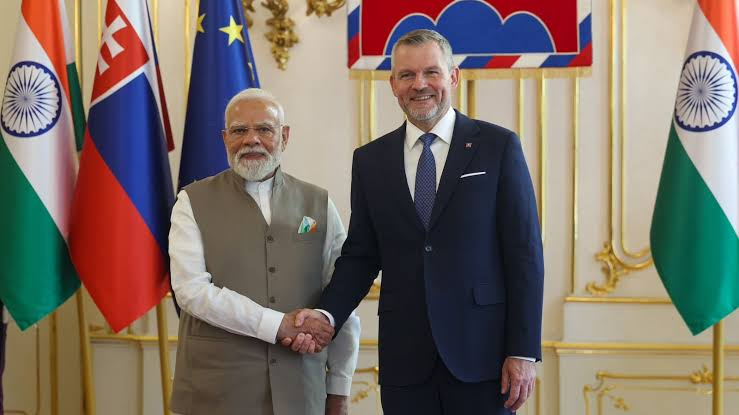
- India’s elevation of its relations with Slovakia to a Comprehensive Partnership level and bilateral discussions on defence cooperation, hi-tech manufacturing, technology and trade all indicate a burgeoning Indian interest in stabilising contacts with Central and Eastern Europe.
- The strategic importance of Slovakia lies not in its size but in its ability to serve as a partner in India’s larger economic and geopolitical relations with Europe, as well as in technological cooperation.
- The visit to Slovakia is a clear indication that the European policy of India is no longer limited to the traditional power axis on the continent.
On 10 June 2026, Prime Minister Narendra Modi became the first Indian Prime Minister to visit Slovakia since the country was established in 1993. While the visit might not have garnered the same global attention as meetings with the big powers the US, France, Germany- its importance lies exactly in what it is showing us about India’s foreign policy trajectory. India’s elevation of its relations with Slovakia to a Comprehensive Partnership level and bilateral discussions on defence cooperation, hi-tech manufacturing, technology and trade all indicate a burgeoning Indian interest in stabilising contacts with Central and Eastern Europe.
In terms of traditional engagement, the focus of India’s engagement with Europe has been on the major Western European economies. But shifting geopolitics, supply chain diversification, and the impetus to align with trustworthy strategic partners have pushed New Delhi to widen its diplomatic reach. Slovakia, located at the centre of Europe, with a robust industrial and defence manufacturing industry, is a new player in this scheme.
So, Modi’s visit is more than just bilateral diplomacy. It is part of a broader effort by India to enhance its profile in central Europe and expand economic and security ties, and to develop a more pan-European relationship. In an era of shifting global power dynamics, the India-Slovakia relationship provides a lens through which to view New Delhi’s reoriented approach to Europe in the twenty-first century.
Why does Slovakia matter to India?
At first glance, Slovakia highlights look to be a strange priority in India’s overtures towards Europe. With a population barely above five million and a fairly low-key international profile, it is frequently dwarfed by the continent’s bigger economies. However, its strategic significance is tied in part to the nature of its economy, location, and increasing importance in European supply chains.
Located in the heart of Europe, Slovakia serves as a gateway to the European Union market and possesses a highly developed industrial base. Slovakia is among the world’s leading automobile producers on a per-capita basis, hosting major manufacturing facilities for Volkswagen, Kia, Stellantis, and Jaguar Land Rover. With India wanting to plug further into global value chains and attract foreign investment as part of initiatives like ‘Make in India,’ alliances with high-tech manufacturing countries like Slovakia are only going to get more significant, not less.
Alongside and as part of its economic cooperation, Slovakia’s role within the European Union and NATO gave India a further lever to enable enhancement with European institutions. In an era when New Delhi looks to widen its presence across the continent, building ties with countries in Central Europe enables India to spread its partnerships beyond traditional interlocutors like France and Germany.
The strategic importance of Slovakia lies not in its size but in its ability to serve as a partner in India’s larger economic and geopolitical relations with Europe, as well as in technological cooperation.
Defence and Economic Cooperation: The Pillars of the Partnership
Prime Minister Modi’s visit also resulted in an agreement on deepening cooperation in the defence and industrial sectors, bringing out the enhanced strategic aspect of India-Slovakia relations. Both countries also signed a Letter of Intent on defence cooperation, indicating a willingness to discuss cooperation in defence production, technology transfer, and industrial links. This is in line with India’s larger aim of upgrading its armed forces and increasing domestic manufacturing under the ‘Atmanirbhar Bharat’ banner.
Slovakia has an advanced defence industry and is especially strong in the field of armoured vehicles, artillery systems and military technologies. For India, dealing with such European specialised defence producers means an opportunity to diversify sources of procurement and to consider joint production arrangements. With long-term geopolitical uncertainties continuously reshaping the dynamics of global security, fostering resilient defence partnerships with trusted allies has emerged as a greater focus of India’s foreign policy.
Economic coordination also attracted much attention during the stay. They centred on trade, investment, innovation, digital technology and advanced manufacturing. Both sides identified potential for enhanced cooperation in the areas of automobile manufacturing, clean energy, artificial intelligence, as well as R&D. These fields enhance India’s vision to become an international manufacturing and technology centre, and Slovakia to expand its economic ties with one of the world’s rapidly growing biggest economies.
In sum, they underline the fact that India-Slovakia relations are shifting from conventional diplomatic interactions towards a more meaningful engagement that is based on common economic and strategic interests.
India’s Central Europe Strategy: Beyond Traditional Partners
The significance of Modi’s Slovakia visit ultimately lies in what it reveals about India’s evolving approach towards Europe. India has traditionally engaged with the continent in a way that is largely confined to the major powers of Western Europe, including France, Germany, and the United Kingdom, for decades. Although these ties are still essential, New Delhi is increasingly aware of the strategic advantage in forging ties with smaller but still economically vibrant countries within Central and Eastern Europe.
This rebalancing is spurred by both economic and geopolitical factors. The breakdown of global supply chains, intensifying competition between major powers, and the need to find trustworthy economic partners have led India to expand its global outreach. Countries like Slovakia provide access to specialised industrial competencies, new technology fields and key players at the European Institution level. Deepening bilateral relations with these countries thus enables India to expand its footprint on the European continent as well as counter-balance an over-dependence on a handful of partners.
The increasing significance of Central Europe is also indicative of wider geopolitical shifts. With the European Union aiming to address vulnerabilities in critical supply chains and to diversify economic partners, India has appeared as a natural partner. For New Delhi, its engagement with Central European countries is a chance to expand its footprint in the larger European matrix without putting too much diplomatic muscle into just a few key capitals.
The outreach also complements India’s attempt to scale up dialogue with the European Union (EU) amidst the revival of negotiations on a broad-based India-EU free trade agreement. Deepening engagement with Central European states through better cooperation can produce political goodwill and open up new opportunities to work together in the trade, technological, connectivity, and security sectors. India, rather than treating Europe as a monolith composed of its biggest powers, is opening up a more complex and regionally-minded approach.
Seen in this light, the visit to Slovakia is not just a diplomatic milestone. It is indicative of a larger readjustment in India’s European policy—a readjustment that includes expanding the strategic options available to India, increasing India’s economic resilience, and presenting India as a bigger player in a changing global order.
Conclusion
Although Prime Minister Modi’s visit to Slovakia did not produce the headlines that engagements with larger powers might have been associated with, its strategic importance cannot be underestimated. The two countries have now established the basis for a more meaningful partnership by raising bilateral relations to a higher level and taking cooperation in defence, technology and manufacturing forward. More significantly, the tour demonstrates India’s increasing attention towards Central Europe, as part of a wider strategy aimed at diversifying its diplomatic and trade relations throughout the continent. The visit to Slovakia is a clear indication that the European policy of India is no longer limited to the traditional power axis on the continent. In what is seen as New Delhi’s pursuit of economic resilience and strategic flexibility, Central Europe will probably see its position on India’s diplomatic map grow.
References:
- Central European Institute of Asian Studies. (2025, November 4). Slovakia’s lagging relationship with India: It’s time for a coherent strategy.
- Ministry of External Affairs, Government of India. (2026, June 9). Visit of Prime Minister to France and Slovakia (June 13–18, 2026).
- NDTV. (2026, June 15). India, Slovakia forge comprehensive partnership in PM Modi’s first visit.

Archita Gaur is a postgraduate student at the School of International Studies, JNU. She specialises in the World Economy and has a strong interest in public policy, economic research, and governance. The views expressed are the author’s own.
 Anjali Singh
  Aayush Pal