
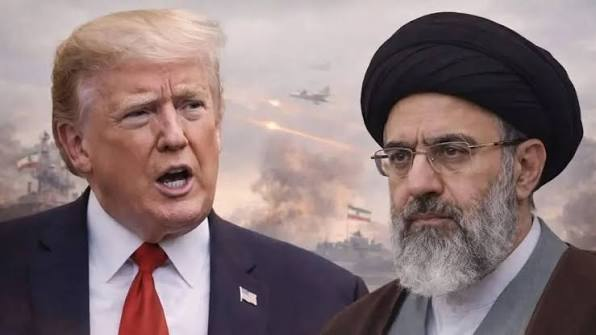
- Both Iran and the United States of America have agreed to a Memorandum of Understanding.
- As per the agreement, the United States of America will remove the maritime blockade on Iran, while Iran, on the other hand, will allow free and inclusive movement through the Strait of Hormuz.
- For the first time in seven years, Iran will be able to sell its oil in the global market.
- Mediators such as Qatar have expressed hope that this temporary Memorandum of Understanding will eventually develop into a long-term peace arrangement for the region.
After long months of uncertainty, geopolitical instability, and a crisis that was once considered too complicated to be resolved, the crisis in Hormuz has finally witnessed a breakthrough. Both Iran and the United States of America have agreed to a Memorandum of Understanding.
This comes as President Trump visited France to attend the G7 Summit and, on the sidelines of the event, agreed to the understanding. The memorandum was signed electronically, and according to Iranian sources, no official signing ceremony will be conducted.
The war, which began on February 28, created an unprecedented crisis and pushed the global economy towards recession. It has now temporarily come to a halt. As per the agreement, the United States of America will remove the maritime blockade on Iran, while Iran, on the other hand, will allow free and inclusive movement through the Strait of Hormuz.
The United States will also remove restrictions imposed on Iranian crude exports. For the first time in seven years, Iran will be able to sell its oil in the global market. This is a major relief not just for Iran but also for countries across West Asia that have suffered due to the maritime blockade in the Hormuz.
However, some critical questions still remain. One of the biggest concerns is the future of Iran’s nuclear programme. Iran has remained firm that it will not allow its enriched uranium to be exported to a third country. At the same time, Tehran is not necessarily in favour of diluting its enriched uranium stockpile.
Interestingly, President Trump made a surprising remark in Paris, stating that he is comfortable with Iran possessing enriched uranium for the generation of electricity. He went on to say that if other countries are permitted to do so, then why should Iran be treated differently? This marks a significant shift in Trump’s position, as for months he had maintained that Iran should not possess a nuclear weapon. Iran, meanwhile, has consistently maintained that it has no intention of developing one.
Iran has also been clear that Lebanon should be included in the ceasefire framework and that Israel should not continue its offensive in southern Lebanon. Tehran has demanded an Israeli withdrawal from southern Lebanon. However, Israel has stated that its actions in southern Lebanon are independent of the Memorandum of Understanding signed between Iran and the United States.
Therefore, several critical questions still stand between Iran and the United States. Nevertheless, the signing of this agreement is undoubtedly positive news for the global economy. Not only will oil once again flow more freely into international markets, but the energy scarcity that had emerged globally could also gradually ease. While immediate relief should not be expected, the agreement is certainly a step in the right direction.
Another question that remains is whether Iran will receive the proposed economic package worth $300 billion. The United States has made it clear that unless Iran fulfils all commitments under the ceasefire arrangement, not a single cent will be released.
Mediators such as Qatar have expressed hope that this temporary Memorandum of Understanding will eventually develop into a long-term peace arrangement for the region. Such an outcome would help ensure energy stability, reduce tensions, and prevent further conflict across West Asia.

Kumar Satish is a postgraduate in International Relations with a keen interest in reading and writing on geopolitical affairs.
 Anjali Singh
  Aayush Pal