
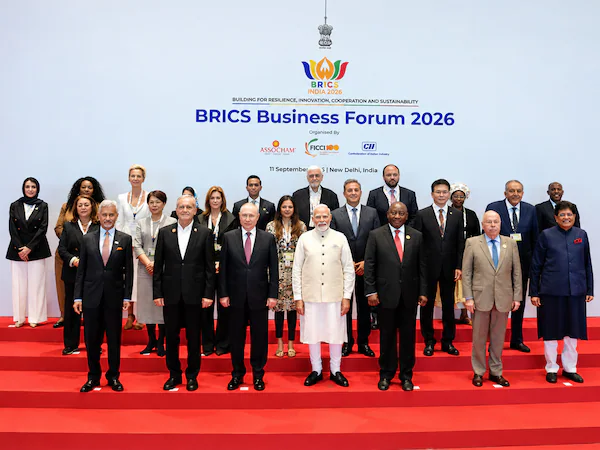
- The reason India’s presidency was particularly significant is that despite a deeply divided house and sharp differences between BRICS members, whether between Iran and the United Arab Emirates or between India and China, the members were able to adopt the New Delhi Declaration.
- Since BRICS is increasingly considered a voice of the Global South, this year’s summit also provided an opportunity for member countries to push for major reforms in global institutions.
- The summit provided Prime Minister Narendra Modi with a major diplomatic opportunity.
- The 2026 BRICS Summit was therefore not just a geopolitical victory for India. More importantly, it demonstrated how important BRICS has become for India and for the Global South in the current geopolitical scenario.
At a time when geopolitical tensions across countries have been at an all-time high and conflicts have become increasingly frequent, a common representation was seen when India hosted the 18th BRICS Summit in New Delhi, showcasing remarkable leadership and diplomatic objectives in a divided and contested world order. The summit was important in many ways, as BRICS is no longer just considered a new reality of the geopolitical world; it has become one of the biggest contributors to the world economy, with the participation of some of the world’s most populated countries. Collectively, BRICS represents around 49% of the world’s population and a significant share of global GDP, making it one of the biggest geopolitical realities of the world in terms of its geographical, economic and political representation. The summit was particularly important as several heads of state and government from BRICS member countries were in India. Among the notable figures was Russian President Vladimir Putin, whose visit was his second trip to India in less than 10 months, which speaks volumes about the growing ties between India and Russia. One of the major highlights of the summit was the participation of Chinese President Xi Jinping, who was on his first visit to India after 7 years. This was also his first visit to India since the Galwan conflict, making his presence particularly significant for the bilateral relationship between India and China. Another major talking point was the participation of Iranian President Masoud Pezeshkian. This was important because Iran has been involved in active conflict, while Russia also remains involved in the war in Ukraine. The summit therefore brought together 2 countries that are directly involved in major ongoing conflicts. At the same time, the participation of the UAE’s leadership was also significant. The presence of both Iran and the UAE highlighted the geopolitical complexity of BRICS, particularly given the tensions and competing interests between countries in the Middle East. In many ways, the BRICS Summit had everything that a major geopolitical summit should have: global participation, political importance, controversies and major outcomes. Considering all of this, there could not have been a better presidency for this year’s BRICS Summit than India.
India’s Leadership and the New Delhi Declaration
The reason India’s presidency was particularly significant is that despite a deeply divided house and sharp differences between BRICS members, whether between Iran and the United Arab Emirates or between India and China, the members were able to adopt the New Delhi Declaration. This was a major success for India, especially because this was the second time in a short period that India successfully hosted a major global geopolitical event and managed to achieve a common declaration. A similar example was seen in 2023, when India hosted the G20 Summit and successfully adopted the New Delhi Leaders’ Declaration. The New Delhi Declaration covered global governance, security, trade, finance, technology and sustainable development. Since BRICS is increasingly considered a voice of the Global South, this year’s summit also provided an opportunity for member countries to push for major reforms in global institutions. BRICS countries argued that the Global South needs greater representation and a stronger voice in organisations such as the World Bank, IMF and United Nations. There was also a major push regarding de-dollarisation, with member countries reiterating the importance of increasing trade in local currencies, particularly in cross-border transactions, and continuing cooperation on payment systems. This becomes extremely important because some BRICS members have been directly affected by Western sanctions, with Russia and Iran being 2 major examples. Their experience with sanctions has highlighted the vulnerability of countries that remain heavily dependent on a global financial and trading system centred around Western institutions. This has been a learning lesson for other BRICS members about the importance of greater independence in trade and financial transactions. However, it is important to understand that no consensus has been reached on creating a common BRICS currency. Although discussions around reducing dependence on the US dollar have continued, BRICS has not adopted a common currency.
Security, Global Issues and the BRICS Agenda
On the major security issues discussed at the summit, the New Delhi Declaration also called for restraint and diplomatic solutions to ongoing conflicts, particularly in the Middle East. BRICS members called for dialogue and diplomatic efforts to resolve conflicts rather than further escalation. This becomes particularly important because 2 BRICS members, Iran and the UAE, are directly connected to the security dynamics of the Gulf region. Political stability in the region is therefore important not only for the countries involved but also for BRICS as a whole. Another major outcome for India was the position taken by BRICS members on terrorism. The declaration reaffirmed a zero-tolerance approach towards terrorism and called for greater international cooperation against terrorism. This becomes particularly important for India because terrorism has been one of the country’s major security concerns, particularly terrorism originating from Pakistan. India therefore used its leadership of BRICS to push for a stronger and more unified position against terrorism and to encourage member countries to be more willing to engage in counter-terrorism cooperation. Another important discussion at the summit was cooperation in artificial intelligence. Member countries agreed on the need for greater cooperation within BRICS in the fields of artificial intelligence, digital technology and innovation. The countries also discussed other contemporary issues and agreed on greater engagement through the New Development Bank, which remains one of the major institutional achievements of BRICS. Member countries also agreed to increase people-to-people interaction and maintain a greater focus on climate change and sustainable development. One symbolic moment after the group photograph was when Prime Minister Narendra Modi and other BRICS leaders planted a tree. This was a small but significant gesture reflecting India’s emphasis on climate action, sustainability and collective responsibility.
Bilateral Diplomacy: Modi’s Major Meetings
However, one of the biggest headlines from the BRICS Summit came from the bilateral meetings held on the sidelines. The summit provided Prime Minister Narendra Modi with a major diplomatic opportunity. Over the course of around 48 hours, Modi held meetings with more than a dozen world leaders, including the leaders of China, Russia and Iran. The most closely watched bilateral meeting was between Prime Minister Narendra Modi and Chinese President Xi Jinping. Both leaders agreed that differences between the 2 countries should not be allowed to turn into disputes and reiterated that stronger India-China relations are important for strengthening BRICS. This meeting was particularly significant given the recent improvement in India-China relations. Since 2023, both countries have gradually worked towards stabilising their relationship, particularly by addressing the border situation and looking for areas where both sides can find mutually beneficial solutions. An improvement in India-China relations is important not only for the 2 countries but also for the wider geopolitical balance. Together, India and China represent more than 2.8 billion people and are among the world’s largest economies. Their ability to manage differences while cooperating on global issues has significant implications for BRICS and the wider Global South. Another major bilateral meeting took place between Prime Minister Narendra Modi and Russian President Vladimir Putin. This was the third meeting between the Indian Prime Minister and the Russian President in the span of around 10 months and speaks strongly about the importance that both countries continue to attach to their relationship. Both countries reiterated the importance of their strategic partnership and discussed strengthening bilateral economic engagement, trade and other areas of cooperation. There was also an understanding of the need to diversify and further expand the relationship beyond its traditional areas. Another important bilateral meeting was between Prime Minister Narendra Modi and Iranian President Masoud Pezeshkian. This particular meeting attracted considerable attention because of the warm manner in which Prime Minister Modi welcomed the Iranian President. Modi was seen holding Pezeshkian’s hand before their bilateral meeting, which became one of the notable visual moments of the summit. Iran is strategically important for India because of its geographical position and India’s connectivity ambitions towards Central Asia. Iran is also important for India from an economic and energy perspective. India has invested heavily in the Chabahar Port, which provides India with an important connectivity route towards Afghanistan and Central Asia. However, the war and the sanctions policy of the United States have complicated India’s economic engagement with Iran and affected the pace of cooperation. The bilateral meeting therefore provided an opportunity for India and Iran to reaffirm their understanding and continue working on their strategic relationship. There are, however, differences between India and Iran. India has at times expressed concerns about Iran’s approach towards Pakistan and has expected Tehran to maintain a more independent position when dealing with issues involving India and Pakistan. Despite these differences, India continues to see Iran as an important strategic partner because of its geography, connectivity, energy resources and role in India’s wider Central Asian strategy.
India’s Geopolitical Victory and the Future of BRICS
The 18th BRICS Summit, by all means, had everything. It had geopolitical significance, bilateral importance, differences between member countries, major global issues and important outcomes. More importantly, India used the summit to engage with the Global South and continuously send a clear message that it is emerging not only as an important member of the Global South but also as one of its stronger voices. Prime Minister Modi’s willingness to take up the concerns and aspirations of the Global South and engage with other BRICS countries itself demonstrates how important BRICS has become for India. The 2026 BRICS Summit was therefore not just a geopolitical victory for India. More importantly, it demonstrated how important BRICS has become for India and for the Global South in the current geopolitical scenario.

Aayush Pal is a freelance writer on contemporary geopolitical developments. The views expressed in his work are entirely his own.
 Kumar Satish
  Anjali Singh