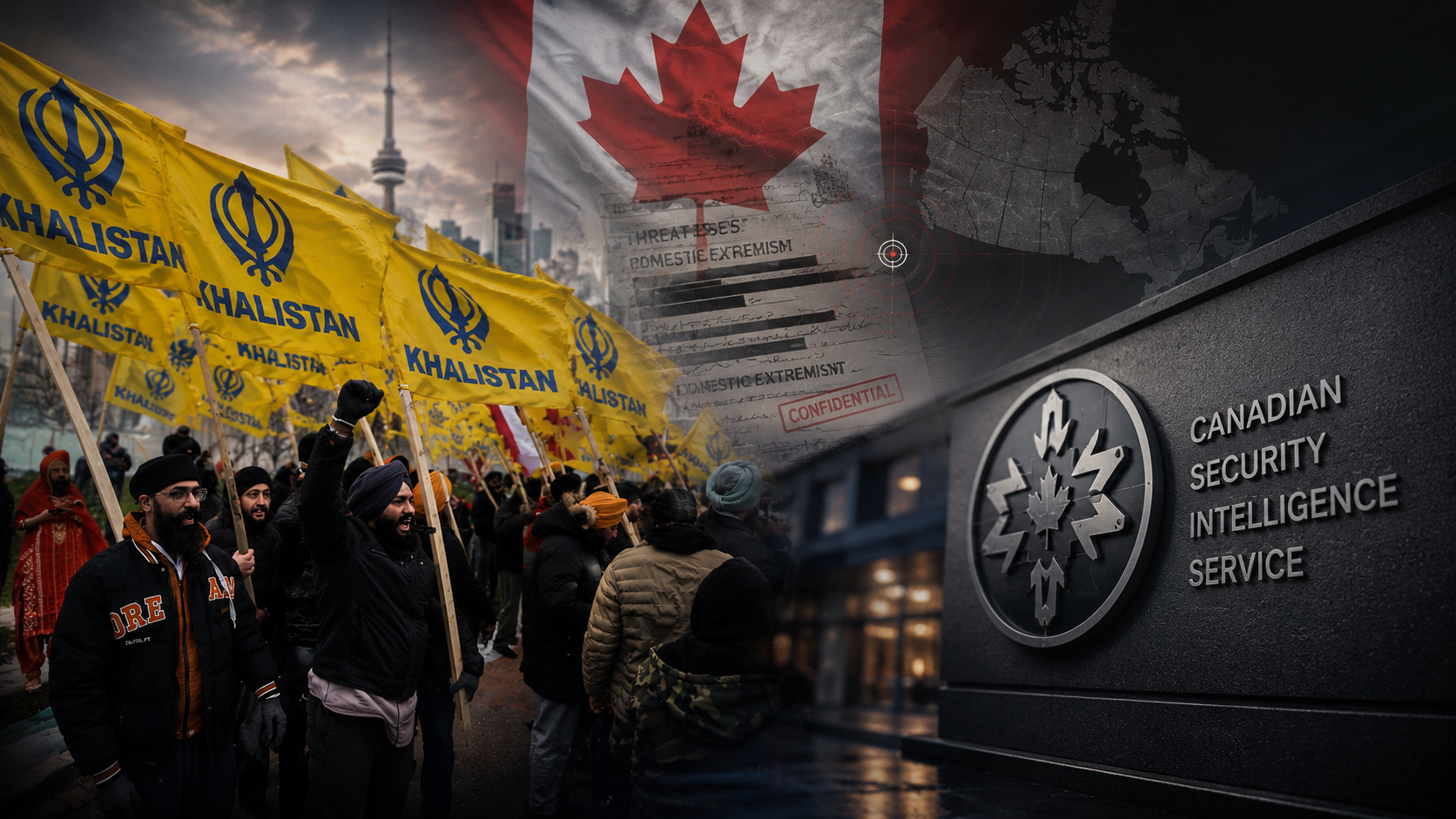
- Canada’s intelligence agency has identified Khalistani terrorism as a national security threat within Canada.
- Bilateral relations deteriorated sharply in 2023 when Trudeau accused the Indian government of involvement in the killing of Hardeep Singh Nijjar. India firmly rejected these allegations.
- Since 2024, with the arrival of the new Canadian Prime Minister Mark Carney, relations between India and Canada have entered a phase of reset. The new leadership has demonstrated a more pragmatic approach.
- The recent report by Canada’s intelligence agency is a positive signal. It reflects a shift toward realism and an acknowledgement of security concerns that India has consistently highlighted.
In an important development, Canada’s intelligence agency has identified Khalistani terrorism as a national security threat within Canada, accusing such extremist networks of involvement in violent and criminal activities inside the country. This report has been released by the Canadian intelligence agency on the 40th anniversary of the Air India Flight 182 bombing, in which 329 people were killed. This incident remains the deadliest act of terrorism in Canadian history and one of the worst terror crimes globally.
The report concludes that while peaceful advocacy for demands is not inherently problematic, the use of violent means is completely condemnable. Khalistan, which has already been designated as a terrorist movement in India, has been involved in violent activities across the country and continues to pose a national security threat. Over time, the issue has evolved into an international concern, with the Indian government consistently raising alarms about the presence of such networks in countries like Canada, the United Kingdom, and Australia.
India has maintained continuous engagement with these countries, urging them to take cognisance of the issue and cooperate in addressing it. The presence of such extremist elements is not only a threat to India but also creates domestic security challenges for these nations.
The most significant divergence between India and Canada emerged during the tenure of Justin Trudeau. Bilateral relations deteriorated sharply in 2023 when Trudeau accused the Indian government of involvement in the killing of Hardeep Singh Nijjar. India firmly rejected these allegations, and the Canadian government has so far not presented conclusive evidence to substantiate its claims. This episode appeared to be politically driven and led to a serious diplomatic fallout.
As a consequence, negotiations on the free trade agreement were halted, and diplomatic ties were downgraded. However, since 2024, with the arrival of the new Canadian Prime Minister Mark Carney, relations between India and Canada have entered a phase of reset. The new leadership has demonstrated a more pragmatic approach, recognising India’s strategic importance.
We have already seen high-level engagements, including the Canadian Prime Minister’s visit to India earlier this year. Talks on the free trade agreement have resumed, and both countries are working toward strengthening bilateral cooperation.
In this context, the recent report by Canada’s intelligence agency is a positive signal. It reflects a shift toward realism and an acknowledgement of security concerns that India has consistently highlighted. Both countries stand to gain significantly by adopting a pragmatic approach, as terrorism is not confined to any single nation but poses a challenge to the global order.
The designation of Khalistani extremism as a security threat by Canadian intelligence can contribute to rebuilding trust and may help steer India-Canada relations toward a more constructive and stable trajectory.

Aayush Pal is a freelance writer on contemporary geopolitical developments. The views expressed in his work are entirely his own.
 Anjali Singh
  Archita Gaur