
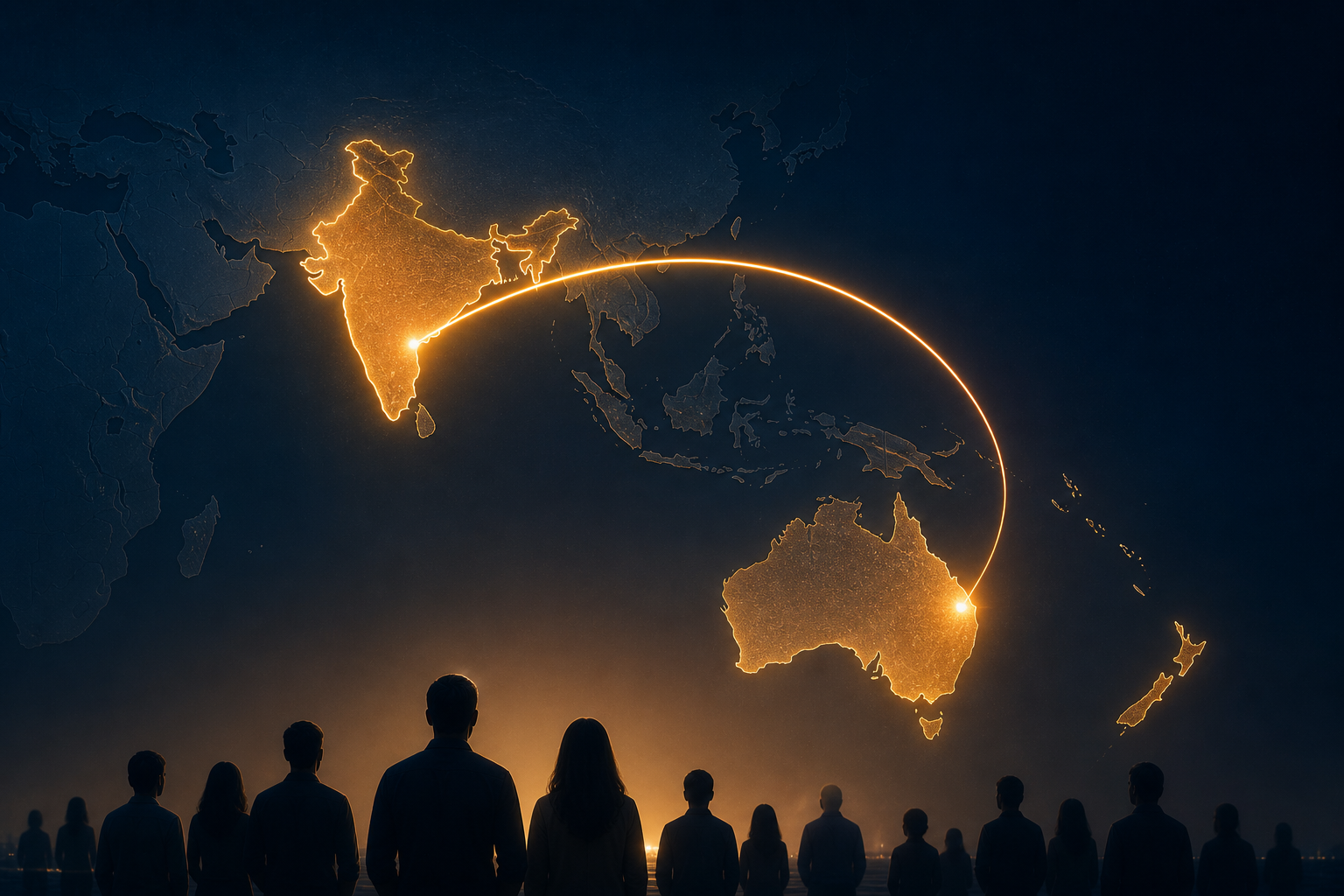
- India-born citizens are now Australia’s largest immigrant population, which represents a historic demographic change with important ramifications for regional geopolitics, internal politics, and international relations.
- Migrants from England, who had dominated the population since colonial times, have been surpassed for the first time in more than a century, signifying Australia’s shift from a Eurocentric identity to a more Indo-Pacific orientation.
- Skilled migration from India improves human capital and increases economic interdependence between Australia and India, especially in industries like IT, healthcare, and education.
India-born citizens are now Australia’s largest immigrant population, which represents a historic demographic change with important ramifications for regional geopolitics, internal politics, and international relations. Migrants from England, who had dominated the population since colonial times, have been surpassed for the first time in more than a century, signifying Australia’s shift from a Eurocentric identity to a more Indo-Pacific orientation.
From a constructivist perspective, this change represents a change in Australia’s sense of national identity. Australia is progressively redefining itself as a member of the Indo-Pacific region, despite its historical imperial and cultural ties to the United Kingdom. The Indian diaspora’s explosive expansion, which currently numbers over 971,000, indicates greater sociocultural integration with Asia. This demographic shift affects foreign policy narratives, policy priorities, and cultural norms, strengthening multiculturalism and changing Australia’s global perspective.
From a liberal institutionalist perspective, migration remains a key factor in Australia’s economic prosperity. For many years, immigration has been a vital growth engine that has kept the nation out of recession. Skilled migration from India improves human capital and increases economic interdependence between Australia and India, especially in industries like IT, healthcare, and education. This is consistent with more general frameworks for bilateral cooperation, such as trade agreements and partnerships in education, which gain from robust people-to-people ties. Thus, migration serves as a conduit, strengthening economic and diplomatic ties.
But the development also highlights conflicts that are captured by frameworks of domestic politics and realism. Australia’s housing problem and rising cost of living have made immigration a divisive political topic. Concerns about resource competitiveness and national cohesion are reflected in the rise of anti-immigration sentiment, which is supported by individuals such as Pauline Hanson and her One Nation party. Realists believe that states must strike a balance between openness and internal stability since too much immigration might put a strain on infrastructure and cause political reaction, which could lead to changes in policy toward more stringent regulations.
This situation illustrates Robert Putnam’s two-level game theory, in which governments have to balance both local and foreign obligations at the same time. Although migration helps Australia both diplomatically and economically, political opposition may limit future immigration laws, which could have an impact on bilateral ties with important allies like India.
Geographically, India and Australia’s strategic alliance is strengthened by the growth of the Indian diaspora, especially within Indo-Pacific frameworks like the Quad. A sizable diaspora fosters mutual understanding, business networks, and soft power. Additionally, it builds constituencies that favour deeper connections in sectors like trade, education, and security cooperation. Migration thus becomes a tool of international diplomacy and soft power.
The decrease in inhabitants who were born in England also draws attention to more general worldwide patterns. Flows motivated by globalisation and economic opportunity are replacing traditional migration patterns founded in colonial relationships. Migrants from China, India, and other Asian countries are becoming more prevalent, which is indicative of shifting economic gravity toward Asia. This supports the notion of a multipolar world where economic and demographic power are becoming more intertwined.

Anjali Singh is a postgraduate student of Political Science and International Relations, a Social Media Analyst, and a former Research Intern at the Indian Council of World Affairs. Views expressed are the author’s own.
 Aayush Pal
  Pranav S
  Kumar Satish