

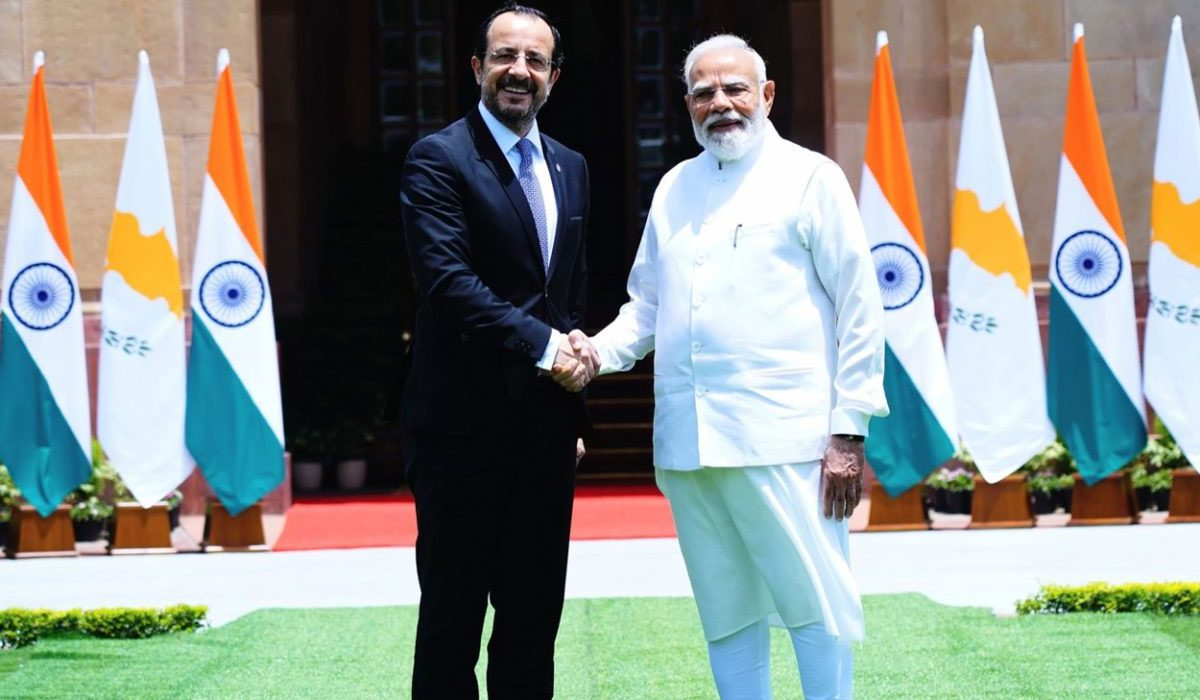
- India-Cyprus elevated their relationship to a strategic partnership, and the visit reflected the growing ties between Eastern Mediterranean nations and India amid a time of global geopolitical uncertainty.
- India’s engagement with Cyprus can also be seen in the context of India’s strategic balancing against Turkey.
- India’s aspirational India Middle East Economic Corridor project is crucial for connecting Asia to Europe through strategic maritime and connectivity networks, and in this larger vision, Cyprus emerges as an important partner.
In an important geopolitical visit, the Cyprus President Nikos Christodoulides visited India. It is an important visit as it highlighted not only a change in India-Cyprus relations, as both countries elevated their relationship to a strategic partnership, but more importantly, it also reflected the growing ties between Eastern Mediterranean nations and India amid a time of global geopolitical uncertainty.
India’s relationship with Cyprus is of great importance, particularly as the Eastern Mediterranean has become a global centre stage for geopolitical developments. India’s growing engagement with the region reflects its broader objective of contributing towards peace, stability, and strategic balance in the region.
During this important visit, both India and Cyprus created a five-year defence cooperation roadmap from 2026 to 2031, where Cyprus showed willingness and interest in purchasing Indian drones and missile systems, particularly those that were successfully tested during last year’s Operation Sindoor. Along with this, six major Memorandums of Understanding were signed between India and Cyprus. Some of them include cooperation through a Joint Working Group on Counter Terrorism, search and rescue operations, diplomatic training, and innovation in technology.
Eastern Mediterranean and India’s Expanding Strategic Footprint
Prime Minister Narendra Modi, while highlighting India-Cyprus relations, stated that Cyprus is of great importance to India, especially in the context of the India-Middle East Economic Corridor, as Cyprus is the tenth biggest investor in India. Lately, engagement between India and Cyprus has significantly increased as India has focused more on the Eastern Mediterranean region. India has made credible strategic inroads in the region, whether through its relationship with Greece, Cyprus, or Israel. These three countries hold great importance and share common geopolitical aspirations in the region.
This is also the very region that is being heavily contested by powers like Turkey, which has created a sense of belligerence in the region. India’s engagement with Cyprus can also be seen in the context of India’s strategic balancing against Turkey. Turkey has been vocal against India, particularly through its growing engagement in South Asia and its open strategic alignment with Pakistan against India. Thus, India’s engagement with Cyprus is being seen as both a balance of power strategy and a political message to Turkey.
Cyprus Turkey Tensions and India’s Economic Vision
More importantly, the relationship between Cyprus and Turkey itself remains highly controversial. Back in 1974, Turkey invaded the northern part of Cyprus, and in 1983, Northern Cyprus declared independence from Cyprus with Turkish backing. Since then, Cyprus has remained divided into two parts. This has led to a deep fracture between the two countries, and Turkey continues to oppose Cyprus reunification efforts.
In this context, India’s relationship with Cyprus further makes the regional dynamics more interesting, as Cyprus seeks support from important and powerful nations like India to strengthen its strategic position against Turkey. However, beyond geopolitics, there are also major economic gains for India in the region. India’s aspirational India Middle East Economic Corridor project is crucial for connecting Asia to Europe through strategic maritime and connectivity networks, and in this larger vision, Cyprus emerges as an important partner. Therefore, this relationship is ultimately a win-win situation for both countries.

Kumar Satish is a postgraduate in International Relations with a keen interest in reading and writing on geopolitical affairs.
 Aayush Pal
  Pranav S