
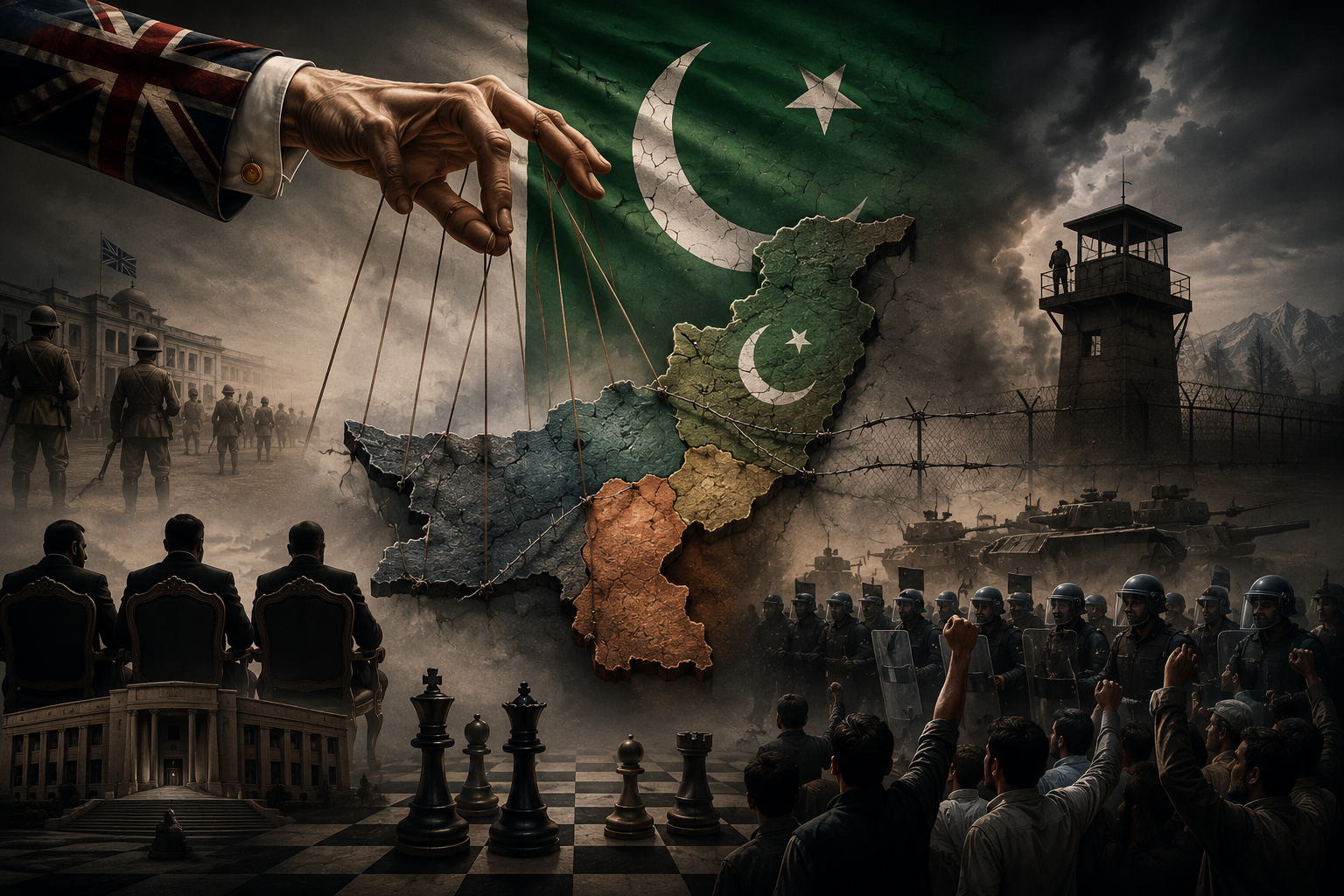
- The purpose of this article is not to describe the present protest but to demonstrate how the colonial attitude that Pakistan’s leadership inherited from the British exacerbated the trouble.
- The concept of Pakistan in the minds and words of all these individuals, including the Lahore Resolution, was based on two key tenets: first, the well-being of all Muslims throughout the region or country. Second, all states in Pakistan would be given equal treatment.
- They have a colonial mindset toward Pakistan’s non-Punjabi territories, including Kashmir.
- Therefore, the current response to the peaceful democratic demonstration reflects the internal Pakistan centre-periphery connection. The core wields considerable influence, with weak and marginalised peripheries.
The recent clash between protestors and officials on the Pakistani side of Kashmir resulted in over 50 deaths and more than 100 injuries. Both protesters and law enforcement personnel have suffered casualties. The violence began after an activist alliance called for a protest reservation of legislative seats for refugees from the Indian side of Kashmir. Law enforcement officials accused the rally of inciting sedition and anarchy and prohibited additional demonstrations. The authorities’ response prompted the protestors to plan a march to the capital, Muzaffarnagar. As a result, the problem remains unresolved as of the writing of this article. The purpose of this article is not to describe the present protest but to demonstrate how the colonial attitude that Pakistan’s leadership inherited from the British exacerbated the trouble.
The concept of Pakistan
The British established Pakistan as a nation-state under the Mountbatten Plan, which aimed to partition British India into two entities. The concept of Pakistan is based on the ‘Two-Nation Theory,’ which holds that Hindus and Muslims are not only separate but also contradictory nations in the subcontinent. This two-nation thesis predates the idea of a distinct homeland for Muslims in the subcontinent. For example, the nineteenth-century Hindi-Urdu dispute led Sir Syed Ahmed Khan to argue that Hindus and Muslims are two separate nations with difficult coexistence. Sir Syed reached this opinion due to the rising distrust between the two populations. Indian poet Iqbal, previously known for his love of India, perfected the concept of the two-nations theory. As President of the Muslim League, Iqbal delivered his address in Allahabad in 1930. He expressed concern that India’s Hindu majority will eliminate Muslim culture and history. A separate Muslim state in the northwest of undivided India would benefit not only Muslims but also the country’s tranquillity.
Later, it was Chaudhary Rahmat Ali, in his pamphlet “Now or Never: Are we to Live or Perish Forever?” who used the word “Pakistan” for the first time. According to him, Pakistan included Punjab, Sindh, Kashmir, the North-Western Frontier Province, and Balochistan. He saw Pakistan as the only realistic solution to the Hindu-Muslim issue. By the late 1930s, Jinnah had reinforced communal politics in India. After failing to solidify his position as the single voice for Muslims in the subcontinent, Jinnah proposed the Lahore Resolution, which requested Pakistan (a separate state for Muslims). The concept of Pakistan in the minds and words of all these individuals, including the Lahore Resolution, was based on two key tenets: first, the well-being of all Muslims throughout the region or country. Second, all states in Pakistan would be given equal treatment.
The Colonial Mindset of Pakistan’s Elites
The ongoing violence in Pakistani-controlled Kashmir is not an extension of the Kashmir dispute with India. Rather, it might be considered the result of colonial thinking about history, resources, power, and provinces, which is still prevalent among Pakistan’s elite. They have a colonial mindset toward Pakistan’s non-Punjabi territories, including Kashmir. The colonial notion of administering Pakistan has existed since its creation. For example, Jinnah’s decision to seize the princely kingdom of Kalat by force is still causing issues in Balochistan. This colonial perspective is based on several key tenets. First, they have a very limited geographical vision of Pakistan. Mariam Abou Zahab stated that there is a concept of ilaqa ghair, which refers to an area that is both part of and separate from Pakistan. This land does not fit into mainstream Pakistani culture; hence, it remains separated from the rest of Pakistan. Second, Pakistan maintained the previous colonial legal and administrative structures for these territories. They were viewed as a resource extraction area for mainland development, as well as a rebel stronghold. This region must be governed by force. Third, any concession in the form of autonomy for these regions was viewed as a danger to national unity. The situation was clearly visible during the East Pakistan issue, when the West Pakistan establishment refused to grant East Pakistan its fair part in the country’s government. The demand was disallowed on the grounds of national unity, but it resulted in the country being divided into two.
The current POK crisis is a reflection.
The Joint Awami Action Committee, formed in 2023, planned the current protests. It is a partnership of lawyers, traders, doctors, students, and civil society actors who work on local concerns such as democratic balance and the protection of people’s economic rights in the area. However, Pakistani authorities prohibited it on the grounds that it promoted terrorism in Pakistani-controlled Kashmir. This prohibition is a typical Pakistani response to peaceful democratic protests for regional objectives. It is consistently delegitimised in the name of terrorism and foreign plots. Pakistan’s decision to reserve 12 Legislative Assembly seats is in response to India’s decision to reserve 24 seats for Pakistan’s share of Kashmir under the Jammu and Kashmir Reorganisation Act of 2019. However, the people find the reservation unacceptable because they regard it as political marginalisation. They are also ethnically distinct from the Kashmir Valley population.
Therefore, the current response to the peaceful democratic demonstration reflects the internal Pakistan centre-periphery connection. The core wields considerable influence, with weak and marginalised peripheries. The ongoing Kashmiri protests and persecution reflect Pakistan’s approach to other provinces such as Balochistan and Khyber Pakhtunkhwa. This situation results from Pakistan’s mindset of treating these provinces as colonial territories.

Dr Mohammad Rizwan holds a PhD in political science from Jamia Millia Islamia. His doctoral research focuses on Pakistan’s relations with major global powers. Views expressed are the author’s own.
 Anjali Singh
  Parag Gilada