
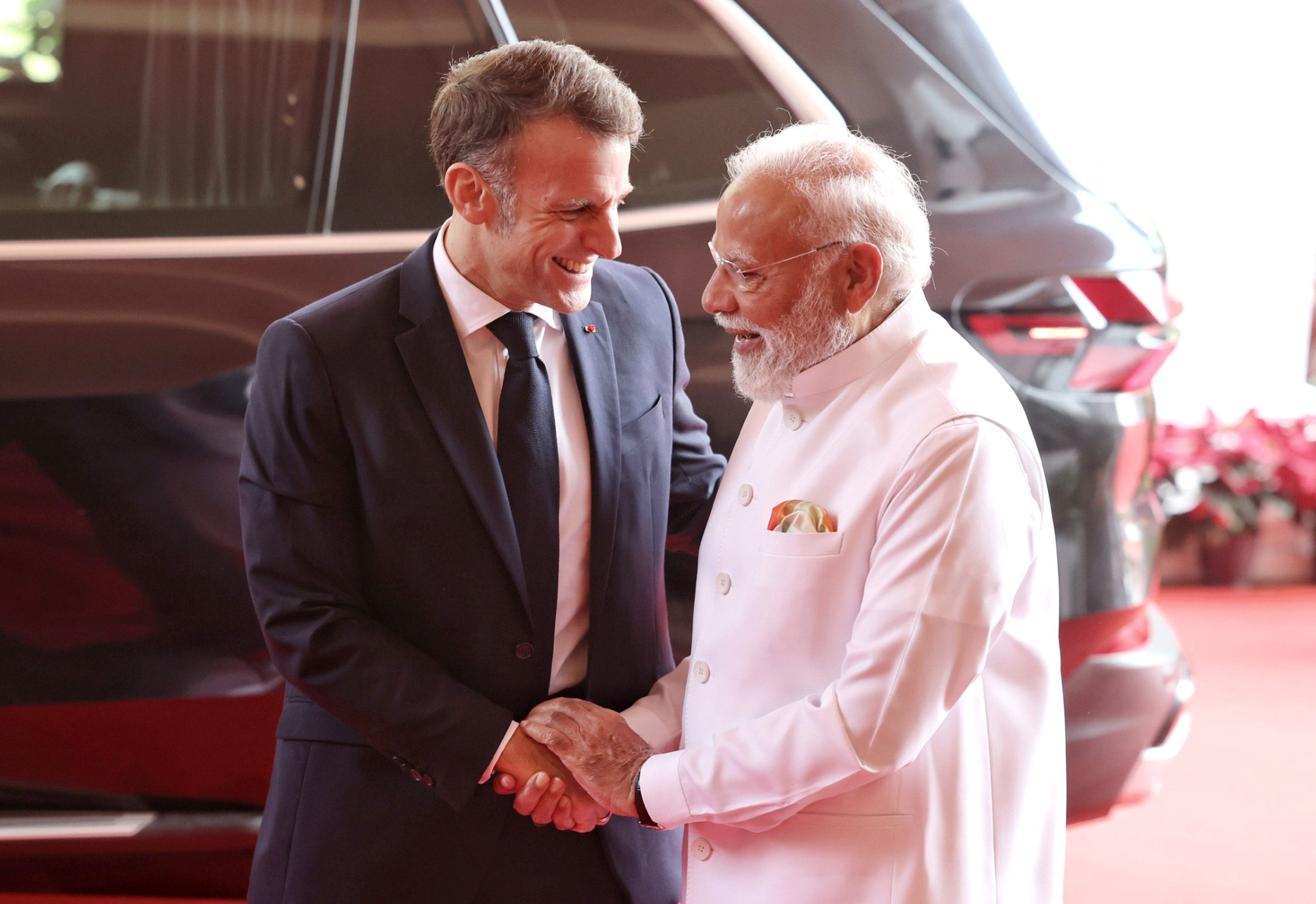
- The two countries have moved beyond a purely defence-centric relationship and have emerged as strategic partners, which has been the long-term objective of both nations.
- The growing India-France partnership is also being shaped by the evolving geopolitical environment.
- As a result, Europe is increasingly looking to diversify its partnerships.
- As Europe searches for new strategic partnerships and India seeks to diversify its global engagements, France continues to play a leading role in strengthening India’s engagement with the European continent.
The relationship between India and France is ageing like a fine wine. The two countries are steadily expanding their partnership, and this was once again evident during Prime Minister Narendra Modi’s bilateral visit to France. Prime Minister Modi is also attending the important G7 Summit during his visit.
The visit comes just months after French President Emmanuel Macron travelled to India for the AI Impact Summit organised by India in February this year. Over the years, India-France relations have grown significantly. Historically, the partnership was largely centred on defence cooperation, but today it has expanded into multiple sectors. The two countries have moved beyond a purely defence-centric relationship and have emerged as strategic partners, which has been the long-term objective of both nations.
Expanding Cooperation Beyond Defence
During the visit, Prime Minister Modi met President Macron ahead of the G7 Summit. The two leaders discussed several critical areas, including defence, energy, artificial intelligence, economic cooperation, people-to-people exchanges, and emerging technologies.
Important agreements were signed between the two countries. India and France agreed to cooperate in high-speed railway networks and also set an ambitious target of doubling their bilateral trade from the current $16 billion over the next five years. The two leaders have also signed a security pact for classified data,
Most importantly, Indian Foreign Secretary Vikram Misri confirmed that discussions took place regarding India’s potential purchase of 114 additional Rafale fighter jets. The talks reportedly focused on incorporating the maximum possible domestic components into the deal. India has consistently sought greater technology transfer from France, including access to the source code of the Rafale aircraft. France has indicated its willingness to discuss such cooperation.
Access to the source code would be a significant development for India. It would allow the Indian Air Force greater flexibility in integrating indigenous weapons and systems into the Rafale platform, thereby strengthening India’s defence capabilities and supporting the country’s drive towards defence self-reliance.
Europe’s Search for Strategic Autonomy
The growing India-France partnership is also being shaped by the evolving geopolitical environment. France today stands as one of Europe’s most influential powers at a time when the continent’s traditional relationship with the United States is facing new questions.
For the first time since the Second World War, Europe is witnessing a major war on its continent. At the same time, President Macron has repeatedly advocated the idea of “strategic autonomy” for Europe. He has argued that Europe must adapt to a changing global order and become more independent in both defence and economic matters.
The return of President Donald Trump to the White House has further intensified debates within Europe regarding dependence on the United States. Trump has frequently criticised European countries on defence spending and has also commented on several domestic issues within Europe. Simultaneously, European economies have faced challenges arising from trade disputes and tariff measures.
President Macron has, in the past, emphasised how the rise of middle powers would make the world a better place. He has argued that Europe should formulate a new chapter in its engagement with middle powers. It is in this context that President Macron has stated that European countries should advance their relations with countries like India and other influential middle powers such as Canada. India is therefore firmly on France’s radar for good reasons. More importantly, by building a strong relationship with France, India gets an opportunity to further strengthen and reset its engagement with the wider European bloc.
As a result, Europe is increasingly looking to diversify its partnerships. India naturally emerges as an attractive partner in this context. It is therefore not surprising that several European leaders, including President Macron, German Chancellor Friedrich Merz, Finnish President Alexander Stubb, and British Prime Minister Keir Starmer, have either visited India or strengthened engagement with New Delhi over the past six months.
The European Union has also intensified its engagement with India through multiple agreements and negotiations. The message from Europe is clear: it seeks to diversify its partnerships and views India as a key strategic and economic partner for the future.
The China Factor and India’s Opportunity
Another factor strengthening India-Europe relations is the growing concern within Europe regarding China. While European leaders continue to engage with Beijing, several challenges persist in the relationship.
One of the primary concerns is the large trade imbalance between China and European countries, which remains heavily in China’s favour. European leaders have repeatedly highlighted the need to address this imbalance and establish a more balanced economic relationship.
In addition, European countries have expressed concerns regarding China’s position on the Russia-Ukraine conflict. Many European governments believe that China’s support for Russia, whether direct or indirect, has complicated efforts to end the conflict. These concerns have created friction between Europe and China in recent years.
Against this backdrop, India presents itself as a credible alternative partner. New Delhi has successfully positioned itself as a major economy, a reliable strategic actor, and an increasingly important player in global supply chains.
For India, this presents a significant opportunity. Stronger ties with France and Europe provide New Delhi with greater defence cooperation, expanded economic opportunities, technological partnerships, and collaboration in emerging sectors such as artificial intelligence.
President Macron has been particularly vocal about the transformative potential of artificial intelligence, while India is rapidly expanding its capabilities in the same field. Both countries therefore see significant potential for cooperation in digital technologies and AI-driven economic growth. Macron has also appreciated India’s digital transformation and the growing international relevance of India’s digital infrastructure.
The India-France relationship today is far more comprehensive than it was a decade ago. Both countries have elevated their partnership to a new level, and the current geopolitical environment has acted as a catalyst for this transformation. As Europe searches for new strategic partnerships and India seeks to diversify its global engagements, France continues to play a leading role in strengthening India’s engagement with the European continent. The partnership is no longer limited to defence cooperation; it has become a multidimensional strategic relationship with long-term significance for both nations.

Aayush Pal is a freelance writer on contemporary geopolitical developments. The views expressed in his work are entirely his own.
 Anjali Singh
  Archita Gaur