
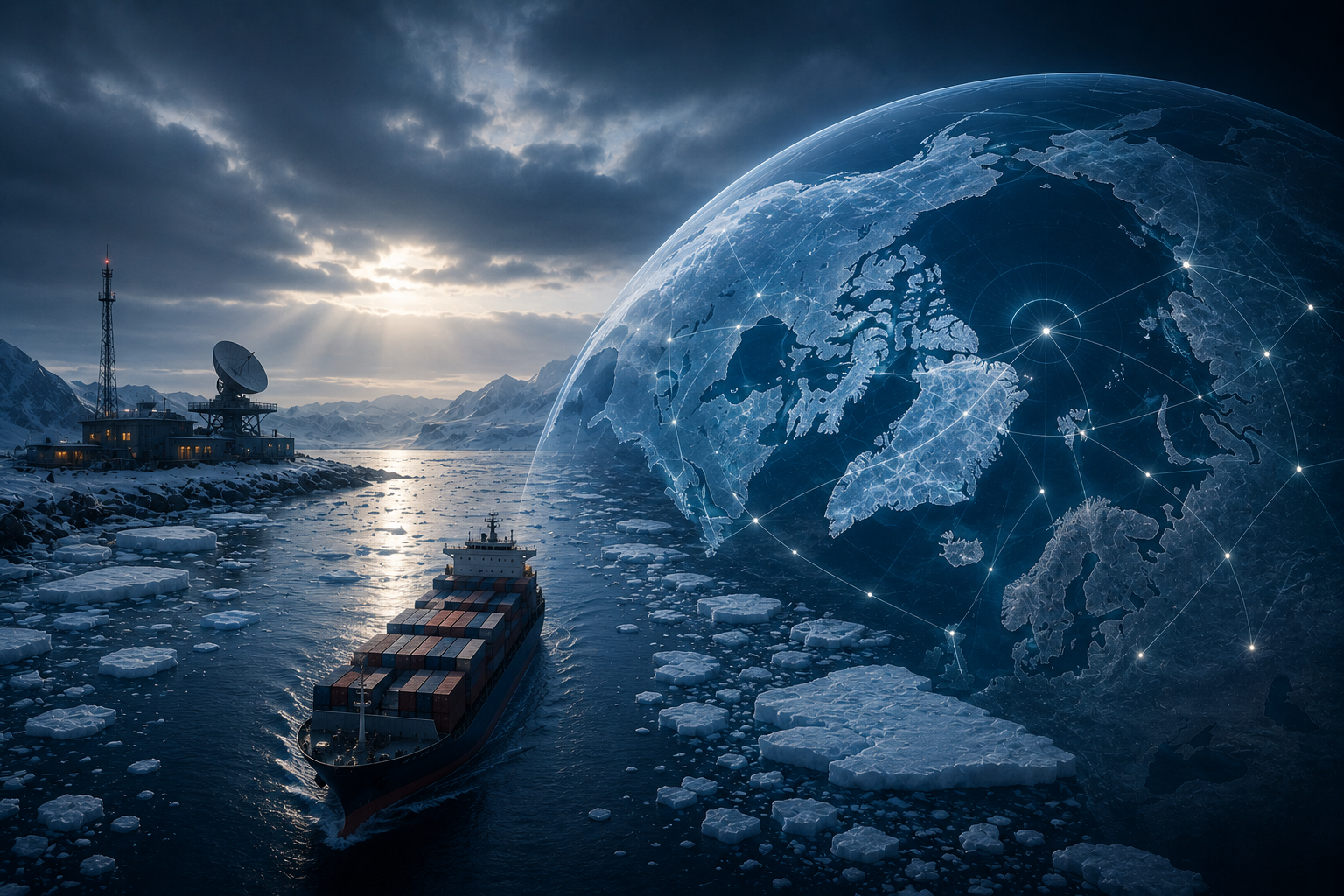
“The Arctic may be thousands of kilometres from India, but its melting ice, emerging trade routes, and geopolitical rivalries are increasingly shaping India’s future.”
- Changes in the Arctic influence India’s climate, maritime trade, energy security, and foreign policy.
- Scientists believe that changes in Arctic temperatures influence atmospheric circulation patterns, which can alter rainfall distribution across South Asia.
- Among these, Russia’s Northern Sea Route (NSR) has attracted global attention.
- The Arctic has transformed from a remote frozen frontier into a region of global strategic importance.
For much of history, the Arctic was regarded as a frozen wilderness at the edge of the world—a region relevant only to the countries bordering the North Pole. Today, that perception has changed dramatically. Climate change has transformed the Arctic into one of the most strategically significant regions on the planet. Melting sea ice is opening new shipping lanes, exposing vast reserves of hydrocarbons and critical minerals, and intensifying competition among major powers.
The Arctic has become a theatre where environmental concerns intersect with economics, energy security, and geopolitics. Russia is investing heavily in Arctic infrastructure and military capabilities. China is promoting its “Polar Silk Road” as part of its global connectivity ambitions. The United States and its NATO allies are increasing their presence to safeguard strategic interests.
At first glance, India’s interest in the Arctic might seem unusual. After all, India is neither an Arctic state nor geographically close to the region. Yet, in an interconnected world, distance no longer determines strategic relevance. Changes in the Arctic influence India’s climate, maritime trade, energy security, and foreign policy. Recognising this reality, India has emerged as an active stakeholder through scientific research, diplomatic engagement, and its Arctic Policy of 2022.
The Arctic matters to India because the future of global commerce, climate stability, and strategic competition is increasingly being shaped in this once-isolated region.
Climate Change: A Polar Problem with Indian Consequences
The Arctic is warming nearly four times faster than the global average. Rising temperatures have led to shrinking sea ice, melting glaciers, and thawing permafrost. These changes are not confined to the Arctic but have global repercussions.
For India, one of the most significant concerns is the impact of Arctic warming on the Indian monsoon. Scientists believe that changes in Arctic temperatures influence atmospheric circulation patterns, which can alter rainfall distribution across South Asia. Irregular monsoons affect agriculture, water security, and food production, directly impacting millions of people.
Another concern is sea-level rise. The melting of Greenland’s ice sheet and Arctic glaciers contributes to rising ocean levels, threatening India’s long coastline and densely populated coastal cities such as Mumbai, Chennai, Kochi, and Kolkata. Coastal erosion, flooding, and saltwater intrusion into freshwater sources could become increasingly severe.
Extreme weather events may also become more frequent. Heatwaves, cyclones, and unpredictable rainfall patterns have become common features of India’s climate, and Arctic amplification is considered one of several contributing factors.
Understanding these linkages explains why India established its Arctic research programme in 2007 and inaugurated the Himadri research station in Norway’s Svalbard archipelago in 2008. Scientific research in the Arctic helps India better predict climatic changes at home.
In many ways, protecting India’s environmental future begins with understanding the Arctic.
Russia’s Northern Sea Route: Redrawing Global Trade
Perhaps the most visible consequence of melting Arctic ice is the emergence of new maritime routes. Among these, Russia’s Northern Sea Route (NSR) has attracted global attention.
Stretching along Russia’s Arctic coastline, the NSR connects the Atlantic and Pacific Oceans. Compared with the traditional Suez Canal route, the journey between Europe and Asia can be significantly shorter, reducing travel time and fuel costs.
For India, this development has important implications.
India’s trade with Europe and Russia continues to grow. Alternative shipping corridors could diversify trade routes and reduce dependence on congested chokepoints such as the Suez Canal. The blockage of the Suez Canal in 2021 demonstrated how vulnerable global supply chains can be to disruptions.
The NSR also complements India’s broader connectivity initiatives, including the International North-South Transport Corridor (INSTC) and the Chennai-Vladivostok Maritime Corridor. These projects aim to strengthen India’s access to Eurasian markets.
Russia has invited international partners to invest in Arctic shipping infrastructure, ports, and energy projects. Given the long-standing India-Russia strategic partnership, Arctic connectivity could become an important area of bilateral cooperation.
However, the NSR is not without challenges. Harsh weather, limited infrastructure, seasonal ice conditions, and geopolitical uncertainties continue to limit its commercial viability. Nevertheless, as technology improves and ice cover diminishes, the route could become a significant component of future global trade.
Energy Security and Critical Minerals
The Arctic is believed to contain approximately 13 per cent of the world’s undiscovered oil reserves and 30 percent of its undiscovered natural gas resources. Besides hydrocarbons, the region is rich in nickel, cobalt, copper, lithium, platinum, and rare earth elements.
For India, these resources are strategically important.
India’s economic growth requires secure and diversified energy supplies. Although renewable energy is expanding rapidly, oil and natural gas will continue to play a significant role in the country’s energy mix for the foreseeable future.
Russia has already become one of India’s major energy suppliers. Cooperation in Arctic energy projects could strengthen India’s long-term energy security while reducing supply vulnerabilities.
Critical minerals are equally important. Electric vehicles, renewable energy systems, batteries, semiconductors, and advanced defence technologies all depend on reliable access to these resources.
China currently dominates many critical mineral supply chains, creating strategic concerns for countries around the world. Diversifying access to these minerals has become a priority for India as it pursues industrial growth and technological self-reliance.
The Arctic’s mineral wealth could therefore become an important component of India’s economic and strategic planning.
The Arctic as a New Geopolitical Arena
The Arctic is no longer simply an environmental issue; it has become a region of strategic competition.
Russia views the Arctic as essential to its economic and military future. It possesses the world’s largest fleet of nuclear-powered icebreakers and has expanded military infrastructure across the region.
The United States has increased its Arctic engagement to protect strategic interests and maintain freedom of navigation. NATO’s northern members are strengthening defence cooperation following changing security dynamics in Europe.
China, despite having no Arctic territory, has declared itself a “Near-Arctic State” and seeks to develop a Polar Silk Road linking Asia and Europe through Arctic waters. Chinese investments in scientific research and infrastructure have attracted international scrutiny.
For India, navigating these rivalries requires a balanced approach.
India has traditionally pursued strategic autonomy and constructive engagement with competing powers. Rather than viewing the Arctic through a military lens, India emphasises scientific research, sustainable development, environmental protection, and international cooperation.
As an Observer in the Arctic Council since 2013, India supports rules-based governance while respecting the sovereignty of Arctic states.
This balanced approach allows India to protect its interests without becoming entangled in major power competition.
India’s Arctic Policy: A Strategic Roadmap
Recognising the Arctic’s growing significance, India unveiled its Arctic Policy in 2022 under the theme “Building a Partnership for Sustainable Development.”
The policy rests on six pillars:
- Science and research.
- Climate and environmental protection.
- Economic and human development.
- Transportation and connectivity.
- Governance and international cooperation.
- National capacity building.
The policy highlights the importance of scientific research while encouraging responsible economic engagement and stronger diplomatic partnerships.
India’s Himadri research station and IndARC underwater observatory contribute to studies on climate change, marine ecosystems, and oceanography.
Unlike some major powers, India’s Arctic approach prioritises sustainability and international cooperation over territorial competition.
Challenges and the Road Ahead
India’s Arctic ambitions face several obstacles.
Geopolitical tensions involving Russia and Western countries complicate international cooperation. Economic sanctions and security concerns may affect future investments and scientific collaborations.
Environmental concerns present another challenge. Increased shipping and resource extraction could damage fragile ecosystems and affect indigenous communities that depend on the Arctic environment for their livelihoods.
Commercial uncertainties also remain. Arctic shipping routes require specialised vessels and substantial infrastructure investments.
India must therefore balance economic opportunities with environmental responsibility and geopolitical prudence.
Conclusion
The Arctic has transformed from a remote frozen frontier into a region of global strategic importance. Climate change, emerging trade routes, energy resources, and geopolitical competition are reshaping international politics and economics.
For India, the Arctic is not a distant curiosity but a region with direct implications for climate security, maritime trade, energy diversification, and foreign policy.
Russia’s Northern Sea Route could redefine global shipping. Arctic hydrocarbons and critical minerals could support India’s energy and industrial ambitions. Scientific research in the Arctic helps India better understand climate patterns affecting the monsoon and coastal regions.
At the same time, increasing strategic competition among major powers means that India must pursue a careful and balanced approach that safeguards national interests while supporting sustainable development and international cooperation.
India’s Arctic Policy reflects this understanding. It recognises that the country’s future prosperity and security are increasingly linked to developments far beyond its immediate neighbourhood.
In the coming decades, the Arctic will not merely be a frozen expanse at the top of the world. It will be one of the defining regions of global politics, economics, and environmental governance. India’s growing engagement with the Arctic demonstrates that it intends to be an active participant in shaping that future rather than a passive observer.
References:
- Ministry of Earth Sciences, Government of India
India and the Arctic: Building a Partnership for Sustainable Development (2022)
https://moes.gov.in - Arctic Council
Official website for Arctic governance and observer states.
https://arctic-council.org - National Snow and Ice Data Center (NSIDC)
Arctic sea ice data and climate research.
https://nsidc.org - NASA Earth Observatory
Arctic climate change and polar science.
https://earthobservatory.nasa.gov - NOAA Arctic Program
Arctic Report Card and climate assessments.
https://arctic.noaa.gov - The Arctic Institute
India’s Arctic policy and geopolitical analysis.
https://www.thearcticinstitute.org - United States Geological Survey (USGS)
Circum-Arctic Resource Appraisal.
https://www.usgs.gov - International Energy Agency (IEA)
Global energy outlook and Arctic energy implications.
https://www.iea.org - Observer Research Foundation (ORF)
India and the Arctic: Strategic and Economic Perspectives.
https://www.orfonline.org - Stockholm International Peace Research Institute (SIPRI)
Arctic security and geopolitical developments.
https://www.sipri.org

Daljeet Singh holds a BTech in Computer Science and is currently pursuing an MA in Political Science. His interests range across geopolitics, international relations, and technology. An avid reader and writer, he is passionate about exploring the intersections of these fields. Views expressed are the author’s own.
 Anjali Singh
  Parag Gilada