
- The central argument is that the disinformation around BRICS 2026 was not spontaneous online noise but an event-anchored influence operation, a campaign that exploited a moment of peak global attention to inject a pre-scripted narrative of Indian instability into the international conversation.
- The four cases documented during the summit window differ considerably in their surface content; one alleges a terrorist attack, two allege state violence against protesters, one alleges a private act of diplomatic servility.
- The techniques on display constitute a portable methodology, indifferent to the specific target.
- The first line of defence is not faster debunking, valuable as that remains. It is a clearer understanding of the method, held widely enough and early enough to blunt it before it strikes.
Executive summary
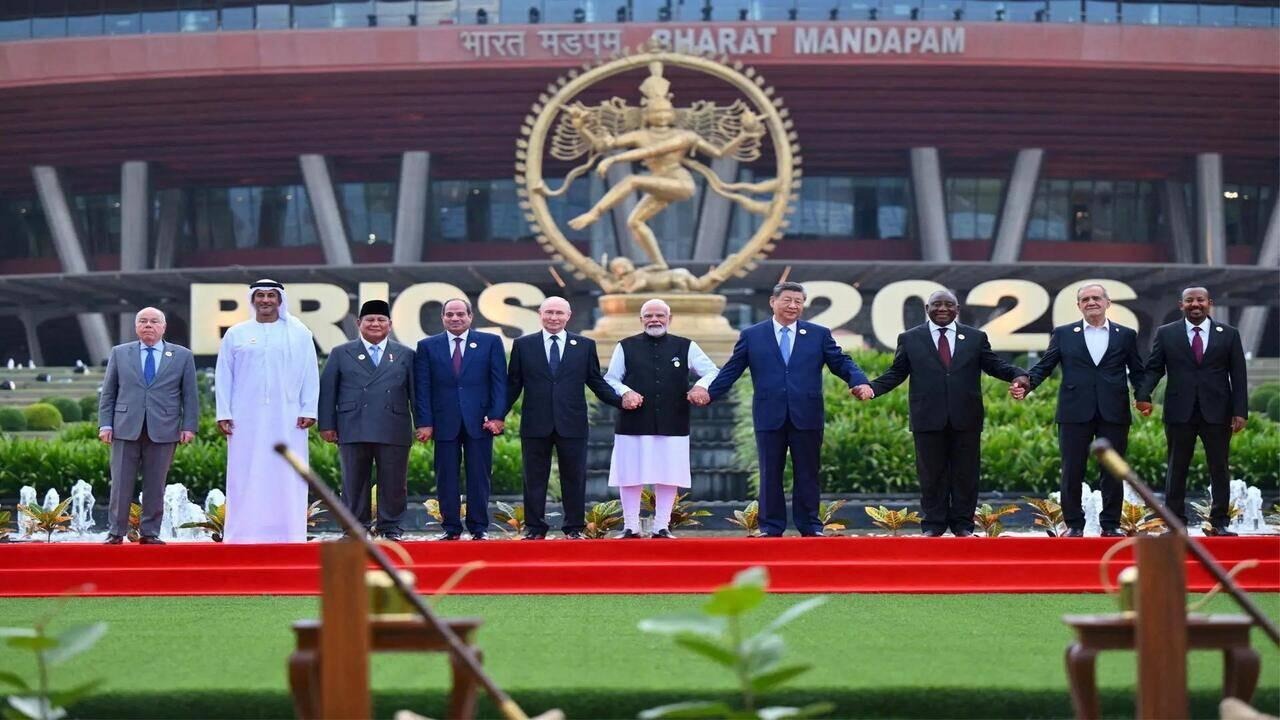
When India hosted the 18th BRICS Leaders’ Summit in New Delhi in September 2026, it convened one of the largest diplomatic gatherings held on its soil in recent memory: the leaders of an eleven-member bloc that now accounts for roughly half the world’s population and a substantial share of global economic output. For two days, the world’s press, its cameras, and its algorithms turned toward a single host capital.
Alongside that summit, and largely invisible to the delegations inside Bharat Mandapam, a second and very different contest unfolded across social media. A cluster of fabrications, an invented bombing, two relabelled protest videos, and a synthetic clip of the Prime Minister in an act of alleged submission circulated with the evident purpose of manufacturing an atmosphere of violence, repression, and diplomatic humiliation around the event.
The article examines four such fabrications during the summit window. Considered in isolation, they are ordinary hoaxes of the kind that surface daily online. Considered together, they reveal something more consequential: a coherent operational method that maps precisely onto techniques long catalogued in the academic and practitioner literature on information warfare. The central argument is that the disinformation around BRICS 2026 was not spontaneous online noise but an event-anchored influence operation, a campaign that exploited a moment of peak global attention to inject a pre-scripted narrative of Indian instability into the international conversation.
The analysis proceeds in five movements. It first establishes why a summit of this scale becomes a target. It then reconstructs the four fabrications in detail. It identifies the shared grammar of the operation—cheap fakes, synthetic media, and identity impersonation and draws on cognitive science to explain why such fabrications continue to shape belief even after they are debunked. It weighs the difficult question of attribution with appropriate caution. And it closes with implications and recommendations for governments, platforms, and the fact-checking community, on the argument that event-anchored disinformation is predictable and therefore, in part, preventable.
1. The strategic backdrop: why a summit becomes a target
BRICS in 2026 is a markedly different entity from the four-country grouping that held its first leaders’ summit in 2009. Two successive rounds of enlargement, in 2024 and 2025, transformed it. The bloc now comprises eleven full members—Brazil, Russia, India, China, South Africa, Egypt, Ethiopia, Iran, the United Arab Emirates, Saudi Arabia, and Indonesia, supplemented by a further tier of partner countries stretching across Asia, Africa, Latin America, and West Asia. India assumed its fourth chairship on 1 January 2026 under the theme “Building for Resilience, Innovation, Cooperation and Sustainability,” and over the course of the year convened more than 350 meetings and high-level engagements across some twenty-five cities before the leaders themselves gathered in New Delhi on 12–13 September.
This scale is precisely what turns such a gathering into a magnet for narrative contestation. A summit that brings heads of state among them Vladimir Putin, Xi Jinping, and Masoud Pezeshkian to a single host capital does more than convene a meeting; it concentrates the finite resource of global attention on one country for a defined window. For the host, this is an opportunity to project competence, stability, and leadership. For adversarial actors, it is the mirror-image opportunity: the very spotlight that amplifies the host’s intended message will just as efficiently amplify a counter-message, provided that counter-message can be made to look real. In the language of influence operations, the summit does the hardest part of the propagandist’s job for free, it assembles the audience. The operation need only supply the crisis.
The stakes are not merely reputational in the abstract. As BRICS advances concrete proposals on cross-border payments, settlement in national currencies, and reform of the institutions of global governance, the cohesion of the bloc and the credibility of its host become objects of genuine geopolitical interest. A narrative that portrays the host as unable to keep order in its own capital, or as a repressive state that brutalises its own citizens, does more than embarrass a government. It corrodes the bloc’s implicit claim to represent a stable, credible, alternative pole in a contested international order. The target of an operation like this is not only India’s image; it is the proposition that a grouping led, in that moment, by India can be taken seriously.
This is why event-anchored disinformation should be understood as a strategic instrument rather than a nuisance. It is cheap to produce, difficult to fully counter, and calibrated to arrive at the precise moment when the largest possible audience is primed to receive it.
2. Four fabrications, reconstructed
The four cases documented during the summit window differ considerably in their surface content; one alleges a terrorist attack, two allege state violence against protesters, one alleges a private act of diplomatic servility. Beneath that surface variation, they share a single architecture. Reconstructing each in turn makes both the variation and the common design visible.
2.1 The phantom bombing
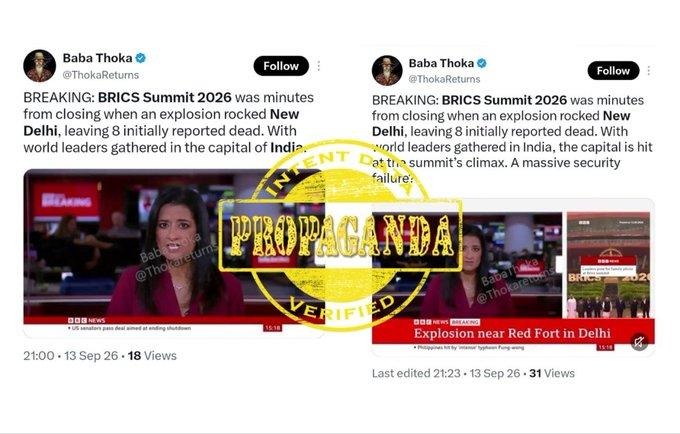
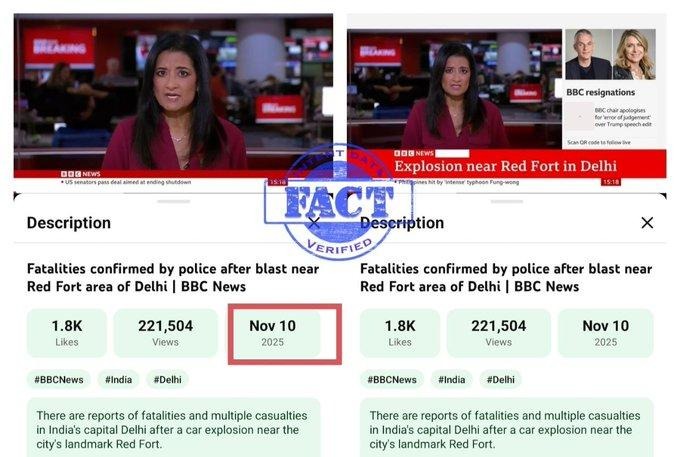
The first and most alarming fabrication claimed that, with the summit only minutes from concluding, an explosion tore through New Delhi and left eight people dead. The framing was deliberate and specific: the blast was presented as an attack timed to the very climax of the gathering, occurring as world leaders remained assembled on Indian soil. The implied narrative required no elaboration: a host state so insecure that it could not prevent mass-casualty violence at its own flagship event, under the eyes of the world.
The supporting evidence was, in a sense, entirely genuine: a BBC News video. But the footage did not depict any event from September 2026. It reported on a Delhi explosion from November 2025, an incident wholly unconnected to the summit. The manipulation lay not in the imagery but in its framing. The credibility and visual authority of a respected international broadcaster were, in effect, borrowed and retrofitted to a false timeline, so that real footage of a real past event became “proof” of a present one that never occurred.
2.2 The relocated crackdown
The second case circulated real footage of police confronting protesters, captioned to allege that Delhi Police were violently suppressing young demonstrators near the summit venue, complete with the incendiary and specific claim that women were being dragged by their hair. The emotional charge of the imagery was authentic; the context wrapped around it was fabricated.
The video did not originate in Delhi. It came from Tirupati, in Andhra Pradesh, where it showed a protest by paramedical students, an event with its own local character, grievances, and circumstances, entirely unrelated to the BRICS gathering hundreds of kilometres away. Both the geography and the grievance were overwritten. A regional demonstration was transplanted to the doorstep of an international summit and recast as evidence of a state brutalising its youth precisely while it played host to the world. The choice of detail like women dragged by their hair was engineered for maximum virality and moral outrage, the kind of specific, visceral image that travels faster than any correction.
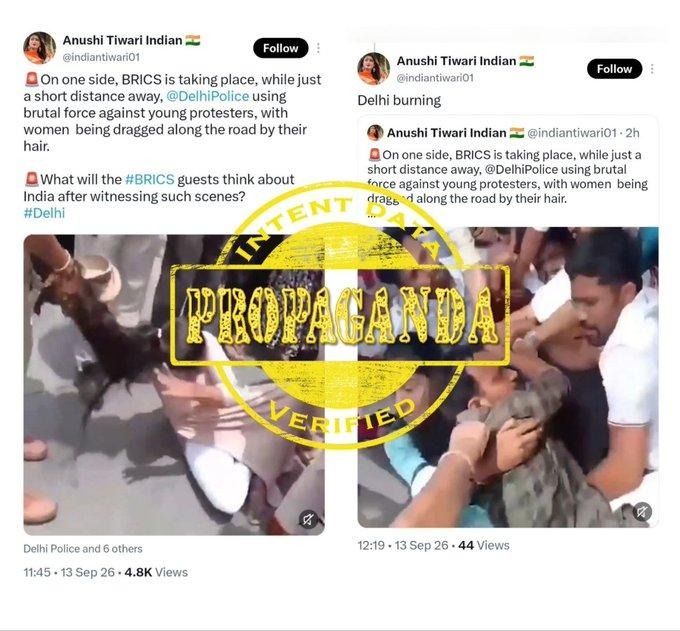
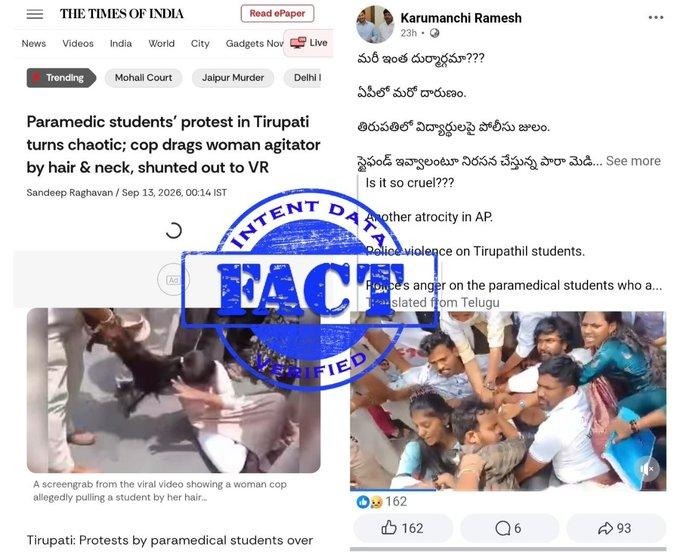
Figure 2 Credits: https://x.com/dintentdata/status/2099056928466825644?s=20
2.3 The imaginary march
The third fabrication escalated the protest motif into a full narrative of open revolt. It claimed that an organisation had launched a march on Delhi during the summit, that police had failed to halt the advancing protesters, and that young demonstrators had breached the capital to expose the alleged oppression they suffered under the government. Where the second case manufactured a single violent incident, the third manufactured a movement, an image of a population in revolt against its rulers at the very moment those rulers sought to project strength on the world stage.
The deception here rested on temporal sleight of hand executed across two separate clips. The first set of visuals had been circulating online since at least December 2024. The second video was older still, traceable online to at least February 2020. Neither had any connection to September 2026, and no such march on Delhi occurred during the summit. Two unrelated pieces of old footage, of different vintages, were bundled together and relabelled as a single unfolding event, the past dressed up as breaking news.
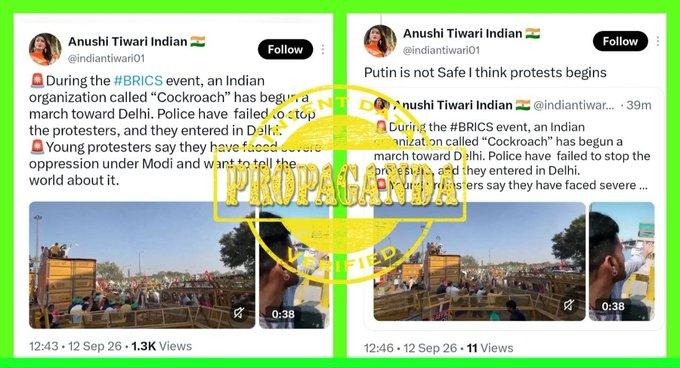
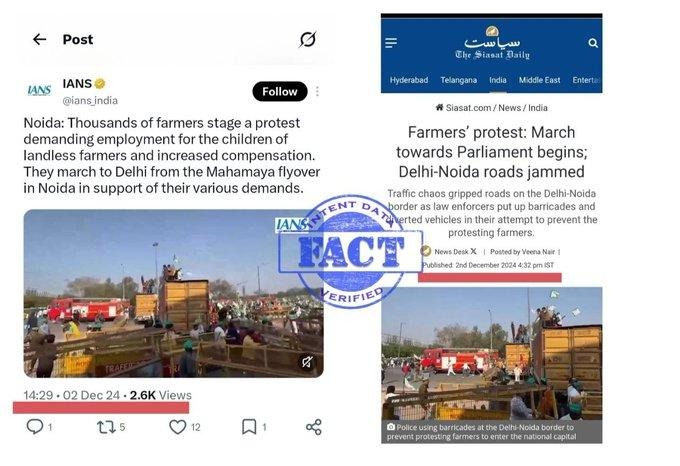
Figure 3Credits: https://x.com/dintentdata/status/2098690621884219448?s=20
2.4 The synthetic humiliation
The fourth case moved from the streets to the realm of personal diplomacy, and in doing so crossed a technological threshold that sets it apart from the other three. It alleged that the Indian Prime Minister had touched the feet of the Iranian President and sought his blessings purportedly out of admiration for Iran and Islam. The narrative was designed to portray the host’s leader not as a peer among heads of state but as a servile figure, diminished and deferential, at the summit he himself was hosting.
Here there was no misattributed real event to unwind. The clip depicted an encounter that had never taken place. It was an entirely synthetic, AI-generated creation, with no authentic origin to trace and no underlying footage that had merely been recontextualised. This is the campaign’s most technologically advanced edge, and its most forward-looking warning. Where the first three fabrications recycled genuine footage stripped of its context, this one conjured a diplomatic moment out of nothing.
3. Why this matters beyond India
It would be a mistake to read this episode as a narrowly regional affair, of interest only to observers of South Asian rivalry. The techniques on display constitute a portable methodology, indifferent to the specific target. The value of the BRICS case to analysts lies less in any exceptional feature than in how representative it is. Any state hosting any major summit, staging any election, or managing any crisis is exposed to precisely this treatment, and the lessons generalise directly.
Three implications deserve emphasis.
First, the asymmetry of speed is the central structural problem, and it is not going away. A fabrication reaches its audience in seconds; rigorous provenance work takes hours or days. By the time the Andhra Pradesh origin of a protest video has been established, documented, and published, the “Delhi crackdown” framing has already circulated, been screenshotted, been re-shared beyond the reach of the original posts, and shaped impressions that per the continued influence effect, no correction fully reverses. Debunking, however excellent, is inherently a rearguard action. A defensive posture built solely around after-the-fact correction is a posture built to lose.
Second, the shift toward synthetic media changes the nature of the defensive task in a way that current tools and habits only partly address. Media-literacy guidance built on the premise that authentic footage can always be traced to a source does not fully answer a threat in which the footage itself may be fabricated from nothing. This argues for sustained investment in three areas at once: detection tooling capable of flagging generated content; provenance and content-authentication standards, cryptographic signing of authentic media at the point of capture that shift the burden from proving a fake false to proving a real thing genuine; and public education that updates the intuition “video is evidence” for an age in which it is not reliably so. None of this displaces the continued need to counter the humble cheap fake, which remains the more common weapon.
Third, and most constructively, event-anchored disinformation is predictable, and predictability is the defender’s greatest asset. Summits, elections, state visits, and national days are known flashpoints. The appearance of recycled footage, relocated protests, and synthetic clips around them is not a surprise to be reacted to but a near-certainty to be planned for. This reframes the problem from crisis response to preparedness.
Conclusion
For a determined set of actors, the BRICS Summit 2026 was less a diplomatic gathering than an opening. Around a real event they constructed a counterfeit one: an explosion that did not occur, a crackdown that happened hundreds of kilometres away, a march that never marched, and a moment of submission that never took place. The individual hoaxes were crude in intent, but their execution spanned the full spectrum of the modern disinformation toolkit, from authentic footage stripped of its date and place, to a wholly synthetic video generated from nothing, all delivered through accounts impersonating the very citizens they sought to inflame, and all timed to arrive while the world was watching.
The value of documenting these cases lies not in the debunking of any single fabrication but in the exposure of the architecture that connects them. That architecture—cheap fakes anchored to a moment of maximum attention, laundered through false domestic identities, increasingly supplemented by generative forgery, and engineered to lodge a belief that survives its own correction is not an Indian problem, and it is not a BRICS problem. It is the shape of an emerging and generalisable threat. As multilateral diplomacy grows more contested and generative tools grow more powerful, the manufacture of crisis around genuine events is becoming a defining feature of the information environment in which every state now operates.
The first line of defence is not faster debunking, valuable as that remains. It is a clearer understanding of the method, held widely enough and early enough to blunt it before it strikes. That is what this episode, read as a whole rather than as a series of isolated hoaxes, is able to provide.

Diksha Bharti is currently pursuing a Master’s program in Russian studies. She has previously worked as a Research Associate at Politika and the Consilium Research Institute. She has a keen interest in geopolitics and has contributed to several reputed platforms. Views expressed are the author’s own.
 Kumar Satish
  Aayush Pal
  Anjali Singh