
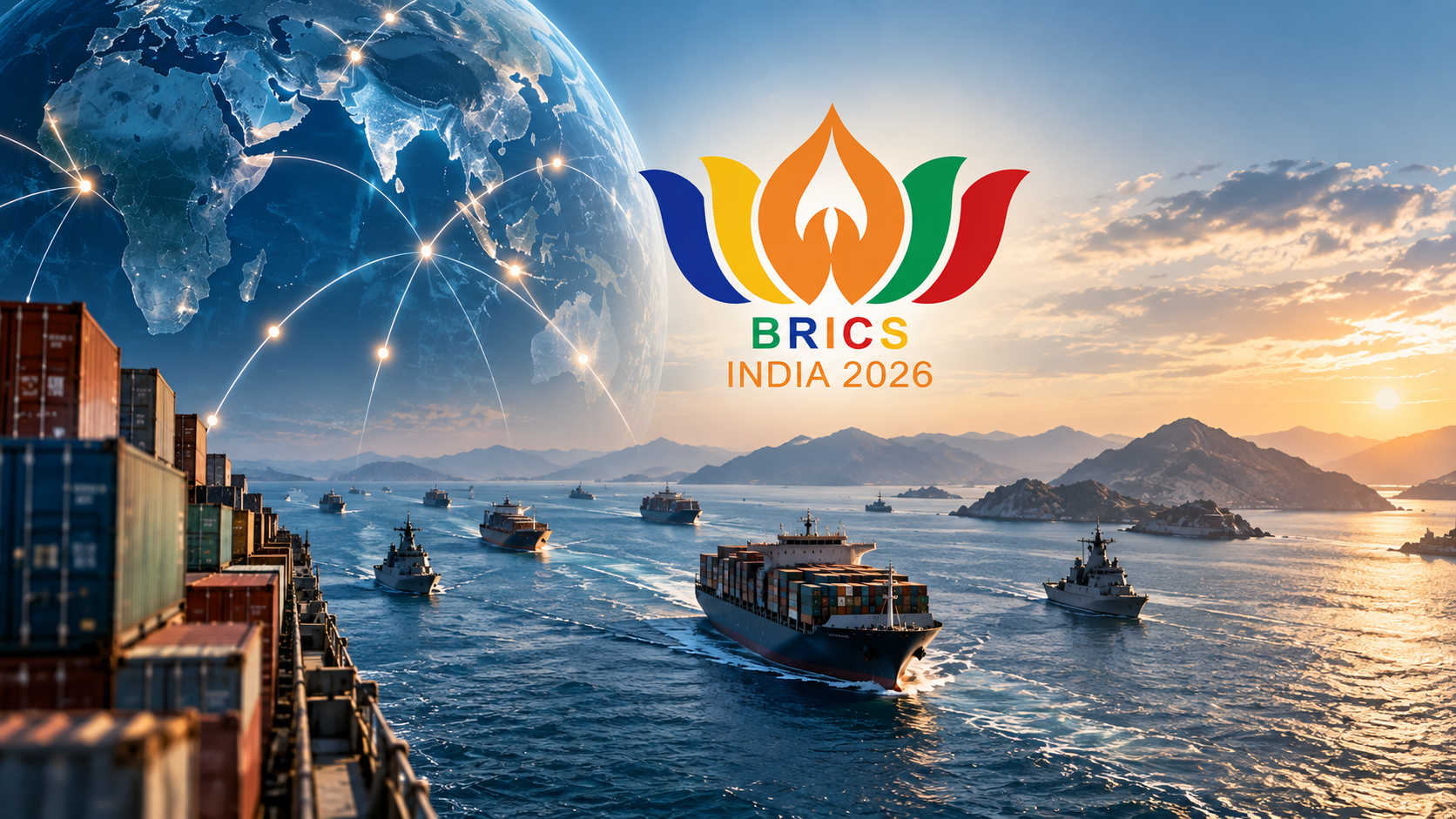
- The expansion of BRICS has fundamentally altered the geopolitical geometry of the Indian Ocean Region, transforming it from a traditional theatre of bilateral security competition into a dense web of overlapping minilateral formats.
- Rather than creating a unified naval alliance, expanded BRICS membership acts as an accelerator for modular security cooperation, allowing member states to forge targeted partnerships based on shared geographic vulnerabilities, trade dependencies, and resource protection needs.
- Consequently, the Indian Ocean is transitioning into a multi-layered security ecosystem where operational partnerships are formed on an ad-hoc, problem-solving basis.
- This evolving architecture signifies that the future of Indian Ocean governance will not be dictated by any single hegemon or rigid alliance system.
The expansion of BRICS has fundamentally altered the geopolitical geometry of the Indian Ocean Region, transforming it from a traditional theatre of bilateral security competition into a dense web of overlapping minilateral formats. Historically, maritime security in the Indian Ocean was framed around Western naval supremacy and regional balances anchored by major indigenous powers. However, the integration of critical littoral states across the Middle East, East Africa, and Southeast Asia into the BRICS framework has effectively consolidated control over the world’s most crucial maritime chokepoints—including the Strait of Hormuz, the Bab-el-Mandeb, and the approaches to the Strait of Malacca—within a single multilateral tent. This geographic aggregation shifts the analytical focus from macro-level bloc politics to flexible, domain-specific minilateral arrangements that operate beneath the broader BRICS umbrella. Rather than creating a unified naval alliance, expanded BRICS membership acts as an accelerator for modular security cooperation, allowing member states to forge targeted partnerships based on shared geographic vulnerabilities, trade dependencies, and resource protection needs.
Chokepoint Governance and the Architecture of Functional Minilateralism
The primary mechanism through which expanded BRICS shapes Indian Ocean dynamics is functional minilateralism tailored to chokepoint governance. The inclusion of major primary energy exporters alongside crucial maritime transit nations creates unprecedented structural overlap between energy security and operational naval strategy. This is particularly evident in the Western Indian Ocean, where the security of commercial shipping lanes in the Gulf of Aden and the Arabian Sea is no longer reliant solely on external Western-led naval task forces like the Combined Maritime Forces. Instead, regional actors are increasingly constructing localized, task-oriented coalitions to protect critical maritime infrastructure, combat piracy, and secure energy corridors.
This trend towards localised maritime governance was clearly underscored during the 18th BRICS Summit in New Delhi, where the operational safety of commercial mariners and the protection of freedom of navigation emerged as central strategic priorities. Initiatives such as India’s proposal for a dedicated Seafarers Emergency Support Network demonstrate how minilateral coordination within the expanded group is pivoting toward practical, humanitarian, and operational frameworks. By establishing direct channels among maritime authorities for distress alerts, medical aid, and emergency evacuations across volatile maritime zones, the expanded grouping is building institutional layers of non-traditional maritime security that operate independently of Western-dominated maritime architectures.
Strategic Interdependence and the Convergence of Asymmetric Capabilities
The convergence of diverse naval capabilities within the expanded BRICS platform has catalysed a shift from unilateral force projection to cross-regional capability aggregation. The Indian Ocean is witnessing a rise in low-intensity, high-frequency joint naval drills, intelligence-sharing protocols, and coordinated maritime domain awareness initiatives among subsets of member states. These minilateral engagements allow rim states to combine their specialized assets—ranging from deep-water surface fleets and long-range maritime patrol aircraft to littoral combat capabilities and coastal surveillance networks.
For emerging middle powers, this minilateral flexibility offers a mechanism to enhance their own maritime domain awareness without incurring the strategic costs of formal, binding military alliances. By participating in modular security arrangements, littoral nations can leverage technical data channels—such as information shared through the Information Fusion Centre – Indian Ocean Region—to secure their Exclusive Economic Zones and monitor critical sea lines of communication. Consequently, the Indian Ocean is transitioning into a multi-layered security ecosystem where operational partnerships are formed on an ad-hoc, problem-solving basis. This decentralized operational model reduces reliance on extra-regional powers for primary maritime policing, fundamentally redefining how security is maintained across the global trade commons.
Navigating Intra-Bloc Rivalries and Strategic Autonomy in the Maritime Commons
Despite the operational advantages of minilateral cooperation, the expanded BRICS footprint in the Indian Ocean is inherently defined by intra-bloc strategic friction. The group encompasses nations with contrasting long-term maritime ambitions, leading to a complex dynamic where cooperation on non-traditional security coexists with persistent traditional security dilemmas. India’s strategic posture in the Indian Ocean, grounded in its vision of Security and Growth for All in the Region and its role as a net security provider, continually interacts with China’s expanding naval presence and infrastructure investments under its far-reaching maritime initiatives.
Rather than suppressing these strategic divergences, the expanded BRICS format acts as a platform for managing strategic friction through minilateral hedging. Middle powers within the grouping actively utilise flexible, multi-vector diplomacy to maintain equilibrium, engaging in targeted economic and maritime cooperation with one partner while relying on balancing arrangements with others. This strategic autonomy prevents the Indian Ocean from bifurcating into rigid, zero-sum geopolitical camps. Instead, regional actors leverage the overlapping institutional space of expanded BRICS to preserve their manoeuvring room, ensuring that maritime security initiatives remain focused on tangible commons management rather than power projection or ideological alignment.
The Institutionalisation of a Multipolar Oceanic Order
The long-term impact of expanded BRICS on the Indian Ocean Region points toward the institutionalisation of a genuine multipolar maritime order. As minilateral maritime networks mature, they are creating alternative norms, operational standards, and operational habits that challenge traditional top-down security frameworks. The focus is steadily shifting toward shared stewardship, where maritime safety, crisis management, and the protection of global supply chains are handled through distributed regional coalitions.
This evolving architecture signifies that the future of Indian Ocean governance will not be dictated by any single hegemon or rigid alliance system. By linking key littoral states across Asia, Africa, and the Middle East, the expanded BRICS dynamic has institutionalised a network of overlapping minilateral partnerships that prioritise regional ownership over external intervention. As these minilateral mechanisms become more operationalised through joint initiatives, maritime domain integration, and emergency response frameworks, they will permanently redefine the strategic grammar of the Indian Ocean, establishing a resilient, multipolar framework for maritime governance in the twenty-first century.

Hridbina Chatterjee is a final-year postgraduate student in International Relations at Jadavpur University, Kolkata. She has written for newspapers and think tanks, with interests in South Asian politics, India’s foreign policy, and the Indo-Pacific. Views expressed are the author’s own.
 Kumar Satish
  Aayush Pal
  Anjali Singh