

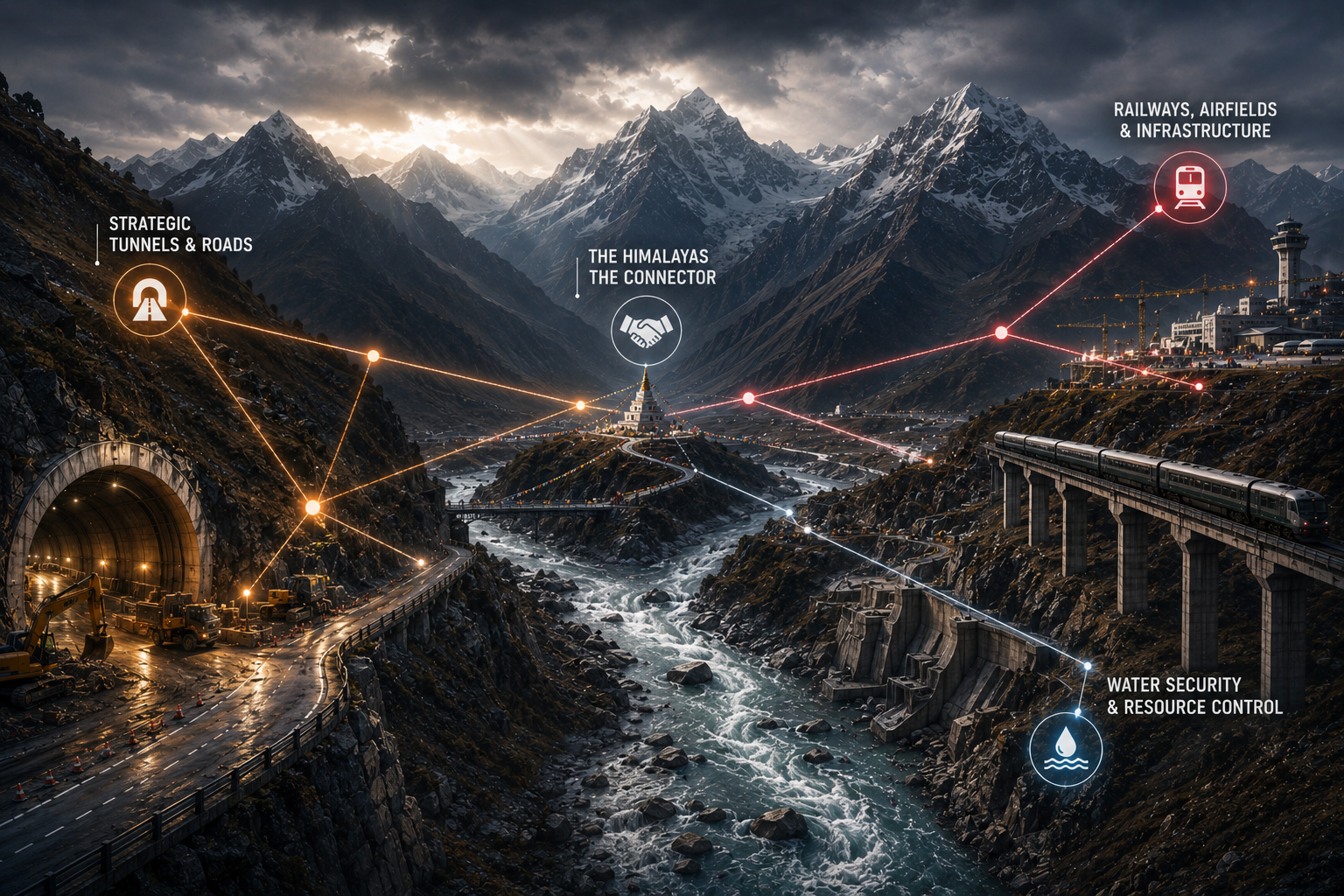
- The border between India and China has never truly been settled. The Line of Actual Control (LAC) — a 3,488-kilometre frontier that shifts with the seasons, the patrol schedules of rival armies, and the quiet repositioning of tents and checkpoints — is the world’s most consequential undefined boundary.
- This is like a game, but not the old game between Britain and Russia. This is a game between India and China, and it is happening in the Himalayas. Nepal is like a referee. It does not want to be.
- Caught between these two giants, Nepal has spent decades perfecting what analysts call ‘equidistant diplomacy’ — maintaining balanced ties with both neighbours to maximise its leverage while minimising the risk of being absorbed into either’s orbit.
- Beneath the visible contest of roads and soldiers lies an even more consequential struggle: control of the Himalayan watershed.
India, China, and Nepal are locked in a contest of infrastructure, diplomacy, and strategic positioning across the world’s most formidable mountain range — a theatre where roads, railways, and rivers carry the weight of geopolitical destiny.
The Himalayan rock is really hard. Workers are making a tunnel through it at 15,800 feet above sea level. This tunnel is called the Shinkhun La tunnel. It will be the highest road tunnel in the world. It will connect Manali to Leh. A hundred kilometres away, Chinese engineers are building highways, airfields and railway lines in the Tibet Autonomous Region. In Nepal, the prime ministers keep changing. They have to balance things between India and China, which’s not easy.
This is like a game, but not the old game between Britain and Russia. This is a game between India and China, and it is happening in the Himalayas. Nepal is like a referee. It does not want to be. The stakes are big. Who gets to be in charge, who gets water, who gets to trade and who gets the ground? The Himalayas are really important. That is why India and China are competing here. The Shinkhun La tunnel and the highways and airfields in the Tibet Autonomous Region are all part of this game.
The Line That Moves
The border between India and China has never truly been settled. The Line of Actual Control (LAC) — a 3,488-kilometre frontier that shifts with the seasons, the patrol schedules of rival armies, and the quiet repositioning of tents and checkpoints — is the world’s most consequential undefined boundary. Since the deadly clashes of June 2020 in the Galwan Valley, which killed at least 20 Indian soldiers and an undisclosed number of Chinese troops, the LAC has become the fulcrum of Asian security.
An October 2024 agreement provided a diplomatic opening. India and China agreed to restore pre-2020 patrolling rights in the contested areas of Depsang and Demchok in eastern Ladakh — pulling troops back, dismantling temporary infrastructure, and staggering patrol schedules to prevent face-offs. The deal was struck on the eve of the BRICS summit in Kazan, lending it a theatrical quality: a diplomatic choreography driven as much by the needs of multilateral optics as by genuine strategic convergence.
“Both nations continue to prepare for conflict even as they talk of peace, rendering the agreement a contradiction in itself.”— Asia Times, January 2025
The fundamental disconnect between rhetoric and reality persists. Beijing has consistently refused to call the October arrangement an “agreement,” insisting it only addressed specific patrolling patterns in limited areas. Meanwhile, China’s Western Theatre Command — responsible for the entire Himalayan frontier — continues to expand its footprint. The détente, as one analyst wrote, is “a tactical pause in an enduring standoff.”
Beijing’s Infrastructure Offensive in Tibet
While diplomats exchange pleasantries, Chinese engineers are reshaping the Tibetan plateau with breathtaking speed and ambition. Beijing allocated 80 billion yuan (approximately $11 billion) for TAR infrastructure in 2024 alone, directed toward railways, highways, and airports — investments that carry unmistakably dual-use characteristics.
The PLA’s strategic plan for the Tibet Military Region aims to “internally connect all PLA units within the Tibet Military Region and externally connect with other theatre commands” by 2035. Toward this end, China is building 10 new general airports and 47 temporary take-off and landing points within the region — the General Aviation Development Plan explicitly states that border-area airports will be prioritised to form “national security barriers.”
China’s Tibet Infrastructure: Key Projects
- Pangong Tso Bridge (completed 2024): Enables rapid troop movement between the north and south banks of Pangong Lake, the site of 2020 clashes
- G-695 Highway: Newly aligned road running close to the Arunachal Pradesh and Ladakh sectors
- Xinjiang–Tibet Railway: Under development; links Hotan to Lhasa, transforming PLA logistics across the western plateau
- Sichuan–Tibet Railway: Allows movement of heavy armour and missile units to frontier regions at unprecedented speed
- Golmud Missile Base: Expanded facility in occupied Tibet; analysts estimate it could host 24–36 road-mobile missile launchers
The strategic calculus is transparent. By building transportation infrastructure, Beijing simultaneously enhances its ability to project military power and respond to contingencies along the Tibetan frontier while obscuring the goal behind a narrative of economic development. A November 2025 report by the Stockholm-based Institute for Security and Development Policy added another dimension: this military construction is causing severe environmental damage to the fragile Himalayan ecosystem, threatening water security for hundreds of millions across South and Southeast Asia.
India’s Infrastructure Counter-Offensive
New Delhi has not been idle. Since the 2020 Galwan crisis, India’s Border Roads Organisation (BRO) has completed over 450 projects worth ₹16,000 crore, a pace of construction unprecedented in India’s post-independence history. In October 2024, Defence Minister Rajnath Singh inaugurated 75 critical strategic projects in a single ceremony — 22 roads, 51 bridges, and two miscellaneous works spanning eleven states and union territories.
The crown jewels of India’s Himalayan infrastructure push include the Sela Tunnel in Arunachal Pradesh — the world’s longest twin-lane tunnel, inaugurated by Prime Minister Modi in March 2024 — which provides all-weather connectivity to Tawang, the strategically critical district near the LAC. In July 2024, Modi personally conducted the “First Blast” of the Shinkhun La tunnel, which at 15,800 feet will become the world’s highest road tunnel once complete.
The most ambitious project of all is the 1,840-kilometre Arunachal Frontier Highway, running the length of the LAC through India’s northeastern frontier. Modi broke ground on the $4.73 billion project in September 2025 — a deliberate geopolitical signal that China received with notable displeasure. China disputes India’s right to build in Arunachal Pradesh, which it claims in its entirety as “Zangnan,” part of South Tibet.
“India’s vulnerability in even maintaining a strategically defensive posture has been challenging due to the gaps in logistics and troop mobility.”— M.S. Prathibha, Institute for Defence Studies and Analyses
The infrastructure race has created a feedback loop: every Chinese road built near the LAC accelerates Indian construction, which in turn hardens Beijing’s resolve. What began as a border management challenge has become a full-spectrum infrastructure competition that will define the military balance in the Himalayas for decades.
Nepal: The Indispensable Buffer
Caught between these two giants, Nepal has spent decades perfecting what analysts call “equidistant diplomacy” — maintaining balanced ties with both neighbours to maximise its leverage while minimising the risk of being absorbed into either’s orbit. The strategy has grown considerably more complicated in recent years.
In December 2024, Prime Minister KP Sharma Oli — making his fourth stint in office — broke with the long-standing convention of Nepali prime ministers visiting New Delhi first after assuming power. Instead, Oli flew to Beijing, signing 10 agreements including a framework for implementing the Belt and Road Initiative (BRI), the flagship Chinese connectivity programme Nepal joined in 2017 but has never operationalised.
Nearly a decade after the 2017 BRI memorandum, not a single project has actually been built. The Kerung–Kathmandu railway — the centrepiece of China’s vision for Himalayan connectivity — remains a feasibility study, stalled by extraordinary engineering challenges, seismic risk, and Nepal’s well-founded anxiety about Chinese loan terms. Oli’s December 2024 deal only moved forward after China replaced “aid financing” language with “grant financing” — a telling signal of Nepali wariness about the debt trap that swallowed Sri Lanka’s Hambantota port.
Nepal’s economic reality constrains its strategic ambitions. Nearly 70% of its trade runs through India; millions of Nepali citizens live and work across the open border; India buys the bulk of its hydropower. In 2025, China’s exports to Nepal reached NPR 298.77 billion — a significant figure, but one that underscores the structural asymmetry: Nepal’s exports to China amounted to just NPR 2.48 billion in the same period.
Nepal’s Balancing Act: The Numbers
- ~70% of Nepal’s trade is with India
- China’s exports to Nepal (2023–24): NPR 298.77 billion
- Nepal’s exports to China: NPR 2.48 billion
- 14 of 21 Nepal–China border trade points reopened in May 2024
- BRI framework signed 2017 — zero projects implemented as of 2026
- Nepal declared “dialogue partner” at SCO summit, 2025
Kathmandu’s diplomatic difficulty deepened in 2025 when India and China, in a rare moment of bilateral coordination, agreed to reopen trade routes via Lipulekh, Shipki La, and Nathu La without consulting Nepal — crossing territory that Kathmandu claims. Nepal lodged formal protests, as it has done repeatedly since 2015. The episode illustrated a painful truth: even when India and China cooperate, Nepal can find itself sidelined.
Water: The Invisible Front
Beneath the visible contest of roads and soldiers lies an even more consequential struggle: control of the Himalayan watershed. Four major river systems — including the Brahmaputra (Yarlung Tsangpo), which flows from the Tibetan Plateau into the Bay of Bengal — are shared between China and India. China’s upstream position as the source of these rivers, combined with its aggressive dam-building programme and the January 2025 approval of the world’s most expensive infrastructure project (a hydroelectric dam on the Yarlung Tsangpo that dwarfs the Three Gorges Dam), gives Beijing extraordinary leverage over downstream populations in India, Bangladesh, and Southeast Asia.
No formal water-sharing agreements exist between India and China. In a region where glaciers are retreating, monsoon patterns are destabilising, and hundreds of millions depend on Himalayan river flows, this absence is not merely a diplomatic gap — it is a potential flashpoint that climate change will only intensify.
The Shape of Things to Come
The Himalayas in 2026 are a zone of managed competition — hot enough to demand constant vigilance, cool enough (for now) to avoid outright conflict. Both India and China have pragmatic reasons to avoid war: their economies are deeply intertwined (China overtook the United States in 2024 to become India’s largest trading partner again), and both face more pressing strategic challenges elsewhere. Yet both continue building, deploying, and positioning as if war were a constant possibility.
Nepal will continue to walk its diplomatic tightrope, extracting what development it can from the competition of its neighbours while working to ensure that neither gains a decisive foothold. The BRI will remain more aspiration than architecture on Nepali soil — a symbol of Chinese ambition constrained by Himalayan geography, Nepali caution, and Indian vigilance.
What the new Great Game ultimately reveals is that in the 21st century, geopolitical competition is infrastructure competition. The nation that builds faster — roads through permafrost, tunnels beneath glaciers, airstrips above the clouds — shapes the battlefield of the future. In the Himalayas, the construction crews are the vanguard.
References:
- Chatham House. “How China–India relations will shape Asia and the global order.” April 2025. chathamhouse.org
- Asia Times. “Delusion of de-escalation on the China-India border.” January 22, 2025. asiatimes.com
- Geopolitical Monitor. “India-China Border Agreement: A Tactical Step, No Strategic Reset.” March 28, 2025. geopoliticalmonitor.com
- Foreign Policy. “Why the India-China Relationship Is Poised to Remain Tumultuous in 2025.” February 6, 2025. foreignpolicy.com
- Foreign Policy. “China and India Haven’t Patched Things Up on the Border.” April 3, 2025. foreignpolicy.com
- The Diplomat. “With an Eye Toward India, China Bolsters Military Infrastructure Development in Tibet.” January 19, 2024. thediplomat.com
- CSIS. “China’s Gray-Zone Infrastructure Strategy on the Tibetan Plateau: Roads, Dams, and Digital Domination.” November 14, 2025. csis.org
- Tibet Rights Collective. “Chinese Infrastructure Buildup Near India’s Northern Borders: The Eight-Year Surge Since Doklam.” November 8, 2025. tibetrightscollective.in
- International Campaign for Tibet. “Why Tibet? Strategic Imperatives for International Peace and Security.” November 25, 2025. savetibet.org
- The News Himachal. “China’s Military Buildup in Tibet Threatens Himalayan Ecosystem and India’s Water Security: ISDP Report.” August 21, 2025. thenewshimachal.com
- Free Press Journal. “India’s World-Class Border Infrastructure Development Along the LAC Accelerates Strategic Readiness.” May 9, 2025. freepressjournal.in
- Indo-Pacific Defense Forum. “Infrastructure Race Accelerates at India-China Border.” January 6, 2026. ipdefenseforum.com
- India Sentinels. “India Fortifies Border Infrastructure with 125 Strategic LAC Projects.” December 7, 2025. indiasentinels.com
- South China Morning Post. “Amid Tensions with China, India Ramps Up Border Infrastructure Connectivity.” July 31, 2024. scmp.com
- Business Standard. “Nepal 2024: Shifting coalitions; new PM balances ties with India, China.” December 30, 2024. business-standard.com
- Khabarhub. “Equidistant, Equicentric, and Equivalent Diplomacy: Nepal between India and China.” August 21, 2025. english.khabarhub.com
- South Asian Voices. “Nepal’s Dilemma: Balancing Sovereignty with Ties to India and China.” October 21, 2025. southasianvoices.org
- PolSci Institute. “Nepal’s Strategic Balancing Act Between India and China.” October 29, 2025. polsci.institute
- Nepal News. “India–China Re-engagement and Nepal’s Strategic Dilemmas.” September 6, 2025. english.nepalnews.com
- Global Voices. “Geopolitics of Energy in Nepal: Balancing India, China, and the US.” April 10, 2025. globalvoices.org
- The Economist. “China Approves the World’s Most Expensive Infrastructure Project.” January 2, 2025. economist.com
- Atlas Institute for International Affairs. “India-China Relations in 2025: Between Reset and Reality.” December 10, 2025. atlasinstitute.org

Divyanka Tandon holds an M.Tech in Data Analytics from BITS Pilani. With a strong foundation in technology and data interpretation, her work focuses on geopolitical risk analysis and writing articles that make sense of global and national data, trends, and their underlying causes. Views expressed are the author’s own.
 Anjali Singh
  Parag Gilada