
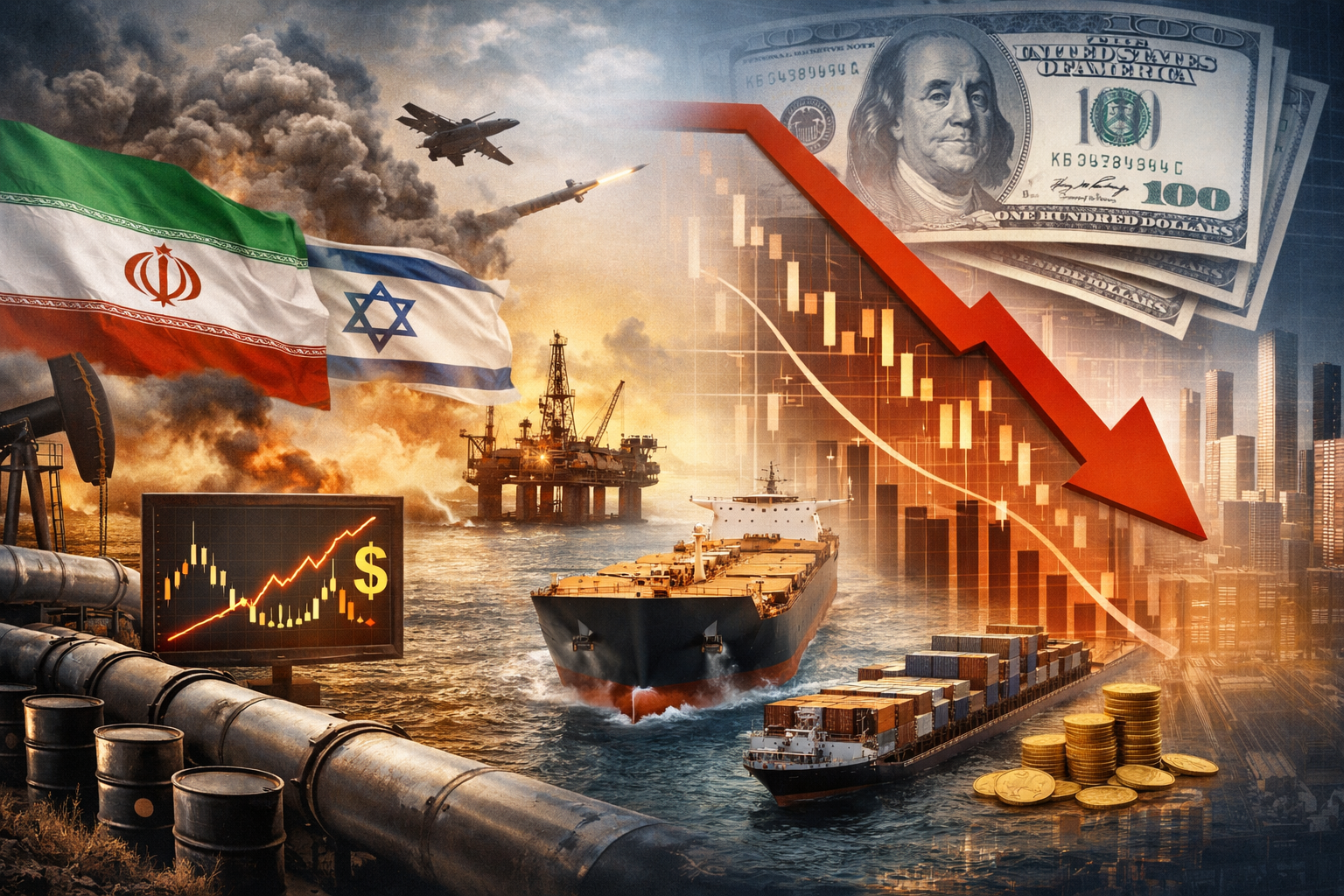
- The first, and most direct, transmission channel of the Iran–Israel conflict is the global oil market.
- Far from being solely an energy market issue, the Iran–Israel conflict is now placing significant strain on global trade and supply chains.
- Among the more substantial implications is a reallocation of global capital flows.
- The Iran–Israel conflict carries significant long-term economic implications that extend well beyond the region.
Territorial conquest and death toll have traditionally been the primary metrics of war. Yet, in a globalised economy, the most significant consequences of conflict are often economic, indirect, long-lasting, and far-reaching. The Iran–Israel conflict, including its current iteration, exemplifies this trend. What may appear as a localised military escalation is, in reality, generating ripple effects across global markets, supply chains, and financial systems. Few sectors illustrate this interconnected vulnerability more clearly than the U.S. Treasury market, valued at over $25 trillion, which is sensitive to geopolitical shocks emanating from regions such as West Asia, where a substantial share of global energy production and critical maritime chokepoints converge within a highly volatile geopolitical landscape.
West Asia accounts for a substantial share of global oil supply, and any disruption, real or anticipated, sends shockwaves through global financial markets, driving oil price volatility, fuelling inflation, and heightening overall market uncertainty. The strategic vulnerability of critical maritime chokepoints, such as the Strait of Hormuz, further amplifies these risks, threatening the uninterrupted flow of energy and global trade. Meanwhile, investors have grown risk-averse amid rising geopolitical tensions, resulting in heightened market volatility and more cautious capital allocation, particularly away from emerging markets.
Under these circumstances, the Iran–Israel conflict constitutes a systemic economic shock with global ramifications, rather than merely a geopolitical confrontation. In this article, I examine the multidimensional economic costs of the conflict, moving beyond the battlefield to assess its impact on energy markets, trade networks, financial systems, and the sustainability of long-term global economic growth.
Energy Shock: The Primary Transmission Channel of Conflict
The first, and most direct, transmission channel of the Iran–Israel conflict is the global oil market. Geopolitical tensions in West Asia have historically driven oil price volatility; however, the current escalation is distinct due to the region’s centrality to global energy supply. The Strait of Hormuz represents a critical bottleneck, with nearly one-fifth of global oil consumption transiting through it, and even the threat of disruption can send prices soaring. Even limited supply disruptions or heightened uncertainty can trigger speculative activity in energy markets, amplifying price spikes.
Such volatility generates significant knock-on effects across the global economy. Elevated energy prices feed directly into inflation by increasing the costs of production and transportation across the economy. For energy-importing countries, especially in the Global South, this translates into widening current account deficits, currency depreciation pressures, and reduced fiscal space. In addition, high fuel prices disproportionately affect energy-intensive sectors, such as manufacturing, aviation, and logistics, thereby constraining growth in these industries. In this regard, the war is not merely a regional disturbance transmitted through energy markets, but a systemic global economic shock, echoing past oil crises, albeit within a far more complex and fragile macroeconomic environment.
Trade Disruptions and Supply Chain Vulnerabilities
Far from being solely an energy market issue, the Iran–Israel conflict is now placing significant strain on global trade and supply chains. The region’s sea lanes, particularly the Strait of Hormuz, are critical not only for oil shipments but also for facilitating a substantial share of global merchandise trade. Heightened geopolitical risk in these waters has led to increased shipping costs, surging insurance premiums, and precautionary vessel rerouting, all of which raise transaction costs and extend delivery times.
In an economy that is organised for efficiency and speed, such disruptions have outsized effects. They fall within the shadow of scattered and interdependent modern supply chains, with any given manufacturing stage taking place across multiple countries. Thus, interruptions at a single point can have ripple effects through a variety of industries, from the production of goods to retail. Higher transportation costs are often passed along to consumers, adding to inflationary pressure that is already being fed by energy price volatility. In addition, this chaos reveals a deeper structural problem, that global trade networks are vulnerable to geopolitical shocks.
The conflict thus illustrates how, while economic interdependence creates greater growth and economic opportunity for states, it also creates new vulnerabilities should key transit routes become contested or unstable.
Financial Market Volatility and Capital Flow Uncertainty
The financial ramifications of the Iran–Israel conflict spill over into global financial markets, as rising geopolitical tensions are contributing to market volatility and risk aversion. Historically, wars in strategically important areas have been known to suddenly move the equity, currency and bond markets as investors start rethinking risks. This war is no different. Uncertainty surrounding the duration and scale of the conflict, coupled with oil price fluctuations, has destabilised financial markets and amplified volatility in investor sentiment.
Among the more substantial implications is a reallocation of global capital flows. During periods of heightened uncertainty, investors often withdraw capital from emerging markets and reallocate it toward perceived safe-haven assets, leading to currency depreciation, capital outflows, and increased financial stress in already vulnerable economies. This mechanism can exacerbate existing macroeconomic imbalances, particularly in countries grappling with high inflation or significant external debt burdens.
In addition, potential disruptions to capital flows from oil-exporting Gulf economies introduce an additional layer of uncertainty into global financial stability. In this context, the conflict generates not only immediate market volatility but also deeper and more persistent financial vulnerabilities, thereby reinforcing its characterisation as a systemic global economic shock.
India’s Economic Exposure in a Volatile West Asian Region
The Iran–Israel tensions carry significant implications for India’s economy, given its heavy dependence on energy imports and trade linkages with West Asia. India remains highly vulnerable to fluctuations in global energy prices, as it is among the world’s largest importers of crude oil. A sustained rise in oil prices widens the current account deficit and contributes to higher domestic inflation, as well as depreciation pressures on the rupee. These macroeconomic strains, in turn, constrain fiscal space and limit the effectiveness of monetary policy responses.
Alongside energy issues, disturbances in important sea lanes disrupt India’s trade with Europe and West Asia, increasing transport costs and delivery risks. The region is also vital for remittances and investment flows, which increase India’s vulnerability to turbulence. At an overarching level, the war places India in a precarious situation, as it tries to balance its relations with Israel, Iran, and Gulf economies. Within this perspective, even when India is far from the battle lines, it is an economy still very much caught up in the conflict’s wider economic fallout.
Long-Term Economic Costs and Global Stability Risks
Beyond the immediate disruptions, the Iran–Israel conflict carries significant long-term economic implications that extend well beyond the region. Prolonged geopolitical tensions tend to dampen investor confidence, delay investment decisions, and constrain global economic growth. Amid persistent uncertainty, businesses and governments are likely to adopt more cautious strategies, reduce capital expenditure, and scale back growth expectations. Meanwhile, sustained energy price volatility raises the risk of stagflation, a macroeconomic condition characterised by simultaneously high inflation and low growth, which poses significant challenges for policymakers.
The dispute is also part of a wider trend of splintering in the world economy, as nations place greater priority on security rather than efficiency in trade and investment decisions. Such a turn to geo-economics may undermine the pillars of globalisation and produce more regionalised and disintegrated economic systems. In this respect, the cost of war is not just short-term but also structural, as it sets the course for the world economy for the future.
Conclusion
The Iran–Israel conflict exemplifies a fundamental reality of the modern global economy: the costs of war extend far beyond the battlefield. Through interconnected energy markets, trade routes, and financial systems, localised conflicts generate global economic repercussions that affect both developing and advanced economies alike. The unfolding crisis underscores how deeply global economic stability is intertwined with geopolitical dynamics in strategically critical regions. For policymakers, this necessitates a renewed emphasis on resilience, diversification, and robust risk management strategies. Ultimately, the true cost of war lies not only in immediate economic disruption but also in the persistent uncertainty it creates for the future trajectory of the global economy.

Archita Gaur is a postgraduate student at the School of International Studies, JNU. She specialises in the World Economy and has a strong interest in public policy, economic research, and governance. The views expressed are the author’s own.
 Dr Mohmmad Rizwan
  Parag Gilada