- India and Japan have emerged as major regional allies, sharing a common vision of a free, open and rules-based Indo-Pacific.
- Nearly 40 per cent of global energy trade passes through such chokepoints, and any disruption has cascading effects on the global economy, forcing countries to activate emergency measures.
- Such actions can lead to violations of maritime boundaries and unauthorised extraction of resources.
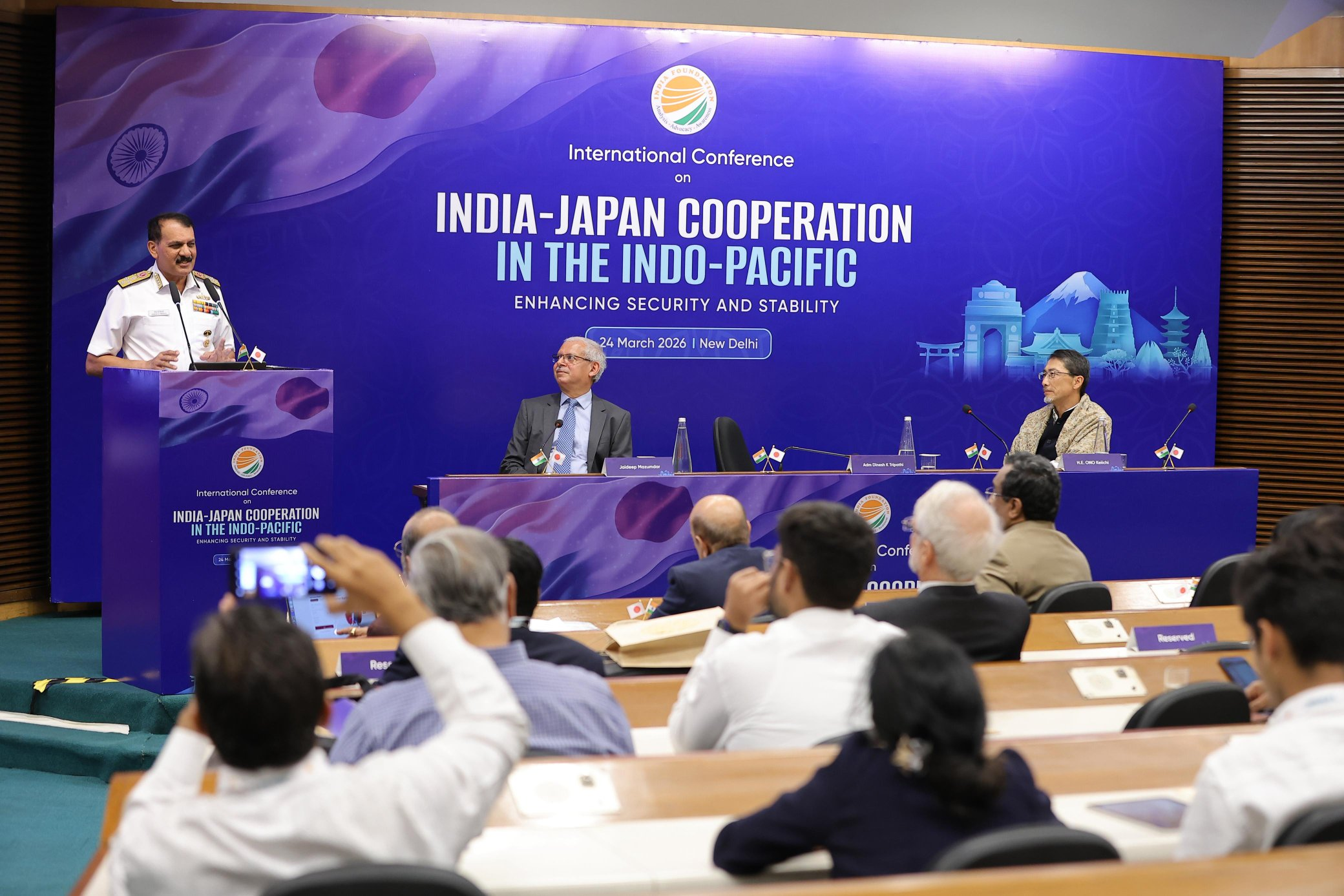
In the international conference on India-Japan cooperation in the Indo Pacific, organised by the India Foundation on 24 March 2026, the session witnessed participation from former Secretary East in the Ministry of External Affairs, Jaideep Mazumdar, Chief of Naval Staff, Admiral Dinesh K. Tripathi, and Keiichi Ono, Ambassador of Japan to India.
The session focused on the ongoing relationship and bilateral cooperation between India and Japan in the strategically important Indo-Pacific region. India and Japan have emerged as major regional allies, sharing a common vision of a free, open and rules-based Indo-Pacific. Both countries remain committed to enhancing security and safeguarding stability in the region.
This summit comes at a critical juncture when global chokepoints are increasingly becoming militarised. Given that the Indo-Pacific hosts several key maritime chokepoints, recent developments highlight their vulnerability. The situation in the Strait of Hormuz is a prime example, where blockades have led to severe disruptions and triggered a global energy crisis. What is unfolding in West Asia could potentially be replicated in East Asia, making it imperative for regional powers to strengthen cooperation and security mechanisms.
During the session, Admiral Dinesh K. Tripathi highlighted how modern technology has lowered the threshold for disruption, enabling states to threaten global chokepoints like the Strait of Hormuz without formally declaring blockades. His remarks come in the backdrop of the ongoing tensions involving Iran, the United States and Israel, where Iran’s actions in restricting maritime movement have significantly impacted global energy flows. Nearly 40 per cent of global energy trade passes through such chokepoints, and any disruption has cascading effects on the global economy, forcing countries to activate emergency measures.
Admiral Dinesh K. Tripathi highlighted how modern technology has lowered the threshold for disruption, enabling states to threaten global chokepoints like the Strait of Hormuz without formally declaring blockades.
Admiral Tripathi also emphasised the risks associated with excessive dependence on a single energy source, noting how such vulnerabilities are exposed during disruptions like those in the Strait of Hormuz. He described the Indo-Pacific as the principal theatre of future geopolitical competition. Without naming any country, he pointed out a shift in global competition from oil and gas to rare earth minerals and critical resources, a trend clearly visible in the Indo-Pacific region.
Another critical issue raised was the sharp rise in deep-sea research activities involving vessels going dark in the Exclusive Economic Zones of other countries. Ships typically use the Automatic Identification System to transmit their location and movement, ensuring transparency and maritime safety. However, there is a growing trend of vessels deliberately switching off AIS, making their movements opaque and difficult to track.
Such actions can lead to violations of maritime boundaries and unauthorised extraction of resources. Under the United Nations Convention on the Law of the Sea, coastal states have sovereign rights over resources within their Exclusive Economic Zones. By going dark, vessels can bypass detection, conduct covert operations, or even engage in resource exploitation under the pretext of research or surveillance.
These developments reflect a broader reality of contemporary geopolitics, where major powers are increasingly using covert and ambiguous tactics to assert influence and expand their strategic footprint.
Given India’s geographical position at the heart of the Indo-Pacific, any instability in the region directly or indirectly impacts its national interests. Therefore, it becomes crucial for India, as a responsible regional power, to deepen cooperation with like-minded countries such as Japan. Strengthening this partnership is essential to maintaining the balance of power, ensuring maritime security, and preserving stability in the Indo-Pacific.

Aayush Pal is a freelance writer on contemporary geopolitical developments. The views expressed in his work are entirely his own.
 Rajeev KS
  Hridbina Chatterjee
  Diksha Bharti