- The ongoing U.S.-Israel military collaboration against Iran has once again entangled the United States in West Asia.
- The United States, under the Trump administration, aims to normalise relations with Beijing. They undertook several steps to achieve these aims, including finalising trade agreements and facilitating the first visit by a U.S. president, Donald Trump, to China in a decade.
- The alteration in U.S. foreign policy has engendered a growing suspicion among its partners in the Indo-Pacific area.
- This represents yet another deceleration in the history of Quad and should not be interpreted as its demise.
- Between 2009 and 2016, Quad experienced a decline, although it subsequently rejuvenated itself. Thus, its future rebirth remains a possibility.”
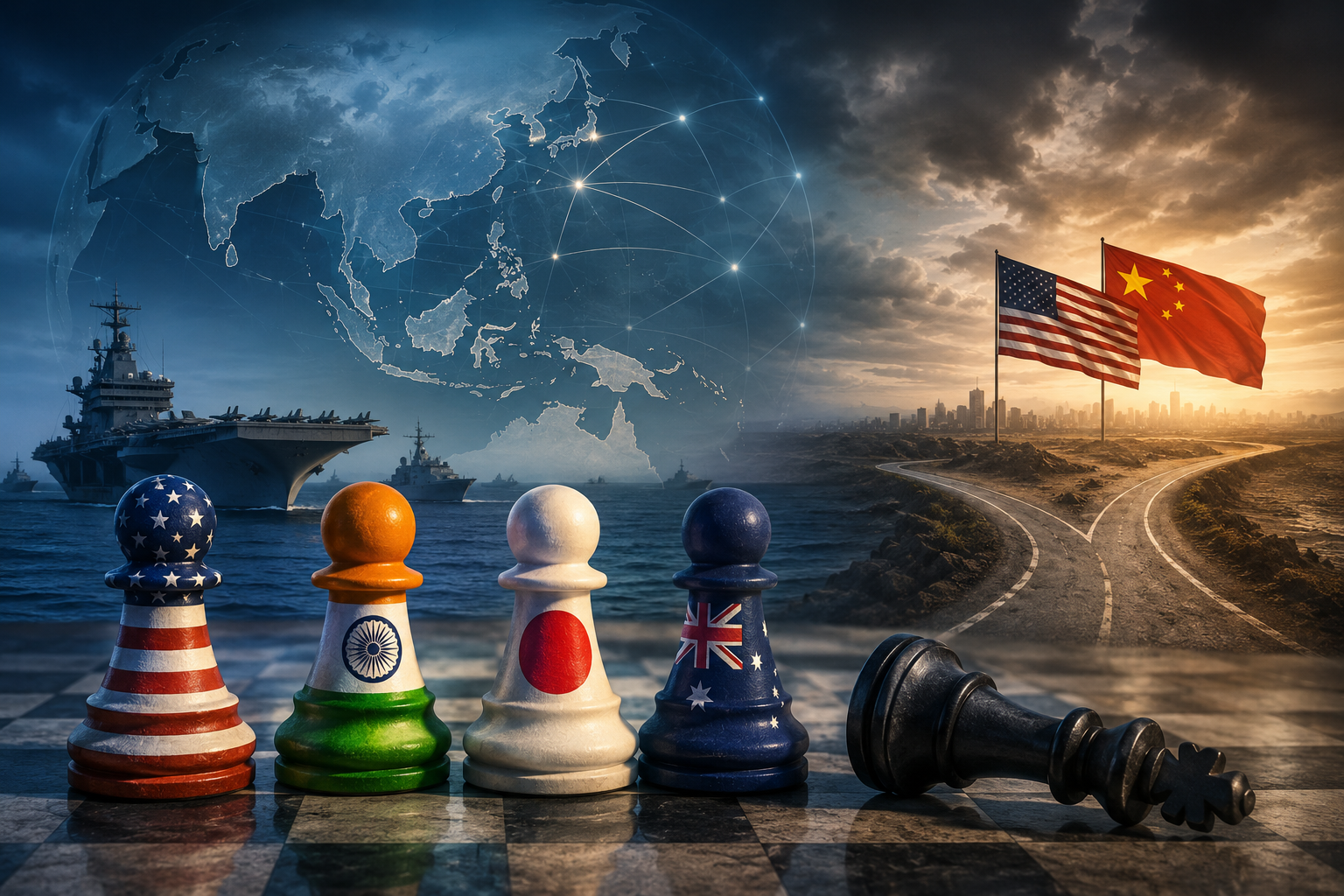
Geopolitical analysts are speculating about the demise of the Quadrilateral organisation, which includes the United States, India, Japan, and Australia. These voices emerged with Donald J. Trump’s second term as President of the United States. They grew more robust due to Trump’s foreign policy for Asia, which became increasingly focused on West Asia and less amicable towards friends such as India. Since 2025, U.S. policy toward Asia has adopted a less confrontational stance toward China. The U.S. National Security Strategy of 2025 mentioned the organisation only once. A leader’s meeting occurred in 2025. Neither the U.S. president nor the Japanese prime minister attended the event. Recently, New Delhi convened the QUAD summit with foreign ministers and secretaries from the member nations. The article is analytical, examining how significant geopolitical shifts have affected the status of QUAD.
Historical Context of ǪUAD
The Quad is a strategic and diplomatic initiative including India, the United States, Australia, and Japan aimed at establishing a rule-based order in the Indo-Pacific area. The 2004 Indian Ocean tsunami marked the beginning of the Quad. The four nations established the ‘Tsunami Core Group’ to synchronize their emergency and humanitarian efforts. The Japanese PM reportedly made steps to institutionalise the group from 2006 to 2007. These endeavors were based on the belief that rising China threatens the rule-based system. Afterwards, the Quad 1.0 diminished; however, the circumstances surrounding its decline remain ambiguous. However, the decline of Quad 1.0 was primarily due to nations’ policies that favoured engaging with China on a bilateral basis.
By 2017, China’s assertive military stance in the South China Sea and along its border with India became evident. This compelled Japanese Prime Minister Shinzo Abe to endeavour to rejuvenate the Quad as an institution. On this occasion, Japan obtained assistance from other members. They commenced organising their collaborative meetings at multilateral forums, including ASEAN and the United Nations. The significant enhancement of the Quad occurred between 2020 and 2022. Significant events included the Covid-19 epidemic originating in China, the Sino-India military confrontation in the Galwan Valley resulting in casualties for both nations, and the inauguration of Joe Biden as the new U.S. president. These factors compelled these four nations to enhance their partnership through the Quad initiative. This was a new phase for Quad, which came to be known as Quad 2.0.
These four countries undertook two significant cooperative initiatives: the first being the Quad Vaccine Partnership, designed to supply billions of Covid vaccines to the region. Subsequently, they initiated the Indo-Pacific Partnership for Maritime Domain Awareness. The principal advancements for the Quad regarding multilateral collaboration were as follows.
The Decline of Quad: A Significant Geopolitical Transformation in U.S. Foreign Policy
Several causes contributed to the diminishing prominence of the Quad in global politics. The primary reason is the alteration in U.S. foreign policy. The ongoing U.S.-Israel military collaboration against Iran has once again entangled the United States in West Asia. Consequently, modern U.S. foreign policy increasingly focuses on West Asia, while the Indo-Pacific area loses significance. This was the impetus for building détente between the United States and China. The United States, under the Trump administration, aims to normalise relations with Beijing. They undertook several steps to achieve these aims, including finalising trade agreements and facilitating the first visit by a U.S. president, Donald Trump, to China in a decade.
The United States’ strategy to avert confrontation with China may also be regarded as a result of the recently created understanding between the two nations. Pakistani journalist Najam Sethi contended that the United States has acknowledged China as an equal power and seeks to resolve its issues through non-confrontational means. This may be viewed as an inflated anticipation; however, there are evident indications that the United States is no longer inclined to provoke Beijing. During his visit to China, President Trump referenced the G-2 (the United States and China), indicating that the United States is a dominant power. Recently, the United States has suspended a US$ 14 billion arms deal to Taiwan.
The alteration in U.S. foreign policy diminished the significance of the Quad, as seen by its conduct. In June 2025, Indian Prime Minister Modi extended an invitation to the U.S. President for the summit, but his attendance is pending.
Distrust Among U.S. Allies
The alteration in U.S. foreign policy has engendered a growing suspicion among its partners in the Indo-Pacific area. They believe that President Trump has compromised Asia for America’s interests. This situation compelled these countries to develop their respective policies to address China and other regional issues. For instance, the Japanese Prime Minister has not participated in the Quad Summit since 2025. Japan and South Korea are engaged in discussions with Iran. They could no longer depend on the U. S. for their personal interests.
Conclusion: Options for New Delhi
New Delhi now confronts a new geopolitical dilemma as it navigates strained relations with the United States over tariff issues. It is encountering antagonism from Pakistan and China. The declining status of the Quad holds numerous elements for India; primarily, India has consistently approached the value of the Quad with pragmatism. New Delhi understood that the Quad would not engage in military intervention in the event of a crisis with China. However, it afforded India an opportunity to seek major power status and advance its national interests. India utilised the Quad alliance to ensure the procurement of rare earth minerals from Australia. Secondly, this represents yet another deceleration in the history of Quad and should not be interpreted as its demise. Between 2009 and 2016, Quad experienced a decline, although it subsequently rejuvenated itself. Thus, its future rebirth remains a possibility. Third, India must also engage in collaboration with other nations in the group, barring the United States. India must use prudence and strategic acumen in its engagement with the Quad. It need not be entirely relinquished.

Dr Mohammad Rizwan holds a PhD in political science from Jamia Millia Islamia. His doctoral research focuses on Pakistan’s relations with major global powers. Views expressed are the author’s own.
 Parag Gilada
  Aayush Pal
  Archita Gaur