
- The country occupies one of the most strategically important geographical positions in Asia, connecting South Asia, Southeast Asia, and Southwest China.
- The competition between India and China is likely to shape the future trajectory of regional connectivity in Myanmar.
- Regional connectivity cannot flourish without territorial stability and administrative control.
- Ultimately, Myanmar’s future role as a connector rather than a conflict zone will depend on whether its leadership can achieve sufficient internal stability while balancing the interests of powerful regional actors.
Myanmar’s new leadership under Min Aung Hlaing represents less of a democratic transition and more of a restructuring of military authority into a formal constitutional framework. After years of ruling through the State Administration Council following the 2021 coup, the military leadership sought greater political legitimacy through elections and institutional changes that culminated in Min Aung Hlaing’s elevation to the presidency in 2026. Although critics view the process as heavily controlled by the military establishment, the leadership change has significant implications beyond Myanmar’s domestic politics. The country occupies one of the most strategically important geographical positions in Asia, connecting South Asia, Southeast Asia, and Southwest China. Consequently, any shift in Naypyidaw’s political orientation directly affects regional connectivity initiatives involving the Association of Southeast Asian Nations, the Bay of Bengal Initiative for Multi-Sectoral Technical and Economic Cooperation, India, and China.
From the ASEAN perspective, Myanmar remains both a strategic necessity and a diplomatic challenge. ASEAN’s vision of regional integration depends heavily on connectivity, supply chains, cross-border trade, and political stability. However, Myanmar’s prolonged civil conflict has complicated ASEAN’s consensus-based approach. The organisation has repeatedly restricted high-level political participation by Myanmar while simultaneously attempting to maintain engagement through humanitarian and diplomatic channels. The emergence of a formally constituted government under Min Aung Hlaing may create opportunities for limited re-engagement, especially among member states prioritising stability over political reform. Nevertheless, ASEAN faces a dilemma: excessive engagement risks legitimising military rule, while isolation could push Myanmar further toward external powers. Therefore, the future of ASEAN connectivity projects involving Myanmar will depend on whether the new leadership can reduce internal conflict and restore basic administrative control across major transportation corridors.
Myanmar’s role within BIMSTEC is equally important because it serves as the only member connecting mainland Southeast Asia with the Bay of Bengal region. BIMSTEC has long emphasised transport corridors, energy cooperation, maritime connectivity, and trade facilitation. Projects such as the BIMSTEC Master Plan for Transport Connectivity depend on Myanmar functioning as a stable transit state. Political instability has delayed several infrastructure initiatives, limiting the organisation’s effectiveness. Under the new leadership, Myanmar may seek to utilise BIMSTEC as a platform for diplomatic normalisation since the grouping focuses primarily on development and connectivity rather than governance issues. If Naypyidaw actively participates in BIMSTEC projects, the organisation could gain renewed relevance as an alternative framework linking South and Southeast Asia. However, continued armed conflict would undermine investment confidence and make implementation difficult, regardless of political commitments made at the regional level.
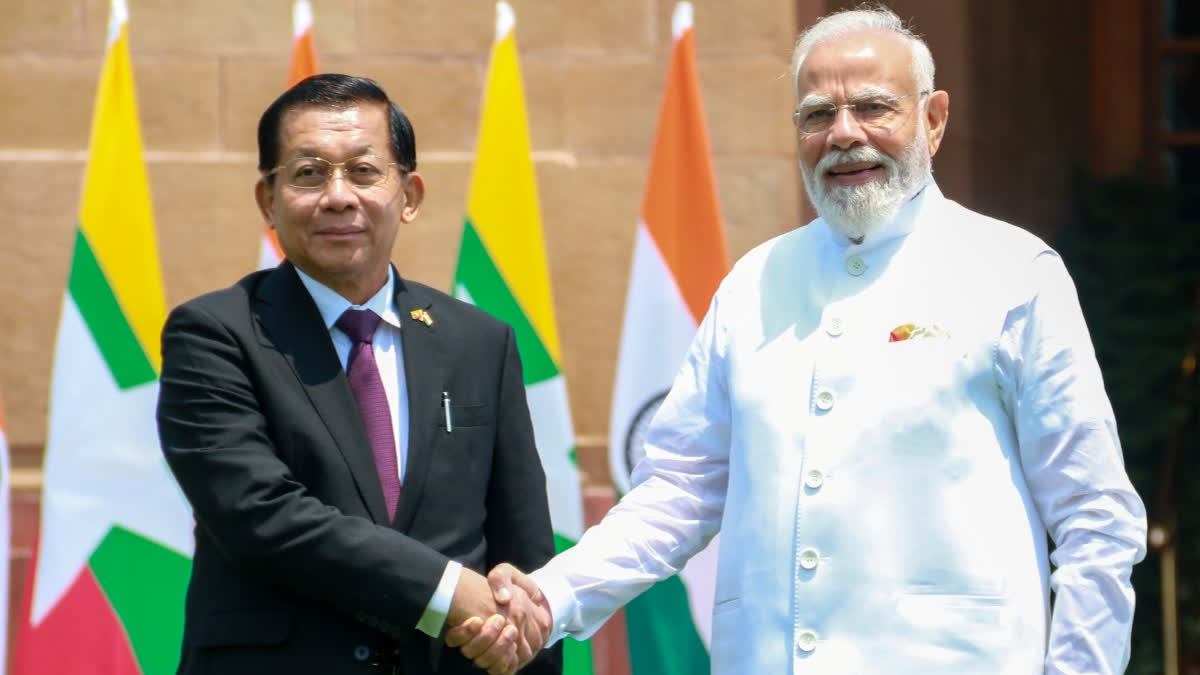
For India, Myanmar occupies a central position in the “Act East Policy,” which seeks deeper economic and strategic integration with Southeast Asia. India shares a long and sensitive border with Myanmar, particularly affecting the northeastern states. Security concerns involving insurgent groups, refugee flows, and cross-border crime have encouraged New Delhi to maintain engagement with Myanmar regardless of international criticism. Major projects such as the Kaladan Multi-Modal Transit Transport Project and the India–Myanmar–Thailand Trilateral Highway illustrate India’s long-term vision of transforming Myanmar into a gateway connecting the Indian Ocean with mainland Southeast Asia. The emergence of a new government in Naypyidaw provides India with an opportunity to accelerate stalled projects and strengthen diplomatic channels. Recent high-level interactions between Indian and Myanmar leaders indicate a pragmatic approach focused on security, connectivity, and economic cooperation rather than ideological alignment.
China’s interests in Myanmar are even more extensive and deeply embedded. Myanmar occupies a critical position within the Belt and Road Initiative and the China–Myanmar Economic Corridor. Through pipelines, highways, railways, and port infrastructure, China seeks direct access to the Indian Ocean while reducing dependence on maritime routes passing through the Strait of Malacca. The deep-sea port project at Kyaukphyu and associated transport corridors illustrate the strategic importance Beijing attaches to Myanmar. The new leadership is likely to continue close cooperation with China because of economic dependence, diplomatic support, and security considerations. Yet Myanmar’s rulers also understand the risks of excessive reliance on Beijing. Consequently, the government may attempt a balancing strategy by engaging India, ASEAN members, and other regional partners while maintaining strong relations with China. This balancing behaviour reflects a longstanding feature of Myanmar’s foreign policy tradition.
The competition between India and China is likely to shape the future trajectory of regional connectivity in Myanmar. Both powers view infrastructure as a strategic instrument rather than merely an economic tool. China’s projects generally possess greater financial resources and implementation capacity, while India often enjoys stronger cultural and historical linkages, particularly through Buddhist heritage and people-to-people contacts. Myanmar’s leadership may leverage this rivalry to attract investment from both sides. If managed effectively, such competition could generate roads, ports, industrial zones, and energy networks that benefit the broader region. However, if geopolitical rivalry intensifies, connectivity projects may become fragmented into competing spheres of influence. The challenge for Myanmar will be maintaining strategic autonomy while extracting economic benefits from both partners without becoming overly dependent on either.
Another crucial factor is the domestic security environment. Regional connectivity cannot flourish without territorial stability and administrative control. Large parts of Myanmar continue to experience conflict involving ethnic armed organisations and resistance groups. Many proposed transport corridors pass through contested regions where security risks remain high. Investors and neighbouring governments require predictable conditions before committing substantial resources. The new leadership has emphasised state authority and economic reconstruction, but sustainable connectivity will require political accommodation with ethnic communities and local stakeholders. Infrastructure projects imposed without local consent may generate resistance rather than integration. Therefore, the future success of ASEAN, BIMSTEC, Indian, and Chinese initiatives depends not only on interstate diplomacy but also on Myanmar’s ability to address its internal political fragmentation and humanitarian challenges.
Myanmar’s new leadership marks an important moment in the evolution of regional geopolitics. The country remains a strategic crossroads linking South Asia, Southeast Asia, and China, making its political trajectory highly consequential for regional connectivity. ASEAN seeks stability and integration, BIMSTEC requires a functioning land bridge, India views Myanmar as the cornerstone of its eastern outreach, and China considers it indispensable to its continental and maritime strategies. The new government may create opportunities for renewed engagement and infrastructure development, but these prospects remain constrained by ongoing conflict, questions of legitimacy, and geopolitical competition. Ultimately, Myanmar’s future role as a connector rather than a conflict zone will depend on whether its leadership can achieve sufficient internal stability while balancing the interests of powerful regional actors.

Kumar Sheni is an Assistant Professor of Political Science at the School of Geopolitics and Public Policy, REVA University, Bengaluru. Views expressed are the author’s own.
 Parag Gilada
  Aayush Pal
  Archita Gaur