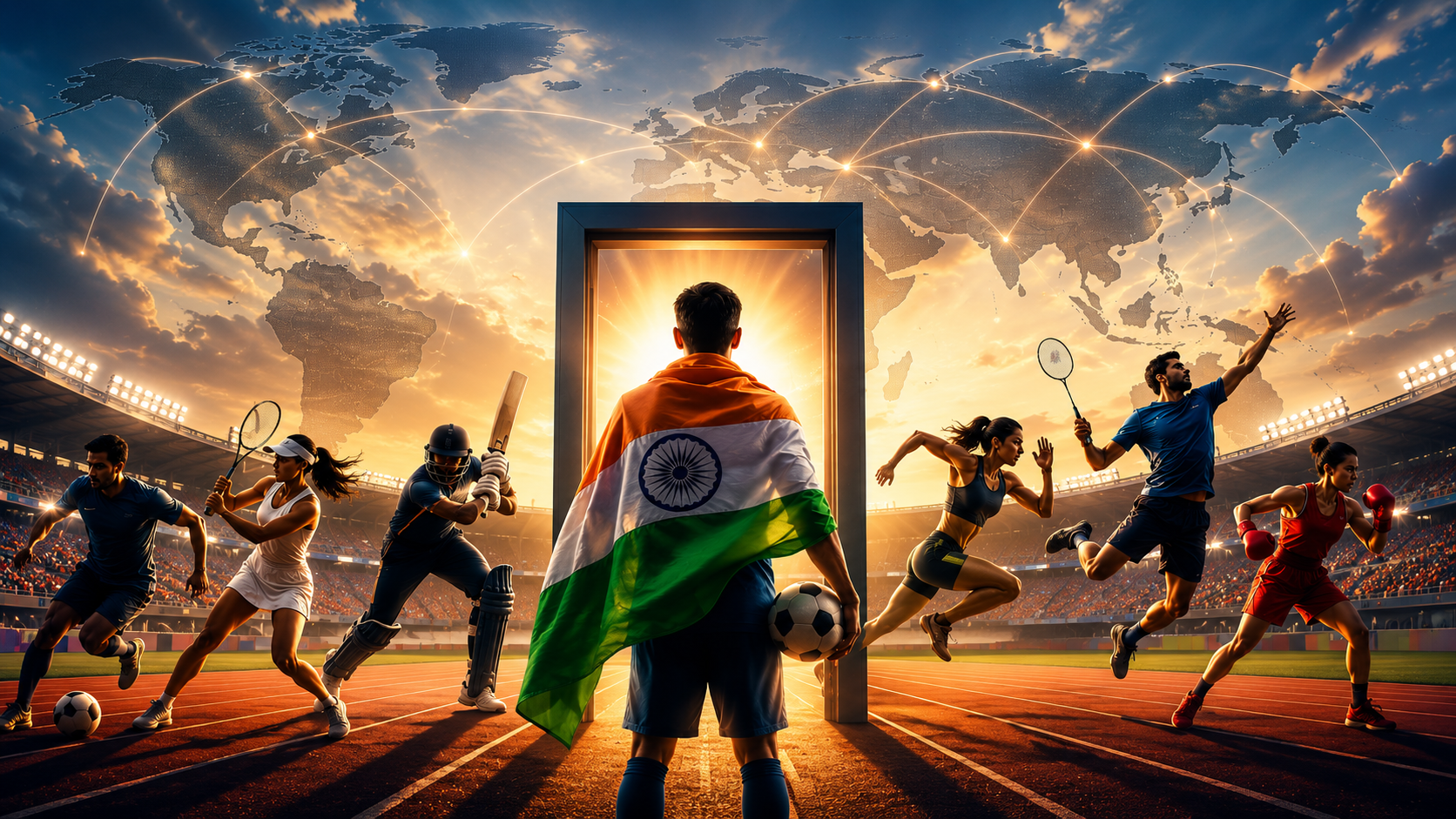
- The Sports Passport is not just a pamphlet but a nuanced instrument of engagement with a diaspora, a direct provocation of a centuries-old framework of Westphalian sovereignty in sports, and an indispensable medium of sports diplomacy in India.
- As a result, there has been a wellspring of world-class athletic talent given a sound footing in the elite sporting systems of Western nations, but essentially locked out of the process of taking Indian Sports to new heights.
- This ‘Sports Passport’ empowers an OCI/PIO athlete to represent the country of origin, India, in international competitions without losing their passport of the country where they were born.
- This policy is changing the definition of ‘diaspora’ from a ‘financial remittance’ to an ‘active player’ in India’s ‘national branding’ and soft power projection.
Against the geopolitical backdrop of the 21st century, the traditional standards for measuring a country’s global standing, which rely solely on economic size and military projection power, have become obsolete. Soft power, the ability to attract and persuade others through culture, values, and sports strength, has emerged as a core component of contemporary statecraft. For India, which is striving to secure the status of a leading global power, its international sports performance remains an important yet underdeveloped frontier of soft power.
Despite a population of more than 1.4 billion and several highly successful global sports diasporas, India has until now had a smaller presence in major multi-sport events such as the Olympics and in globally resonant sports such as football than its geopolitical weight would suggest.
To address the structural imbalance, the Ministry of Youth Affairs and Sports has proposed a long-term policy for the Prime Minister’s Office (PMO) and the Ministry of Home Affairs: a “Sports Passport” scheme. As a targeted programmatic effort, this proposal aims to enable OCI and PIO athletes, who meet specified eligibility criteria, to participate in competitive events hosted by the Government of India without being granted Absolute Legal Citizenship. In the context of international relations and sports policy, the Sports Passport is not just a pamphlet but a nuanced instrument of engagement with a diaspora, a direct provocation of a centuries-old framework of Westphalian sovereignty in sports, and an indispensable medium of sports diplomacy in India.
The 2008 Regulation: A legacy of restrictive sovereignty.
The Sports Passport is a revolutionary product, and it’s easy to see why if you look at the obstacles to that revolution posed by the law. Its origins lie in the Citizenship Act, 1955, which laid out the rigid anti-dual citizenship policy. In the realm of sports, this statutory rigidity was heavily reinforced by a landmark 2008 Ministry of Youth Affairs and Sports notification (No. F. 45-5/2008). This clearly states that people must possess an Indian passport and be of Indian citizenship to represent India in international sports.
Here is the conversion of that structural flowchart into a clean, professional, and easily readable comparative table suitable for a policy document:
Chronological Policy Evolution and Resulting Structural Barriers
| Regulatory Pivot | Statutory Core | Direct Impact on Athletic Eligibility |
|---|---|---|
| The Citizenship Act of 1955 | Enacts an absolute prohibition on dual nationality for Indian citizens. | Establishes the foundational legal barrier; athletes cannot legally hold an Indian passport alongside a foreign one. |
| 2008 Sports Ministry Notification (No. F. 45-5/2008) | Mandates that only absolute Indian passport holders can represent the nation internationally. | Closed previous identity-based loopholes; introduced a zero-sum ultimatum for overseas players. |
| The Resulting Structural Barrier | Creates a legal disconnect between cultural identity and athletic representation. | Systemic Disqualification: Locks out elite OCI and PIO diaspora talent trained in advanced global sports ecosystems. |
Before this, India had a more liberal policy on both OCI and PIO, which meant that citizens of the Indian diaspora were allowed to compete in their nation’s uniforms. Notable examples include:
- Prakash Amritraj and Shikha Uberoi, international players in tennis and the Davis Cup and Fed Cup, respectively, added a competitive atmosphere to the domestic ecosystem.
- Karm Kumar: A good squash player who played regularly for the Indian Sports Association.
These paths came to a sudden stop in 2008 with the issuance of a new directive. It offered diaspora athletes a difficult choice of either surrendering their foreign passports, which enabled them to live, work and train in the West, or giving them up completely in exchange for an Indian passport.
The small number of athletes who made the sacrifice, as the Japanese-Indian footballer Izumi Arata did in 2012, were exceptions, as the financial and personal burden of renunciation would, for most professional diaspora athletes, have been insurmountable. As a result, there has been a wellspring of world-class athletic talent given a sound footing in the elite sporting systems of Western nations, but essentially locked out of the process of taking Indian Sports to new heights.
Tapping the Diaspora: The Catalyst for Reform
It has been a combination of both a sense of necessity and phenomenal global reach that has fuelled the Sports Passport. India’s endeavour to host the Olympic Games in 2036 and to mark itself as the ultimate multi-sports superpower has brought the focus heavily on the difference in performances between the home side and the international sporting giants.
This separation is nowhere more apparent than in football. The All India Football Federation (AIFF), led by President Kalyan Chaubey, has been under immense stress to turn around the fortunes of the national side. India has had to deal with the fact that its strict citizenship laws have made it difficult to recruit highly skilled players from other countries of Indian origin, whereas its neighbours have been swift to improve by relying on their diasporas worldwide.
Footballers like Yan Dhanda (midfielder for the Scottish Premiership team as well as Liverpool’s academy) are prohibited from taking to the pitch for India under prevailing internal regulations despite being a part of a foreign club, the AIFF’s task force said. The Sports Ministry’s thinking is changing from pure territorial to globalised definitions of talent, as it is now considering the diaspora in its policy.
Legislative Innovation: the case of the “Sports Passport” Framework
The proposed Sports Passport is a pragmatic hybrid legal system. It has bypassed the fragile and very secure field of ‘dual citizenship’, which India does not allow because of the complicated regional security scenario, and established a separate, sports-specific status.
Comparative Framework of Nationality vs. Athletic Status
| Dimension | Standard Dual Citizenship | The Proposed “Sports Passport” |
|---|---|---|
| Legal Status | Full political rights, voting, sovereign passport | Special administrative document for athletic representation |
| Legislative Path | Requires a major constitutional amendment | Can be enacted via executive decree or ministry notification |
| Scope of Application | Broad civil, political, and economic rights | Strictly restricted to sporting eligibility and travel for tournaments |
This ‘Sports Passport’ empowers an OCI/PIO athlete to represent the country of origin, India, in international competitions without losing his passport of the country where he was born. This is a high-quality compromise in policy, encompassing an increase in the Indian athletic talent pool at no cost at the time; however, at no expense to the guiding principles of the Citizenship Act of 1955.
The Geopolitical and Institutional Gauntlet navigated
Our internal understanding of what’s generally agreed in the Sports Ministry and sports federations is clear, but the approval that needs to be finalised is both domestic and international and therefore a complex topic to thread through.
1. Domestic Sovereign Approval
The proposal is now under consideration by the Prime Minister’s Office (PMO) and the Ministry of Home Affairs (MHA). The next step is a balancing test between the immediate benefits of athletic performance and the long-established legal principles of nationality and national security.
2. Governing Body Alignment International
Despite New Delhi’s permission, the country will have to make sure that the new system is exclusive to the regulations set by international bodies such as FIFA or the International Olympic Committee (IOC). Under the FIFA Statutes (Article 7), an athlete is able to play for an association if he/she meets nationality requirements (the player must hold the same nationality as the association and must have a parent or grandparent born in the area/region of the association).
International institutions, however, subject such instruments closely to the test to make sure they are not “passports of convenience. To ensure diaspora athletes are properly cleared to play in the World Cup or Olympic qualifying in India without fear of disqualification, the Sports Passport must be a genuine ‘certification’ of their identity which is backed by the state and formally recognised.
The geopolitical implications: soft power/diaspora diplomacy
The Sports Passport is a new approach used as a diaspora diplomacy instrument from an international relations perspective. India is one of the world’s most vast and wealthy immigrant communities. The presence of foreign athletes in New Delhi provides a concrete opportunity for representing one’s original country, which further fosters an emotional and cultural tie between people from overseas and the Indian state. This policy is changing the definition of ‘diaspora’ from a ‘financial remittance’ to an ‘active player’ in India’s ‘national branding’ and soft power projection.
In addition, sport is a broadly visible measure of a country’s ability. The narratives through football or the Olympic Games influence perceptions across the world, and they will demonstrate a country’s modernity, organisation and international competitiveness. India should tap into its own talent pool as well as foreign talent to fast-track its path to a sports powerhouse and have its feats soon resonate with its lofty international standing.
References:
- AccountAid India. (2010).FCRA 2010 theory and practice. Sanjay Aditya & Associates. https://sanjayaditya.com/wp-content/uploads/AccountAble-Handbook-FCRA-2010.pdf
- Chandran, S. D. (2017). Strengthening people-to-people (P2P) connectivity through cultural exchange: Malaysia-India bilateral relations. Pertanika Journal of Social Sciences & Humanities, 25(S), 29–40. http://www.pertanika.upm.edu.my/resources/files/Pertanika%20PAPERS/JSSH%20Vol.%2025%20(S)%20Feb.%202017/04%20JSSH(S)-0343-2016-4thProof.pdf
- Naujoks, D. (2012). Does dual citizenship increase naturalization? Evidence from Indian immigrants in the US (Working Paper No. 58272). EconStor. https://www.econstor.eu/bitstream/10419/58272/1/71706901X.pdf
- Rai, S. (2014). The role of Indian diaspora in India-Myanmar relations (Master’s thesis, Sikkim University). DSpace. http://dspace.cus.ac.in/jspui/bitstream/1/3142/1/Sarita%20Rai.pdf
- Rajya Sabha Secretariat. (2011). Official debates of the Rajya Sabha: Floor sessions on foreign trade policy and industrial development. Parliament of India. https://cms.rajyasabha.nic.in/UploadedFiles/Debates/OfficialDebatesDatewise/Floor/224/F21.12.2011.pdf
- Rajya Sabha Secretariat. (2019). Official report of the Rajya Sabha: Youth standing up for human rights and constitutional protections. Parliament of India. https://cms.rajyasabha.nic.in/UploadedFiles/Debates/OfficialDebatesDatewise/Floor/250/F10.12.2019.pdf

Parag Gilada is a Master’s student at IISM Mumbai in Sports Management, with a bachelor’s from OP Jindal Global University in Global Affairs, with an interest in Sports Diplomacy and Governance. Views expressed are the author’s own.
 Aayush Pal
  Piyush Anand