
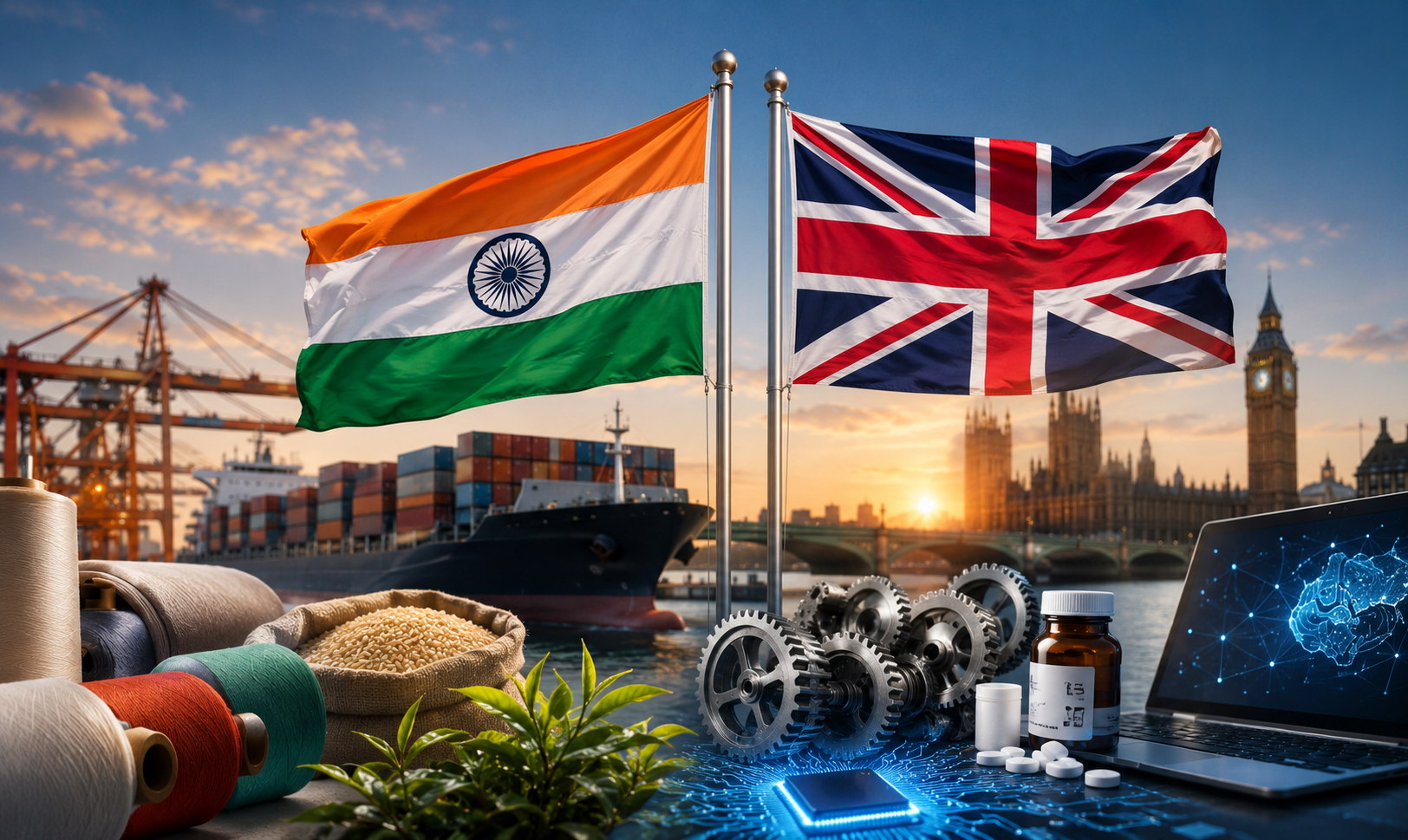
- The India–UK Comprehensive Economic and Trade Agreement (CETA), a free trade agreement (FTA), is not just economically motivated but also politically calculated under the framework of international relations (IR).
- The India–UK CETA can be seen as a combination of liberal institutionalism and realism.
- From a realist point of view, such an arrangement can also be viewed as strategic hedging. Post-Brexit Britain is looking for new economic partners, and India appears to be one of its natural partners.
- In summation, India-UK CETA is much more than just a trade agreement; it is a strategic tool that comes into being under the influence of international relations theories.
In parallel with the G7 summit, PM Narendra Modi’s diplomatic initiative with Europe, including his interactions with France and Slovakia, has highlighted an overall change in India’s economic foreign policy strategy. The centrepiece of this change is the India–UK Comprehensive Economic and Trade Agreement (CETA), a free trade agreement (FTA) which is not just economically motivated but also politically calculated under the framework of international relations (IR).
The India–UK CETA can be seen as a combination of liberal institutionalism and realism. As per the liberal approach, the agreement creates interdependence through trade, institutional, and rule-based cooperation. Meanwhile, from a realist point of view, the CETA enhances India’s geopolitical standing after Brexit by expanding its partnerships and decreasing its dependency on conventional alliances such as the European Union.
Indeed, one key element of this arrangement is the attempt by the two economies to exploit the massive trade potential that exists but is yet untapped. The United Kingdom has been purchasing goods worth several hundred billion dollars per year, including products such as textiles, agricultural produce, engineering goods, pharmaceuticals, and services. However, India’s participation rate in several of these areas has remained very low. For example, while the total value of imports of textiles to the UK is almost USD 28.8 billion, Indian exports constitute only USD 1.79 billion. With zero-duty access through several tariff lines, the CETA seeks to fill the gap and improve India’s competitiveness compared to Bangladesh, Vietnam, and China.
From the perspective of international political economy, this agreement follows the principles of comparative advantage. Labour-intensive industries of India such as textiles, leather, and agriculture can easily satisfy the requirements of cheap imports of the UK. On the other hand, India will benefit from increased access to premium markets for engineering goods, pharmaceuticals, and IT services in which it has made technological breakthroughs.
Another important and strategically critical industry that can potentially benefit from the deal is agriculture. The imports of agriculture from the UK are valued at over USD 90 billion, whereas the exports of the same sector to the UK from India stand at a modest USD 1 billion. Zero tariffs across 1,437 tariff lines have the potential to increase India’s agriculture exports by over 50% within the next three years. It not only helps India financially but also increases its soft power by exporting traditional agricultural products like tea, spices, and basmati rice internationally.
While agriculture is important, the CETA takes on more of a strategic character in the case of the services industry. The services trade deficit between the two countries is already over USD 7.9 billion in favour of India. The CETA reinforces this advantage by making promises over 137 sub-sectors and providing professional mobility provisions. Abolishing economic need tests and intra-corporate transfers are clear indicators of the liberal approach of free flow of labour and knowledge.
Moreover, the Double Contribution Convention (DCC) relieves parties from having to make dual social security contributions that could cost Indian citizens and organisations over $600 million per year. Besides being more economically efficient, such an arrangement will be helpful for India in establishing its status as a global talent pool—a factor that is increasingly becoming important in modern geopolitical rivalry.
From a realist point of view, such an arrangement can also be viewed as strategic hedging. Post-Brexit Britain is looking for new economic partners, and India appears to be one of its natural partners. From the Indian side, this is an opportunity for gaining privileged access to a major Western economy while offsetting Chinese power in global production networks. The decreasing reliance of Britain on Chinese supplies—especially in pharmaceutics and electronics—constitutes a strategic window of opportunity for India.
In terms of sectors, the deal covers a broad array of areas. Engineering products, whose exportation has been experiencing rapid growth, are supposed to increase twofold to over USD 7.5 billion by 2030. Moreover, pharmaceuticals, where the UK spends nearly USD 30 billion a year, provide India with opportunities for development as a manufacturer of cheap generic drugs. Removal of duties on medical devices only makes this path even more promising.
The growing industries such as electronics, digital, and financial technologies will also profit from the deal. Emphasis on digital delivery of services is in line with the general trend towards the transformation of the world economy into a knowledge-intensive industry, which is characteristic for neoliberal institutionalism theory.
Meanwhile, provisions regarding government procurement allowing access to the markets with a total value of more than USD 100 billion in both countries is the practical approach to collaboration and rivalry in the field of strategic trade.
Domestic consequences are not to be overlooked either. By fostering export promotion of industries like textiles, marine products, leather, and gems and jewellery, it is likely to create employment opportunities, especially for people living in the countryside and semi-urban places. It would serve the larger developmental aims of India and help establish the connection between the country’s foreign policy and domestic economic concerns.
Conclusion
In summation, India-UK CETA is much more than just a trade agreement; it is a strategic tool that comes into being under the influence of international relations theories. Liberal ideals of cooperation and interdependence find their expression within the agreement alongside the realist concepts of national interests and economic security. With the rise of multipolarity on the international stage and increased involvement of India in Europe, the significance of CETA-type agreements for shaping the global order can hardly be underestimated.

Anjali Singh is a postgraduate student of Political Science and International Relations, a Social Media Analyst, and a former Research Intern at the Indian Council of World Affairs. Views expressed are the author’s own.
 Aayush Pal
  Hridbina Chatterjee