
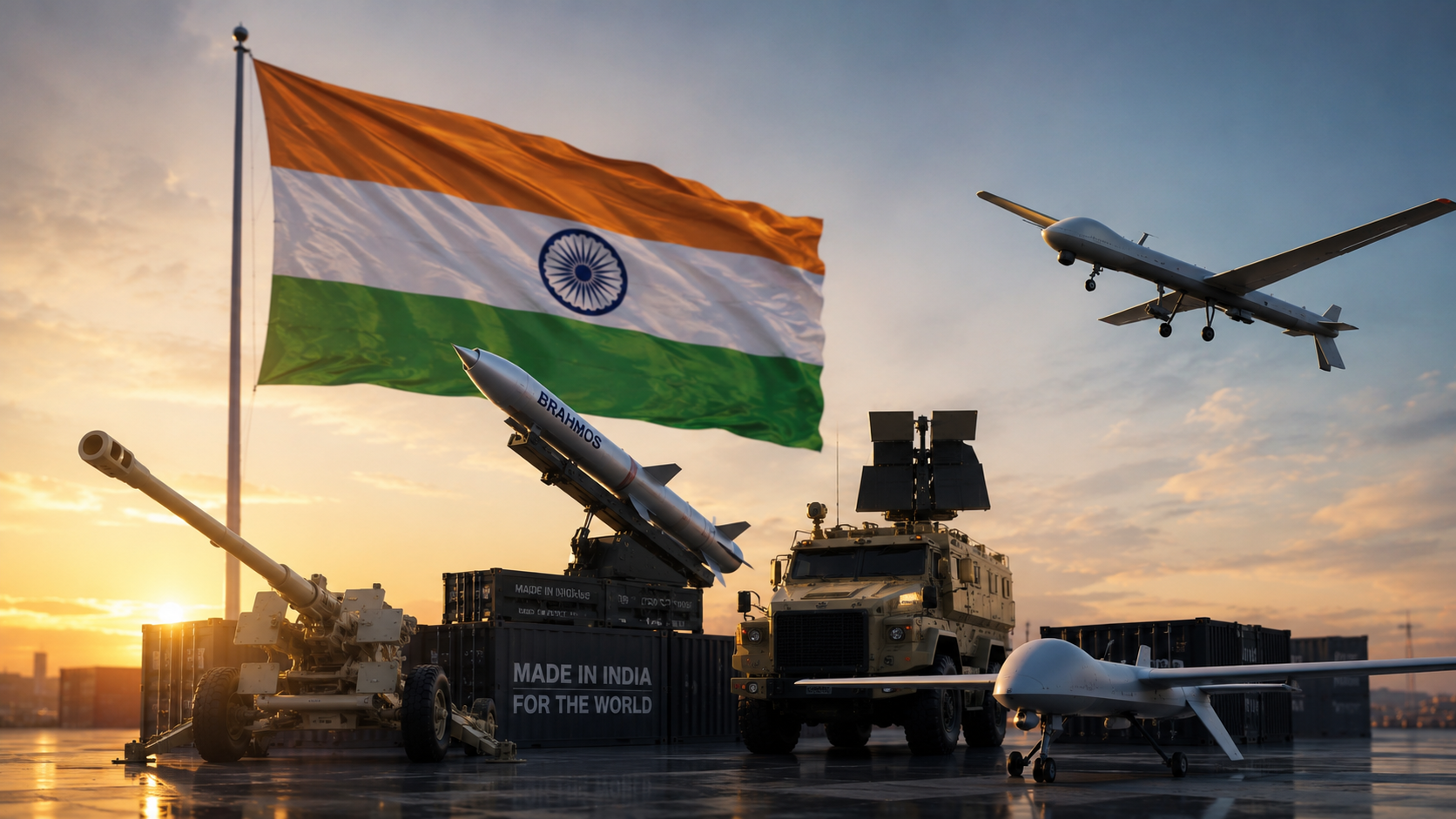
- Defence exports can complement India’s broader engagement with developing countries through capacity building, training, development partnerships, and technology cooperation. Countries looking to diversify away from traditional suppliers may see India as a relatively accessible alternative.
- The real strategic value lies in building long-term security partnerships around those exports.
- India’s growing defence relationship with Armenia demonstrates that its export ambitions extend beyond its immediate neighbourhood.
- Defence exports can therefore create a mutually reinforcing relationship between industrial self-reliance and strategic autonomy.
Defence exports have become a potent instrument of contemporary statecraft, with strategic implications far exceeding their commercial value. Unlike ordinary commercial goods, military hardware fosters long-term strategic relationships through training, maintenance, technological support, and interoperability between military forces. These enduring relationships foster political trust, institutionalised cooperation, and deeper diplomatic engagement, providing arms-exporting states with a means of expanding their strategic influence without direct military intervention. Recognising this strategic potential, India has increasingly integrated defence exports into its broader foreign policy strategy. By supplying indigenously developed defence systems to partner countries, New Delhi is not only addressing their security requirements but also cultivating enduring partnerships that reinforce its vision of a stable, secure, and multipolar regional order.
The Evolution of India’s Defence Export Policy
For decades, India was among the world’s largest importers of defence equipment, sourcing advanced military platforms from Russia, France, Israel, and later the United States. This dependence exposed India to supply chain vulnerabilities, geopolitical uncertainties, delays in procurement, and restrictions on technology transfer. India’s defence industry has shifted from an import-dependent model to one focused on indigenous manufacturing under Make in India and Atmanirbhar Bharat. The government now views defence manufacturing not only as a national security imperative but also as a driver of economic growth, technological innovation, and strategic influence. Policy reforms, including the Defence Production and Export Promotion Policy (DPEPP) 2020, simplified export procedures, encouraged private sector participation, and set ambitious export targets. Rising indigenous capabilities have enabled India to produce globally competitive systems such as the BrahMos missile, Akash air defence system, artillery guns, patrol vessels, and drones. As India’s manufacturing capacity has expanded, defence exports have evolved from a commercial activity into a means of strengthening diplomatic partnerships and enhancing India’s strategic footprint.
Defence Exports as Foreign Policy
Unlike conventional trade, defence deals often create relationships lasting for decades. Training, maintenance, upgrades, spare parts, and technical assistance keep the exporting and importing countries connected. This creates institutional links between their armed forces and defence establishments. For India, these relationships can translate into greater diplomatic trust and strategic cooperation.
The BrahMos deal with the Philippines illustrates how defence exports can deepen strategic partnerships while enhancing India’s security presence in Southeast Asia.
Defence exports can complement India’s broader engagement with developing countries through capacity building, training, development partnerships, and technology cooperation. Countries looking to diversify away from traditional suppliers may see India as a relatively accessible alternative. This supports India’s ambition to position itself as a reliable and responsible partner for the Global South. Defence cooperation therefore becomes an extension of India’s broader diplomatic outreach rather than an isolated commercial activity.
Exporting indigenous systems requires India to develop a stronger domestic defence-industrial ecosystem. Greater domestic production reduces dependence on foreign suppliers and strengthens India’s ability to pursue an independent foreign policy. At the same time, successful exports improve India’s credibility as a defence producer. This creates a feedback loop: greater domestic capability enables higher exports, which strengthen partnerships and, in turn, enhance India’s strategic influence.
India’s objective should ultimately extend beyond increasing the number or value of defence exports. The real strategic value lies in building long-term security partnerships around those exports.
India’s Defence Partnerships in Practice
India’s deal with the Philippines demonstrates its ability to provide an advanced indigenous weapons system to a Southeast Asian partner seeking to strengthen its defence capabilities. More importantly, the relationship extends beyond the sale itself, with cooperation involving training, maintenance and broader defence engagement. It strengthens India’s strategic presence in Southeast Asia and complements its wider engagement with ASEAN and its vision of a free, open and secure Indo-Pacific. The Philippines case therefore illustrates how a defence transaction can evolve into a broader strategic partnership.
India’s growing defence relationship with Armenia demonstrates that its export ambitions extend beyond its immediate neighbourhood. Armenia’s traditional reliance on Russian defence supplies has been complicated by changing geopolitical circumstances, creating space for alternative suppliers. India’s willingness to supply systems such as Pinaka, artillery platforms and other military equipment has given the two countries a new dimension of strategic cooperation. For India, the relationship provides an opportunity to establish a presence in the strategically important South Caucasus while expanding diplomatic ties beyond its traditional areas of engagement. It also demonstrates how India’s growing defence-industrial capabilities can create new diplomatic opportunities in regions where it previously had a limited strategic footprint.
India’s defence engagement with African countries should be viewed alongside its broader development diplomacy, including training, capacity building, humanitarian assistance and technical cooperation. Defence exports can strengthen these existing relationships by enabling partner countries to improve their own security capabilities rather than creating direct dependence on India. This is particularly relevant for countries seeking affordable equipment and diversification of their defence suppliers. India’s approach can therefore complement its broader claim of representing the interests and aspirations of the Global South. The larger foreign-policy objective is not simply to sell military equipment, but to establish India as a reliable security partner capable of contributing to the defence capabilities of developing countries.
The Geoeconomic Imperative
A larger export market gives Indian defence manufacturers an opportunity to move beyond dependence on government procurement and develop greater economies of scale. Sustained export demand can encourage investment in research, development, manufacturing capacity, and advanced technologies. This can benefit not only major defence companies but also MSMEs, start-ups, component manufacturers, and specialised technology firms that form part of the wider defence ecosystem. Defence exports therefore have significance beyond foreign policy: they can contribute to the development of a more competitive and technologically capable domestic manufacturing base.
India’s strategic autonomy ultimately depends not only on diplomatic flexibility but also on its ability to produce critical defence capabilities domestically. Greater indigenous production can reduce vulnerabilities arising from dependence on foreign suppliers, particularly during geopolitical crises or disruptions in global supply chains. At the same time, exporting indigenous systems provides incentives for Indian firms to improve quality, technology, and reliability to meet international demand. Defence exports can therefore create a mutually reinforcing relationship between industrial self-reliance and strategic autonomy.
Defence manufacturing is closely linked to sectors such as aerospace, electronics, engineering, artificial intelligence, drones, naval technology, and advanced materials. Expanding defence production and exports can encourage technological innovation and create skilled employment. International partnerships can also provide opportunities for joint production, technology cooperation, and integration into global manufacturing networks. This gives defence exports a broader geoeconomic significance: India’s defence industry can become not only a tool of security policy but also a vehicle for technological and industrial upgrading.
Rising export figures are important, but export volume alone cannot establish India as a major defence supplier. India faces intense competition from established exporters such as the United States, France, Russia, Israel, and increasingly Türkiye and South Korea. Beyond the quality and price of equipment, buyers consider delivery timelines, financing, maintenance, spare parts, training, and long-term technical support. India’s future success will therefore depend on building a reputation for reliability, technological competitiveness, and sustained after-sales support. If India can achieve this, defence exports could evolve from a relatively small component of its external trade into an important pillar of both its economic strategy and foreign policy.
Conclusion
India’s transformation from a major defence importer to an emerging exporter reflects a broader change in its strategic posture. Defence exports are increasingly connecting industrial policy, economic interests and foreign policy. Their value lies not simply in export revenue but in the relationships and strategic influence they create. The Philippines, Armenia and India’s Global South engagement demonstrate this emerging model. However, sustained influence requires India to become a reliable supplier, not merely a low-cost alternative. If India can combine technological competitiveness with diplomatic credibility, defence exports could become an important pillar of its role as a security provider in the Global South and a more influential actor in a multipolar order.

Archita Gaur is a postgraduate student at the School of International Studies, JNU. She specialises in the World Economy and has a strong interest in public policy, economic research, and governance. The views expressed are the author’s own.
 Aayush Pal
  Piyush Anand
  Parag Gilada