|
Getting your Trinity Audio player ready...
|
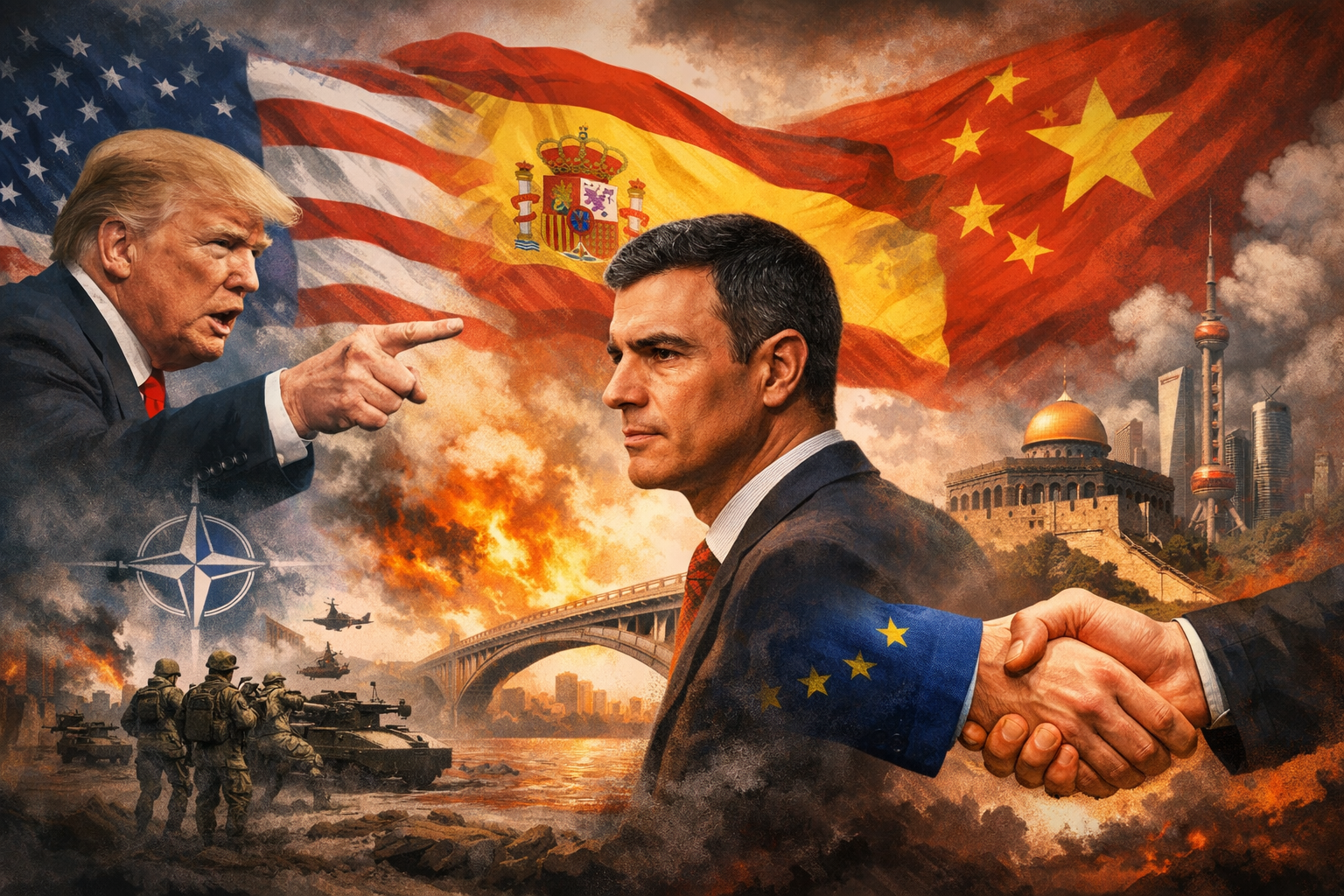
- Spain is seeking strategic independence and diversifying its global partnerships.
- The Spanish Prime Minister has been advocating for a more multipolar world and for Europe to pivot away from its traditional dependence toward a new strategic reality.
- Certain developments have led to sharp criticism from Trump, including warnings about Spain’s position within NATO and potential economic consequences.
- Europe is deeply intertwined with the United States in terms of economic ties, defense cooperation, and people-to-people interactions.
The Spanish Prime Minister, Pedro Sánchez, is on an important visit to China. This marks his fourth visit to China within a year. During this visit, the Prime Minister has emphasised that China should be a strategic partner for Europe rather than a strategic rival.
This comes at a time when Sánchez has been making a stronger presence in European affairs. Spain has emerged as one of the more assertive voices in Europe, often taking a critical stance toward the United States and its policies in the region. Now, during his visit to China, the Spanish Prime Minister is calling for a bridge between the European Union and China.
Europe’s Engagement with China and Economic Realities
Europe needs to recognise the situation and maintain relations with the world’s second-largest economy, China, as both sides are interdependent. This visit also comes at a time when several European leaders, from French President Emmanuel Macron to the German Chancellor, have visited China within a span of two months.
The Spanish Prime Minister has been advocating for a more multipolar world and for Europe to pivot away from its traditional dependence toward a new strategic reality. Sánchez is often seen as one of the architects of this evolving European strategic outlook. He has repeatedly stated that Europe must become more self-reliant in every sphere, including military and economic domains. According to him, Spain and Europe cannot continue to depend heavily on traditional allies like the United States.
Transatlantic Tensions and the Trump Factor
This development also comes at a time when U.S. President Donald Trump has been highly critical of Europe. He has criticised countries like Spain for their domestic policies, particularly on immigration, as well as their stance on Ukraine and broader European security matters. As a result, European countries are beginning to realise that they may need to chart their own independent path.
The Spanish Prime Minister has also highlighted economic concerns, stating that Spain’s trade imbalance with China has widened significantly in recent years, reaching close to $50 billion. At the same time, China remains one of the European Union’s largest trading partners. In 2025, the EU exported around 200 billion euros’ worth of goods to China and imported nearly 560 billion euros, resulting in a trade deficit of around 360 billion euros. This clearly reflects a structural dependency on Chinese manufacturing.
NATO Pressure and Strategic Frictions
Like several other European countries, Spain has become increasingly critical of the United States, especially after the return of President Donald Trump to the White House. Trump has criticised European nations not only for their energy and immigration policies but also for insufficient military spending. He has urged NATO members to increase defence spending to 5 per cent of GDP. Spain, however, has resisted this demand, making it one of the few countries openly opposing it. This has led to sharp criticism from Trump, including warnings about Spain’s position within NATO and potential economic consequences.
Spain’s Position on Israel and Middle East Conflicts
Another major reason for tensions is Spain’s strong criticism of Israeli operations since 2023. Spain has emerged as one of the most vocal critics of Israel in the Western world. It has even supported legal proceedings at the International Court of Justice regarding allegations of genocide against Israeli leadership. Spain has reduced its diplomatic ties with Israel and scaled back military cooperation.
Spain has also criticised the current US-backed military escalation involving Iran, arguing that past interventionist approaches in the region have failed and led to instability. In this context, Spain, along with France and Italy, has not allowed its airspace to be used by the United States for military operations against Iran, signalling a clear strategic divergence.
Strategic Independence and Foreign Policy Shift
All of this has contributed to widening tensions between Spain and the United States. Spain is seeking strategic independence and diversifying its global partnerships.
At the same time, it is important to understand why a country like Spain is taking such strong positions. While part of this approach is driven by strategic considerations, domestic political realities also play a major role. Prime Minister Pedro Sánchez leads a coalition government that depends heavily on support from left-wing parties such as Podemos and Sumar. These parties have strong anti-Israel positions and advocate for reducing ties with Israel.
Migration Overhaul and Domestic Political Calculations
Although being critical of Israel and the United States is one aspect of Prime Minister Pedro Sánchez’s approach, his policy direction goes much further. He has also undertaken a major domestic shift by overhauling the country’s migration policy.
In a significant move, Sánchez has pushed forward a large-scale regularisation process, under which around 500,000 undocumented immigrants are being granted legal status in Spain. This marks one of the most substantial migration policy changes in recent European politics. His government has consistently positioned itself as pro-migrant and progressive on immigration.
However, this policy has triggered strong criticism from the far-right in Spain. Parties like Vox have argued that the Prime Minister is losing domestic support and is increasingly relying on migrant populations to consolidate political backing. According to them, this policy is not just humanitarian but politically motivated.
Corruption Allegations and Political Pressure
The Prime Minister is also facing sustained political pressure due to the ongoing “Koldo Case,” a corruption investigation linked to pandemic-era procurement contracts involving figures close to his party. While Pedro Sánchez has denied any personal involvement, the controversy has added to the perception of political vulnerability.
In this context, both his foreign policy posture and domestic decisions appear to be closely linked with political survival as well as long-term strategic positioning.
Europe’s Strategic Autonomy and Structural Constraints
However, experts say that even though there are political reasons behind some of the actions of the Prime Minister of Spain, Europe moving away from the United States and seeking strategic autonomy is a new reality.
The bigger question, however, is whether it is already too late for Europe to fully realise this shift. Europe is deeply intertwined with the United States in terms of economic ties, defense cooperation, and people-to-people interactions.
So even if Europe, in general, wants to move away from its special relationship with the United States, the real question is for how long, and to what extent, it will be able to pivot.
Reference:
1)https://www.dw.com/en/spanish-premier-calls-for-a-stronger-bond-between-china-and-eu-on-beijing-trip/a-76770392
2)https://www.independent.co.uk/news/world/middle-east/spain-israel-iran-netanyahu-pedro-sanchez-b2955299.html
3)https://www.politico.eu/article/european-pulse-forum-2026-live-updates/

Aayush Pal is a freelance writer on contemporary geopolitical developments. The views expressed in his work are entirely his own.
 Anjali Singh